Survival and profit maximisation
Definition
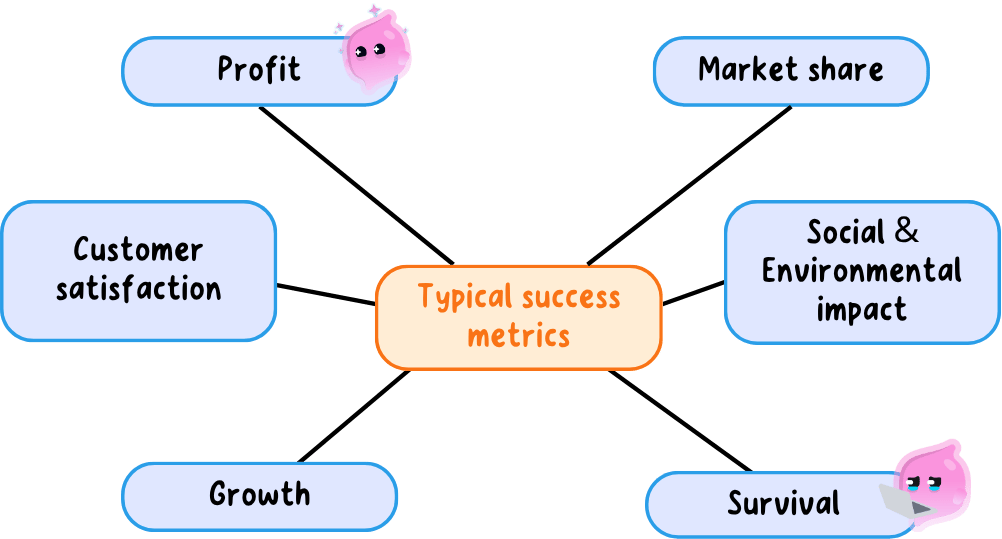
Survival: the objective of staying in business by covering costs and keeping enough cash to pay bills as they fall due.
Profit maximisation: the objective of making the largest possible gap between total revenue and total costs.
- Survival: the business is not chasing a large profit yet, only trying to take in enough money to keep the doors open.
- A new independent café sets this objective in its first year, when customer numbers are still unpredictable and the owner has borrowed to fit out the premises.
- An established firm returns to survival when trade collapses in a recession, because every other objective is only available to a business that is still trading.
- Profit maximisation: the business pushes revenue as high as it can and holds costs as low as it can, so the gap between the two is at its widest.
- It is pursued by raising the price where customers will still pay it, selling more units, or cutting costs such as wages, rent and materials.
- Profit pays the owner an income and leaves retained cash the business can spend on new equipment or new sites without borrowing.
Example
- A new independent café with £4,000 of monthly costs sets an objective of taking £4,000 a month in its first year, and nothing more.
- Tesco, already secure, sets a higher profit figure each year and works towards it by growing sales while squeezing supplier prices.
- Both are financial objectives, but only one of them assumes the business will still be there next year.
Growth and market share
Definition
Growth: the objective of becoming a larger business, measured by revenue, outlets, staff or units sold.
Market share: the percentage of all sales in a market that goes to one business.
- Domestic growth means getting bigger inside the UK, which Greggs has done by opening shops in retail parks, supermarkets and petrol stations as well as on high streets.
- International growth means selling into other countries, which JCB does by exporting diggers built in Staffordshire.
- Selling abroad reaches customers the UK market cannot supply and spreads the risk, because a downturn in one country need not stop sales in another.
- Increasing market share means winning a bigger slice of the same market, which can only be done by taking customers from rivals.
- Aldi has taken grocery share from Tesco and Sainsbury's by holding prices down, and the larger share it now holds gives it more bargaining power over its own suppliers.
- Share can rise even while total sales fall, so it measures the business against its rivals rather than in absolute size.
Customer satisfaction
- The target is repeat custom. The business aims to meet customer needs well enough that buyers come back and recommend it, which is tracked through review scores, repeat orders and the number of complaints.
- Keeping a customer costs less than finding one. Satisfied customers return without being advertised to, so the business spends less on winning replacements for the buyers it has lost.
- A restaurant chain such as Nando's watches its online review scores closely, because a falling score cuts bookings before it shows up in the sales figures.
Social and ethical objectives
- Ethical objectives concern how the business treats people: paying suppliers a fair price, paying staff above the legal minimum, or refusing to buy from factories with poor working conditions.
- Social and environmental objectives concern the effect the business has on the wider world, such as cutting packaging waste, lowering emissions or reducing food waste.
- The National Trust exists to conserve historic places and open them to the public, so its objectives are written about conservation work and visitor numbers rather than profit for owners.
- A social enterprise trades like any other business but puts its surplus back into a social purpose instead of paying it out to owners.
- These objectives usually raise costs. Fair prices to suppliers and lower-waste packaging cost more than the cheapest option, so a business that sets them is accepting less profit in exchange for a stronger reputation.
Common Mistake
- Do not assume every organisation is trying to maximise profit.
- A charity, a social enterprise and a public-sector body such as the NHS set objectives about the service they deliver.
- They still have to cover their costs, because an organisation that runs out of cash closes whatever its purpose.
Shareholder value
Definition
Shareholder value: the return shareholders receive from a company, made up of dividends paid out of profit and a rise in the share price.
- This objective belongs to companies. It applies where the business is owned by shareholders, and it matters most in a plc such as Barclays whose shares are traded on the stock exchange.
- Shareholders gain in two ways. They receive a dividend, which is a share of the profit paid out in cash, and they gain if the share price rises above what they paid.
- It shapes what the directors do. Shareholders can sell their shares or vote directors out, so a board that delivers a poor return risks losing its jobs or seeing the company taken over.
Exam technique
- Identify one objective this business is likely to have is the usual wording, and the answer must name the objective and tie it to a clue in the case material such as the firm's age, size or type.
- Use the precise names, so write profit maximisation rather than "making money" and increasing market share rather than "getting bigger".
- The mistake to avoid is naming profit for a charity or a first-week start-up, when the material has already told you the business has a different priority.
Self review
- Why is survival the usual objective for a business in its first year?
- What is the difference between growth and increasing market share?
- Give one reason a UK business would set an international growth objective.
- Name the two ways a shareholder gains when a plc increases shareholder value.
- Name two social or ethical objectives a business might set, and say why each raises costs.
