The four Ps as one decision
Definition
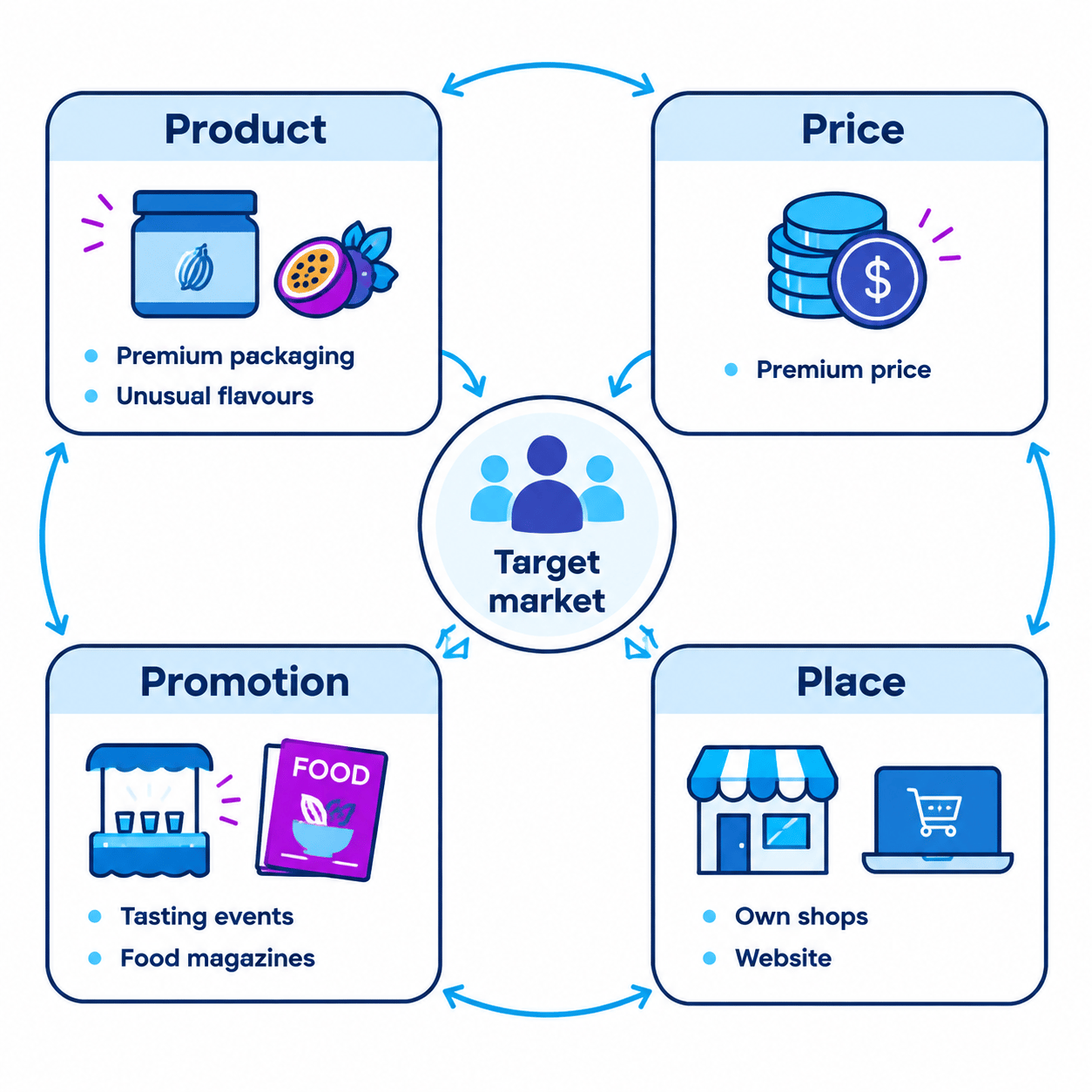
Marketing mix: the four Ps a business decides on together, product, price, promotion and place, to meet the needs of its target market.
- The mix is integrated when all four Ps point the same way and support each other, so the customer receives one clear message rather than four separate ones.
- Change one P and the others usually have to change too. Raising the price means the product has to justify it, the promotion has to look worth it and the shops stocking it have to match it.
Analogy
- The mix is four musicians playing one song, and each can be excellent on their own.
- If one of them plays a different tune the audience does not hear three good players, it hears a mess.
How the four Ps support each other
- Take Hotel Chocolat, which sells chocolate as a gift to customers willing to pay for something special. Every P is built around that one decision.
- Product: a high cocoa content, unusual flavours and heavy boxed packaging that looks like a present before it is opened.
- Price: a premium price that covers those ingredients and that packaging, and that tells the buyer the gift is worth giving.
- Promotion: tasting events, food magazines and email to existing customers, rather than money-off coupons that would undercut the price it has just charged.
- Place: its own shops, department stores and its own website, so the surroundings match the price and no discount shelf sits alongside it.
- Aldi does the same job in the opposite direction. Its own-label range, low prices, price-comparison adverts and no-frills stores all say the same thing, and each P makes the others possible, because plain stores and short ranges are what keep the costs low enough for the prices.
When the mix contradicts itself
- Put a value-range biscuit on a shelf in a luxury department store and neither P works. The store's customers do not believe a cheap biscuit belongs there, and the shoppers who want it are in Aldi.
- A premium price with constant discounts contradicts itself just as badly, because customers who see the product cut every fortnight decide the low price is the real one and stop paying the high one.
- Promotion and place can contradict each other too. A business that advertises heavily on television before the product is in the shops sends customers looking for something they cannot buy, and it pays twice to bring them back.
Common Mistake
Check any mix you recommend by imagining one customer meeting all four Ps at once, because a mix that reads well as a list can still contradict itself in a shop.
The mix changes over time
- A mix that fits today will not fit in three years, because the product ages, rivals copy it, customers' tastes move on and technology changes where they shop. The clearest pattern is the way the mix shifts across the product life cycle.
- At launch the product is new, promotion has to inform and explain, the price may be set high while the product is the only one of its kind, and place is often limited to a few stockists and the business's own website.
- In growth the product is proven, so promotion switches to building the brand, more retailers are added to keep up with demand, and the range widens with extra sizes and colours.
- In maturity rivals have caught up, so the price becomes competitive, promotion reminds rather than informs, sales promotions defend the shelf space, and the product itself may be refreshed to hold the customers it has.
- In decline promotion is cut back to save money, prices are lowered to clear the stock, and the product is dropped from the shops that sell least, until it is withdrawn.
- The mix is also pushed from outside the life cycle, because new technology moves customers on to their phones, incomes fall in a downturn and rivals copy whatever works, so a business has to review the four Ps even when the product itself has not changed.
- How a business should react depends on whether the change will last. A permanent shift, such as customers moving to buying on their phones, is worth rebuilding place and promotion around, while a short dip in sales is better met with a temporary offer, because changing all four Ps costs money and unsettles the customers who liked the old mix.
Example
- A new Dyson vacuum launches at a high price, with adverts demonstrating what it does, sold through Dyson's own site and a small number of retailers such as Currys.
- Years later the same model is cheaper, stocked in supermarkets and discount sites, and promoted with offers rather than demonstrations, because all four Ps have moved together as it matured.
Using the mix to make a decision
- Start from the aim and the target market, because they decide what the mix has to achieve: a business trying to survive needs sales quickly, while one trying to move upmarket needs to change what customers believe.
- Then choose each P with the other three in front of you, and check the four together against the customer you named at the start.
- Finally check the business can deliver it, since a mix commits the rest of the business: production has to make the quality promised in the quantities promoted, and the money has to be there to pay for the promotion before the extra sales arrive.
Key Idea
A rival can copy one P in a week, but copying four that fit together takes years, which is why an integrated mix is what actually keeps customers.
Exam technique
- Recommend a marketing mix for this business wants a decision on each of the four Ps, with each one justified by the target market in the case.
- Show the links out loud, so "the premium price only works because the packaging and the department store back it up" rather than four unconnected paragraphs.
- If the question is about a product that has stopped selling, say which P has fallen out of step and what changing it forces on the other three.
Self review
- What are the four Ps of the marketing mix?
- What makes a mix integrated rather than four separate choices?
- Trace one aim, such as selling a product as a gift, through all four Ps.
- Give one example of a mix that contradicts itself, and explain why it fails.
- How should a business react differently to a permanent change in its market and to a short-term dip in sales?