Internal sources of finance
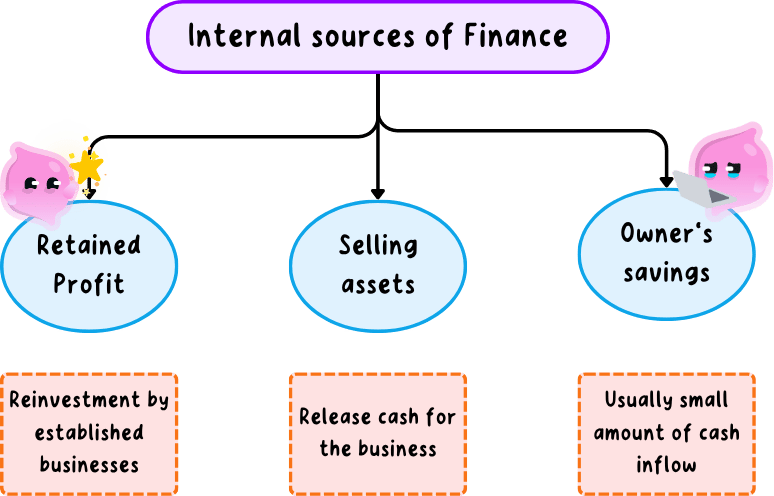
Internal finance: money raised from inside the business, using profit it has already earned or resources it already owns.
Retained profit: profit kept back in the business after tax and after any payments to the owners, so it can be reinvested.
- Retained profit: profit the business has already made and held on to is spent on new equipment, extra stock or expansion, which suits an established, profitable firm such as Greggs funding new shop fit-outs from the profit its existing shops generate.
- Advantage: there is no interest to pay and no outsider gains a say in decisions.
- Drawback: the money only exists after profitable trading, and using it means the owners take less out this year.
- Owner's savings: the owner pays money in from their own bank account, which suits a start-up with no trading record that a bank would refuse.
- Advantage: the money is available at once, with no interest and no lender to convince.
- Drawback: the amount is limited by how much the owner has, and their personal money is now at risk.
- Selling unwanted assets: machinery, vehicles, land or premises the business owns but no longer uses are sold for cash, which suits a firm with surplus equipment standing idle.
- Advantage: cash comes in without creating any debt or interest.
- Drawback: a business with nothing spare to sell cannot use it, and a rushed sale fetches a low price.
- Hartley's Bakery in Stockport wants a second oven costing £6,000.
- It pays for the oven out of retained profit built up over two years of trading, and sells its old delivery van for £2,400 because deliveries are now contracted out.
- Both sources are internal, so the bakery takes on no interest and answers to no new investor.
External finance from a bank
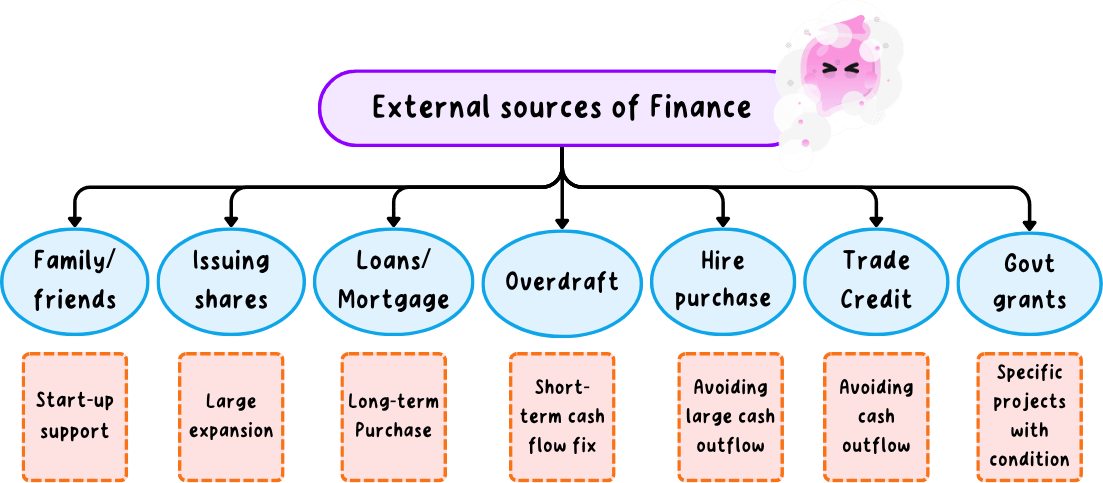
External finance: money raised from outside the business, such as from a bank, an investor, a supplier or the government.
Bank loan: a fixed sum borrowed from a bank and repaid with interest in regular instalments over an agreed period.
Mortgage: a long-term loan used to buy property, secured on that property so the lender can repossess it if repayments stop.
Overdraft: an arrangement that lets a business spend more than it holds in its current account, up to an agreed limit, with interest charged only on the amount actually used.
- Bank loan: the business receives a known sum on a known repayment schedule, which suits a planned one-off purchase such as a £40,000 delivery lorry that will be used for years.
- Advantage: the instalments are fixed and predictable, so the owner can budget for them, and no ownership is given away.
- Drawback: the bank usually wants security, an asset it can seize if the business defaults, and the instalments still have to be paid in a month when sales collapse.
- Mortgage: the cost of buying premises is spread over 25 years or more, which suits a chain of salons buying a freehold unit rather than renting it.
- Advantage: the monthly amount is manageable, and the business ends up owning an asset instead of paying rent for ever.
- Drawback: the building itself is the security, so it can be repossessed if repayments are missed.
- Overdraft: the account is allowed to dip below zero up to an agreed limit, which suits a short cash gap such as paying wages the week before a large customer settles an invoice.
- Advantage: interest is charged only on the amount actually used, and only for the days it is used.
- Drawback: the interest rate is high and the bank can demand repayment at any time.
- A loan and an overdraft are not interchangeable, and confusing them is the most common error on this topic.
- A loan is a fixed sum, taken for a set period, repaid with interest on the whole amount whether or not the business needed all of it.
- An overdraft is short-term and flexible, charges interest only on the amount used, and is repayable on demand, which makes it far too risky and expensive for buying a building.
External finance from suppliers and finance companies
Trade credit: an agreement with a supplier to receive goods now and pay for them later, typically within 30 to 60 days, with no interest charged.
Hire purchase: a way of paying for an asset by deposit and instalments, where the business uses the asset from day one but only owns it once the final payment is made.
- Trade credit: goods arrive now and are paid for 30 to 60 days later, which suits any firm that buys stock regularly, such as a convenience store taking weekly deliveries.
- Advantage: the business can sell the stock and collect the cash before the supplier has to be paid, and no interest is charged.
- Drawback: new businesses are rarely offered it because the supplier has no evidence they will pay, and a firm that pays late loses discounts and can have its credit withdrawn.
- Hire purchase: an asset is paid for by deposit and instalments, which suits an expensive item the business needs immediately but cannot pay for outright, such as a van or a commercial fridge.
- Advantage: the asset starts earning revenue from day one, while it is still being paid for.
- Drawback: interest is added to each instalment, so the total paid ends up above the cash price, and the item can be taken back if payments stop.
- Ashby Joinery in Leicester buys its timber on 30-day trade credit, so each order is fitted and invoiced to the customer before the supplier has to be paid.
- It takes its new van on hire purchase with a deposit and three years of instalments, so the van is delivering kitchens long before the workshop owns it.
External finance from people and the government
New share issue: the sale of newly created shares in a limited company, which raises money the company never repays in exchange for a stake in the business.
Government grant: a sum given to a business by the government or another public body, usually to encourage a particular activity, which does not have to be repaid.
- Family and friends: money is lent or invested by people who already know the owner, which suits a start-up a bank would turn down.
- Advantage: the terms are far softer than a bank's, often interest-free and with no security demanded.
- Drawback: if the business struggles, the money and the relationship are both at risk.
- New share issue: newly created shares are sold to investors, which suits a company funding major expansion, such as a plc opening 30 new stores.
- Advantage: large amounts are raised that are never repaid and carry no interest.
- Drawback: the new shareholders dilute the existing owners' control and expect a share of future profit as dividends.
- Who can use it: only a limited company can issue shares at all, and only a plc can offer them to the general public, so a sole trader or partnership cannot use this source.
- Government grants: a public body hands over a sum to encourage an activity it wants to see, such as training apprentices or installing energy-efficient equipment.
- Advantage: the money never has to be repaid and costs no interest.
- Drawback: grants are competitive, come with conditions on how the money is spent, and are rarely large enough to fund a whole project.
Deciding which of these sources actually fits a particular business and a particular need is the job of the next article on the appropriateness of sources of finance.
When asked to state two sources of finance, name them precisely, because "a bank" is not a source of finance while "a bank loan" and "an overdraft" both are.
- What is the difference between internal and external finance?
- Name the three internal sources of finance.
- Give two differences between a bank loan and an overdraft.
- At what point does a business own an asset bought on hire purchase?
- Which two external sources bring in money that never has to be repaid?
