Definition
E-commerce: buying and selling goods and services over the internet.
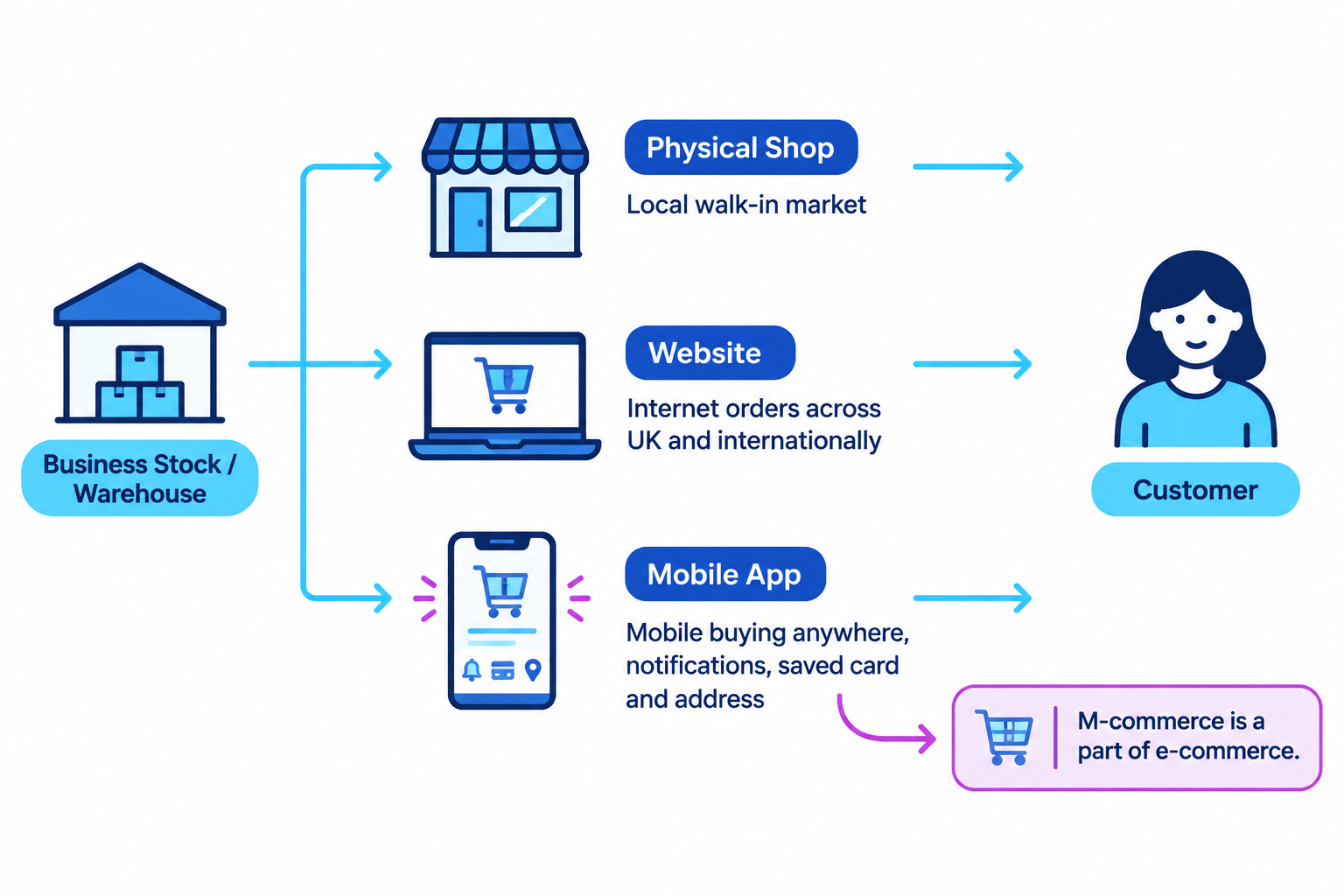
M-commerce: buying and selling through mobile devices such as smartphones and tablets, usually through an app.
- Selling online is a place decision, because a website or an app is another channel of distribution: the customer reaches the product through a screen instead of a shop.
- M-commerce is the part of e-commerce that happens on a phone, and it has grown fastest because the customer can buy on a bus or in a queue, in the moment they think of it, rather than waiting to get to a computer.
- An app also holds the customer's card details and address, so buying takes two taps, and it can send a notification straight to the customer's pocket when there is an offer.
- Both have grown year after year, so a business with no online channel now loses sales to rivals that have one. Next has closed high-street stores while its website has become the larger part of its business, and Tesco has grown its grocery deliveries alongside its aisles.
Note
This guide covers e-commerce as a marketing decision; the wider effects of technology on how a business operates belong to the technology topic.
Reaching further, including international markets
- A shop can only sell to people who walk through the door, so its market is the town around it. A website removes that limit, and the market becomes everyone who can find the site and receive a parcel.
- The business can sell across the whole UK without opening a single extra branch, which means growth without the rent, fittings and staff that new shops would need.
- International markets open up in the same way. A small UK business can take an order from Germany or Australia from one warehouse, which spreads its risk across several countries and lets a niche product find enough customers worldwide even though there are few in any one town.
- Selling abroad brings extra work, because the site may need other languages and currencies, and delivery over long distances costs more and takes longer.
- The site is open at all hours, so orders arrive overnight and at weekends when every high-street rival is shut, and the business earns from those hours without paying anyone to stand behind a counter.
Example
- ASOS built a national fashion business with no shops at all, shipping from a small number of warehouses to customers in the UK and abroad.
- Gymshark did the same for gym clothing, selling to customers in dozens of countries years before it opened a single store.
Lower costs and greater flexibility
- There is no high-street rent, no business rates on a prime site, no shop fittings and no team of shop assistants, so the fixed costs the business must cover each month are far lower than a chain of stores would carry.
- Stock sits in one warehouse instead of being spread across dozens of shops, so less has to be bought in the first place and less is left over to discount at the end of a season.
- Prices, photographs and the whole range can be changed in minutes, and the site records what every visitor looked at, so promotion can be aimed at the customers most likely to buy.
The drawbacks of selling online
- Delivery: every order has to be picked, packed and couriered, so postage and packaging are added to the cost of each sale, and a parcel that arrives late or damaged loses the customer even though the product was fine.
- Returns: customers who cannot try before they buy order two sizes and send one back, and the business pays for the return postage, the checking and the repacking on a sale it never made.
- A secure site: taking card details means paying to build and maintain a secure site, and a crash or a hack stops all sales at once and destroys the trust that made customers hand over their details.
- Easy price comparison: a rival's price is one tab away, so a business selling online competes with the whole country rather than the other shops in its town, which pushes prices and profit margins down.
- No physical browsing: customers cannot hold the product, smell the coffee or try the coat on, and there is no assistant to answer a question, so the site has to do that work with photographs, descriptions and reviews.
Common Mistake
- Selling online is not cost-free: the shop rent is replaced by delivery, returns, the website and the promotion needed to be found at all.
- Wider reach is only a benefit if the extra customers exist, so a business that serves one town gains far less from it than a specialist selling nationwide.
Whether the online channel suits a given business
- The product has to survive the journey and be worth posting, so books, clothes and gym kit suit it while ice cream, a haircut and a fitted kitchen do not.
- The customers have to be willing to buy on a screen, so a business whose customers are older or rarely online still needs a shop, a telephone line or a catalogue alongside the site.
- Most established businesses now run both channels together. Currys lets customers order online and collect in store, and Tesco sells the same groceries in its aisles, on its website and through its app.
Example
- A craft jeweller in a village sells a handful of pieces a week to passing trade, and a website turns the whole country into her market for products small enough to post in an envelope.
- The bakery next door gains almost nothing from the same website, because its cakes will not travel and its customers are the ones already walking past.
Exam technique
- If the case study mentions an app or shopping on phones, use the term m-commerce rather than settling for e-commerce.
- Analyse the benefits to this business of selling online wants a chain, so wider reach brings more orders, more orders raise revenue, and lower fixed costs mean more of that revenue is left as profit.
- The mistake to avoid is listing reach and low costs while ignoring delivery, returns and the fact that rivals' prices are one click away.
Self review
- Define e-commerce and m-commerce, and say how they differ.
- How does selling online let a small UK business reach international markets?
- Why are the fixed costs of a website lower than those of a chain of shops?
- State three costs or risks a business takes on when it starts selling online.
- Why does easy price comparison online squeeze a business's profit margin?