Nitrogen cycles through air, soil and organisms
Nitrogen cycle
The movement of nitrogen between the atmosphere, soil and living organisms through nitrogen fixation, feeding, decomposition, nitrification and denitrification.
- Living organisms need nitrogen to make amino acids, proteins and nucleic acids.
- Nitrogen gas makes up about 78%78\%78% of the atmosphere, but plants cannot absorb or use nitrogen gas directly.
- Plants absorb soluble nitrate ions through their roots and use the nitrogen to make amino acids.
- Feeding transfers nitrogen compounds from plants to animals and through food chains.
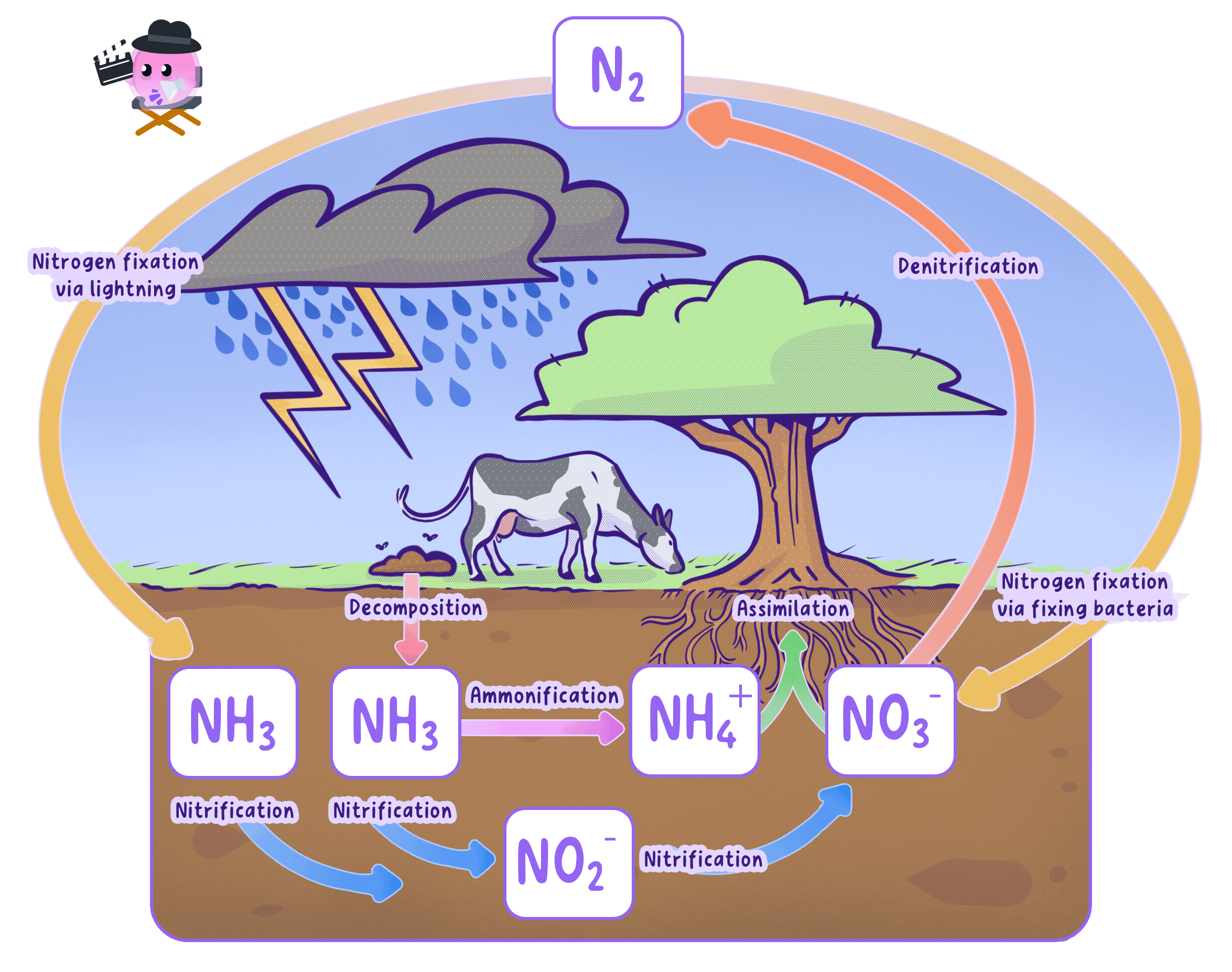
Bacteria make nitrogen available
Nitrogen fixation
The conversion of nitrogen gas from the air into nitrogen compounds that plants can use, carried out by nitrogen-fixing bacteria and by lightning.
- Nitrogen-fixing bacteria convert nitrogen gas into nitrogen-containing compounds that can enter the soil.
- Some nitrogen-fixing bacteria live freely in soil, while others live in root nodules of legumes such as peas, beans and clover.
- Decomposer bacteria and fungi break down proteins in dead organisms, urine and faeces, producing ammonium compounds.
- Nitrifying bacteria convert ammonium compounds into nitrites and then nitrates in oxygenated soil.
Nitrates are absorbed or returned to air
Nitrification
The conversion of ammonium compounds in the soil into nitrates by nitrifying bacteria.
- Plant roots absorb nitrates, so the nitrogen becomes part of new plant biomass.
- Denitrifying bacteria convert nitrates back into nitrogen gas when oxygen availability is low, especially in waterlogged soil.
- Denitrification lowers the nitrate content of soil and can reduce plant growth.
- Drainage and aeration reduce waterlogging, favour nitrifying bacteria and limit denitrification.
Fertilisers replace nitrate ions
Fertiliser
A substance added to soil to supply the mineral ions, such as nitrate, phosphate and potassium, that plants need for healthy growth.
- Nitrogen-containing fertilisers dissolve in soil water and provide nitrate ions that roots can absorb.
- A higher nitrate supply allows plants to make more amino acids and proteins, supporting growth and increasing crop yield when nitrate is the limiting factor.
- Applying more fertiliser than crops can absorb wastes resources and allows nitrate ions to leach from the soil.
Crop rotation raises soil nitrate levels
Crop rotation
The planned growth of different crops in sequence on the same field, including legumes that increase the nitrate content of the soil.
- A farmer grows a legume during one part of the rotation because nitrogen-fixing bacteria live in its root nodules.
- The bacteria convert atmospheric nitrogen into nitrogen compounds used by the legume.
- When roots and other plant material remain in the soil or are ploughed in, decomposers release ammonium compounds that nitrifying bacteria convert into nitrates.
- The following crop absorbs these nitrates, so crop rotation can reduce the amount of manufactured fertiliser needed.
Bacterial names must match their roles
Denitrification
The conversion of nitrates in the soil back into nitrogen gas by denitrifying bacteria, usually in waterlogged soil.
- Nitrogen-fixing bacteria move nitrogen from atmospheric gas into compounds, while nitrifying bacteria move nitrogen from ammonium compounds into nitrates.
- Denitrifying bacteria move nitrogen in the opposite direction by converting nitrates into nitrogen gas.
- Decomposers supply ammonium compounds from dead material and waste, so they connect organisms back to the soil.
- Name the bacterial group and its starting and final nitrogen compound because the word bacteria alone is too vague.
- For crop rotation, link root nodules to nitrogen fixation, soil nitrates, plant protein synthesis and increased growth.
The cycle prevents nitrogen becoming locked away
- Without decomposition, nitrogen would remain in dead biomass and waste rather than returning to the soil.
- Without nitrogen fixation and nitrate replacement, continued plant uptake would reduce the nitrate supply available for new growth.
- The balance between fixation, nitrification, uptake, decomposition and denitrification controls how much nitrate is available to plants.
- Why can plants not use atmospheric nitrogen gas directly?
- What do nitrogen-fixing, nitrifying and denitrifying bacteria each do?
- How does crop rotation with legumes increase nitrate availability?
- Why can waterlogged soil reduce plant growth?
