Indicator species reveal pollution effects
Definition
Indicator species
A species whose presence or absence in a habitat shows how polluted the habitat is.
- An indicator species is useful because its presence, absence or abundance is associated with particular environmental conditions.
- A survey provides biological evidence of how conditions affect organisms over time rather than measuring one pollutant at one moment.
- Indicator evidence is indirect, so a conclusion should be supported by repeated sampling and physical or chemical measurements.
Water species reflect oxygen availability
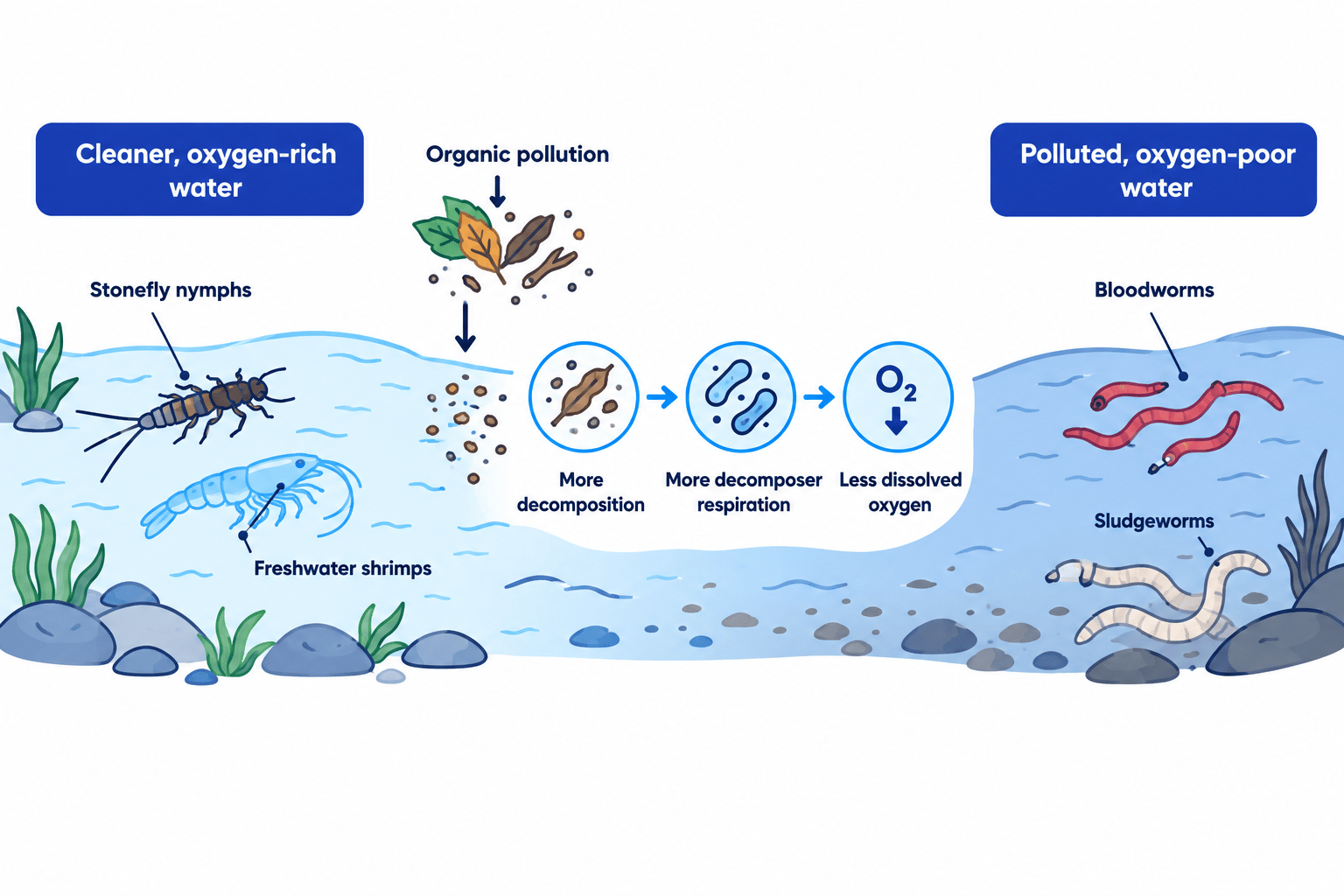
- Bloodworms and sludgeworms can tolerate water with a low dissolved-oxygen concentration, so their presence can indicate polluted water.
- Freshwater shrimps and stonefly nymphs require cleaner, oxygen-rich water, so their presence can indicate low water pollution.
- Organic pollution can increase decomposition, and decomposer respiration then removes oxygen from the water.
- Bloodworms contain abundant haemoglobin, which helps them absorb enough oxygen when dissolved-oxygen concentration is low.
Air species respond to sulfur dioxide
- Different lichen species have different tolerances to air pollution, so the number and type of lichens can indicate air quality.
- Fewer sensitive lichen species usually occur where sulfur dioxide concentration is high.
- Blackspot fungus on rose leaves is associated with clean air because sulfur dioxide inhibits the fungus.
- The presence of blackspot supports a conclusion of low sulfur dioxide and good air quality, while its absence alone is weak evidence because other factors can prevent infection.
Example
- Site A contains many stonefly nymphs and freshwater shrimps but no sludgeworms, so the biological evidence supports a conclusion that its water is relatively clean and oxygen-rich.
- Site B contains many sludgeworms and bloodworms but no stonefly nymphs, so it is likely to be more polluted and lower in dissolved oxygen.
- The conclusion becomes stronger if repeated samples show the same pattern and a dissolved-oxygen test agrees with the species data.
Evidence must be evaluated
- Indicator surveys are usually inexpensive, can cover many sites and show the combined biological effect of pollution over time.
- Species may be unevenly distributed, seasonal or difficult to identify, so one small sample may not represent the whole habitat.
- Temperature, pH, flow rate, shade, substrate and recent weather can affect species independently of pollution.
- Indicator species cannot identify the pollutant or give its exact concentration, so chemical measurements are needed for that information.
Practical
Investigating water indicator species
- Aim: to compare biological evidence of water pollution at several sites along the same stream.
- Apparatus: pond net, white sampling tray, forceps, identification key, timer, labelled sample containers, gloves, eye protection, thermometer, pH probe and dissolved-oxygen meter.
- Method:
- Choose sites upstream and downstream of a suspected pollution source.
- At each site, disturb the same measured area of stream bed for the same time while holding the net downstream.
- Empty the catch into a tray containing stream water.
- Use a key to identify and count bloodworms, sludgeworms, freshwater shrimps and stonefly nymphs.
- Return organisms carefully.
- Repeat at least three times at each site.
- Measure temperature, pH and dissolved oxygen at every site.
- Variables: change the sampling site and measure the abundance of each indicator species, while keeping sampling area, sampling time, net movement, time of day and identification method the same.
- Results: more stonefly nymphs and freshwater shrimps support cleaner, oxygen-rich water, while more bloodworms and sludgeworms support polluted, oxygen-poor water.
- Processing: calculate the mean count using mean count=total countnumber of samples\text{mean count}=\frac{\text{total count}}{\text{number of samples}}mean count=number of samplestotal count and compare the pattern with dissolved-oxygen readings.
- Watch out: avoid concluding from one organism because patchy distribution and identification errors can distort the result, so use repeated samples and an identification key.
- Safety: wear gloves, cover cuts, avoid deep or fast-flowing water, wash hands after sampling and do not touch unknown waste or sharp objects.
Reliable surveys use consistent sampling
- The same sampling effort at every site makes differences in counts more likely to reflect conditions rather than method.
- Repeats allow a mean to be calculated and reveal anomalous samples.
- Sampling several distances from a pollution source can reveal a trend, while an upstream control site provides a comparison.
Exam technique
- An evaluate question needs evidence for the conclusion, a limitation and a supported judgement.
- Use the named species and link each one to clean or polluted conditions rather than writing that some organisms like pollution.
Conclusions must match the evidence
- A correlation between an indicator species and pollution does not prove that the pollutant caused the distribution.
- A strong judgement combines the species pattern, repeated samples, appropriate controls and measurements such as dissolved oxygen or sulfur dioxide.
- If different types of evidence disagree, state the uncertainty and identify the additional measurement needed.
Self review
- Which two species indicate polluted water?
- Which two species indicate clean water?
- What do lichens and blackspot fungus indicate about air quality?
- Give two strengths and two limitations of indicator-species evidence.