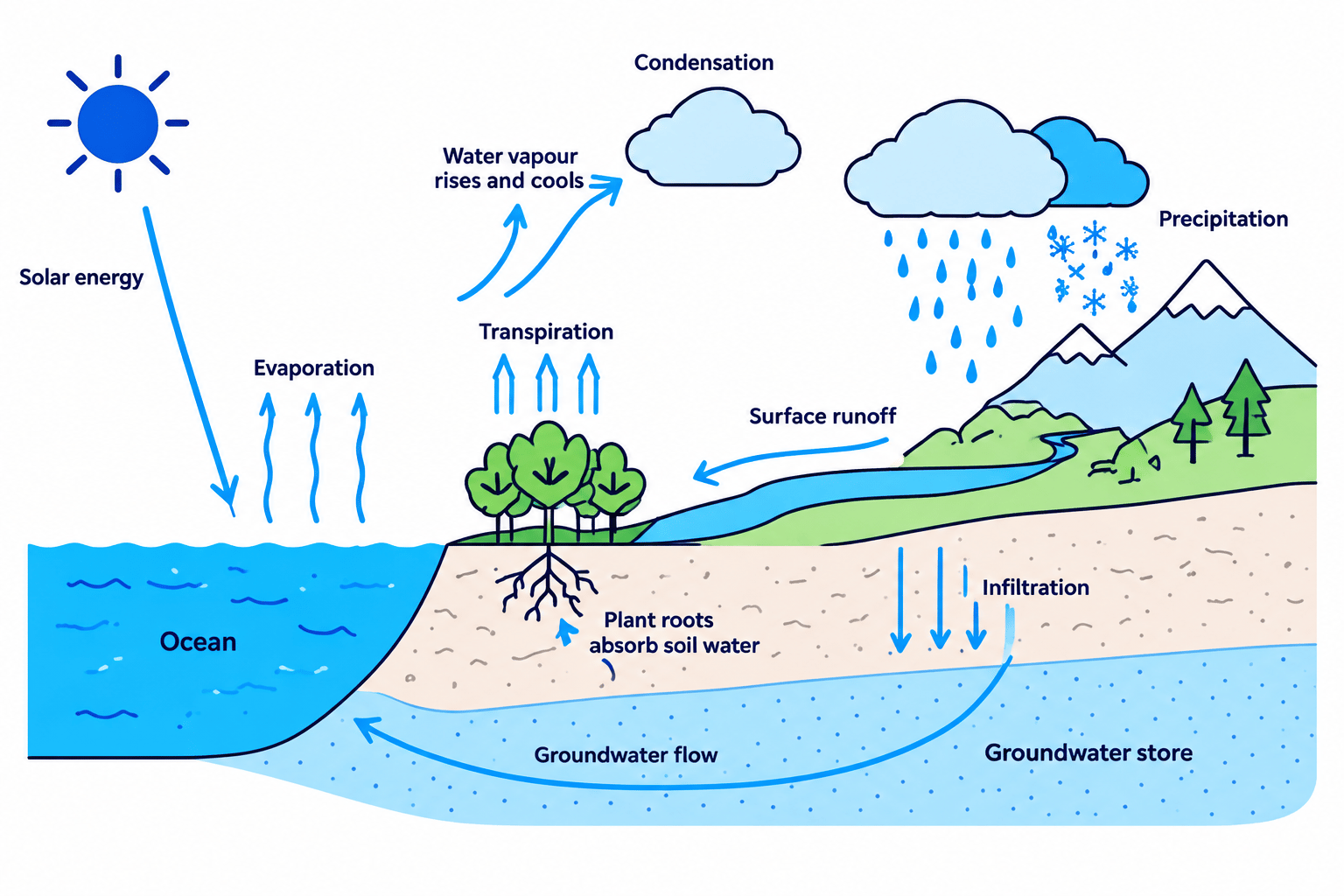
Solar energy drives the water cycle
Definition
Transpiration
The loss of water vapour from a plant, mainly by evaporation from leaf cells followed by diffusion through the stomata.
- Evaporation occurs when solar energy gives liquid water enough energy to become water vapour from oceans, lakes, rivers and soil.
- Transpiration adds water vapour when water absorbed by plant roots travels through the xylem and evaporates from leaf cells before diffusing through stomata.
- Water vapour rises, cools and condenses into tiny liquid droplets that form clouds.
- Precipitation occurs when droplets or ice crystals become large enough to fall as rain, snow, sleet or hail.
Example
- Sea water can supply fresh rain because evaporation transfers water molecules into the air while dissolved salts remain in the sea.
- Cooling then condenses the water vapour before it falls as precipitation.
Water returns to organisms and the sea
- Surface runoff carries water downhill into streams and rivers that return it to lakes and oceans.
- Infiltration moves water into the soil, where it may be stored as groundwater or flow slowly towards rivers and the sea.
- Plants absorb soil water through their roots, and animals obtain water by drinking and feeding.
- Organisms need water as a solvent for metabolic reactions, as a transport medium and as a reactant in photosynthesis.
- Water returns through transpiration, respiration, sweating, excretion and evaporation from surfaces, so the cycle continues.
Exam technique
- Keep evaporation and condensation separate by naming the state change in each process.
- When a diagram asks for one arrow, draw only the requested transfer and label it with the process name.
Drought reduces available fresh water
- A drought is a prolonged period of unusually low rainfall, so reservoirs, rivers and groundwater stores are not replenished fast enough.
- Demand can then exceed the supply of fresh water available for homes, agriculture and ecosystems.
- Water conservation, storage, reuse and treatment reduce pressure on supplies but cannot create rainfall.
Desalination produces potable water
Definition
Potable water
Water that is safe to drink because it contains acceptably low levels of harmful microorganisms and dissolved substances.
- Desalination removes dissolved salts from sea water or brackish water when local fresh-water stores are insufficient.
- Distillation boils water and condenses the vapour, leaving most dissolved salts behind.
- Reverse osmosis forces water through a partially permeable membrane at high pressure while salts remain on the other side.
- Both methods require substantial energy, so they are expensive and can increase carbon dioxide emissions if fossil fuels supply the energy.
- The concentrated brine left behind must be managed because releasing it carelessly can damage aquatic ecosystems.
Example
- A coastal town in drought has access to abundant sea water but little reservoir water.
- A desalination plant can provide a reliable supply of potable water, but the judgement must also consider energy cost, greenhouse-gas emissions and disposal of concentrated brine.
Water treatment makes supplies safe
- Water from fresh sources is screened and filtered to remove debris and suspended particles.
- Sterilisation destroys harmful microorganisms, while chemical tests check that dissolved substances remain at safe levels.
- Potable water is safe to drink but is not chemically pure because small amounts of dissolved substances remain.
Self review
- Which energy source drives evaporation in the water cycle?
- How do condensation and precipitation differ?
- Why can desalination help during drought?
- Give one advantage and two disadvantages of desalination.