Transport tissues: xylem and phloem
Definition
Xylem
A plant tissue made of dead, hollow, lignified tubes that carries water and dissolved mineral ions upwards from the roots and helps support the plant.
- Xylem is a tissue of dead, hollow, lignified vessels that carries water and dissolved mineral ions from roots to stems and leaves.
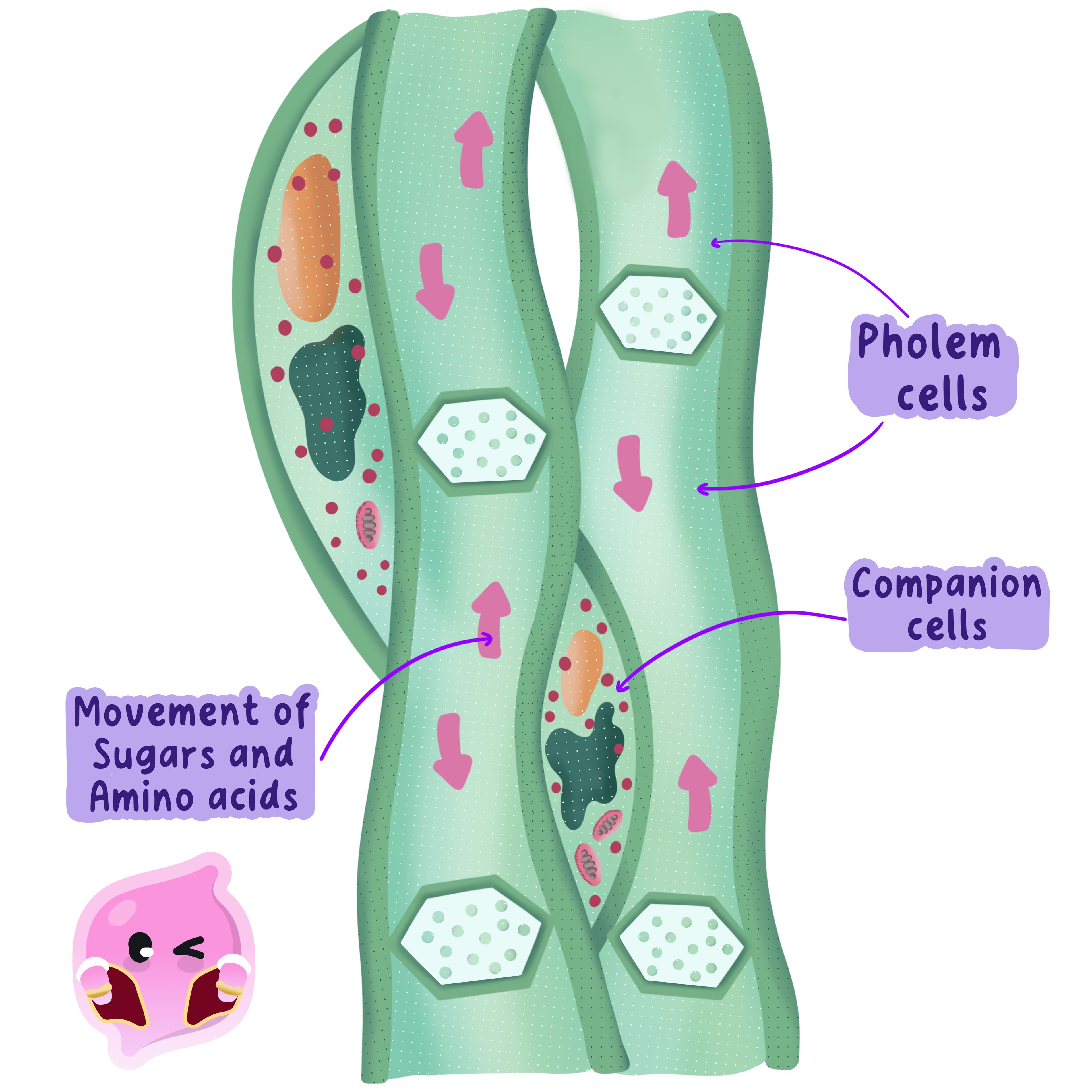
- Phloem is living tissue made of sieve tubes and companion cells that transports dissolved sucrose and amino acids between sources and sinks.
- The tissues occur together in vascular bundles that run through roots, stems and leaf veins.
Xylem is built for one-way water flow
- Mature xylem vessel cells are dead and joined end to end, with their end walls lost to form a continuous hollow tube.
- The vessels contain no cytoplasm, so water meets little resistance as it moves upwards.
- Lignin is deposited in the walls to make them strong and waterproof, preventing collapse when water is pulled upwards. The deposition of the lignin causes the cells to die.
- Pits in the walls allow water to move sideways between vessels and into neighbouring tissues.
Common Mistake
Direction: xylem carries water and mineral ions mainly upwards from the roots, not dissolved sugars.
Phloem is living transport tissue
Definition
Phloem
A living plant tissue made of sieve tubes and companion cells that carries dissolved food such as sucrose and amino acids around the plant.
- Sieve tube elements are living cells arranged end to end, and their perforated end walls form sieve plates.
- Sieve tube elements have very little cytoplasm and no nucleus, leaving space for phloem sap to flow.
- Companion cells contain a nucleus and many mitochondria, providing the energy needed to load and unload sucrose.
- Phloem can transport substances upwards or downwards because different sources and sinks occur in different parts of the plant.
Example
Example: in summer, sucrose may move from photosynthesising leaves to growing roots, while in spring stored carbohydrate can move from roots to developing shoots.
Comparing the tissues
- Xylem is dead, hollow, lignified and carries water and mineral ions mainly upwards.
- Phloem is living, has sieve plates and companion cells, and carries dissolved food in either direction.
Exam technique
- Comparison questions: use paired statements about the same feature, such as dead xylem versus living phloem.
- Structure-to-function marks: explain how the missing end walls form a continuous tube and how lignin prevents collapse.
Self review
- What does xylem transport?
- How does lignin adapt a xylem vessel?
- What are sieve plates?
- Why do companion cells contain many mitochondria?
- How do the directions of transport differ?
