Root hair cells: efficient uptake from soil
Root hair cell
A root surface cell with a long, thin extension that gives a large surface area for absorbing water and mineral ions from the soil.
- Root hair cell means a specialised epidermal cell with a long projection that absorbs water and mineral ions from the soil.
- The long projection gives a very large surface area in contact with the thin film of water around soil particles.
- A thin cell wall and membrane give a short pathway into the cell, which increases the rate of uptake.
- Many mitochondria release energy by aerobic respiration for active transport of mineral ions.
Adaptation answers must link a feature to its effect: long extension, larger surface area, faster uptake.
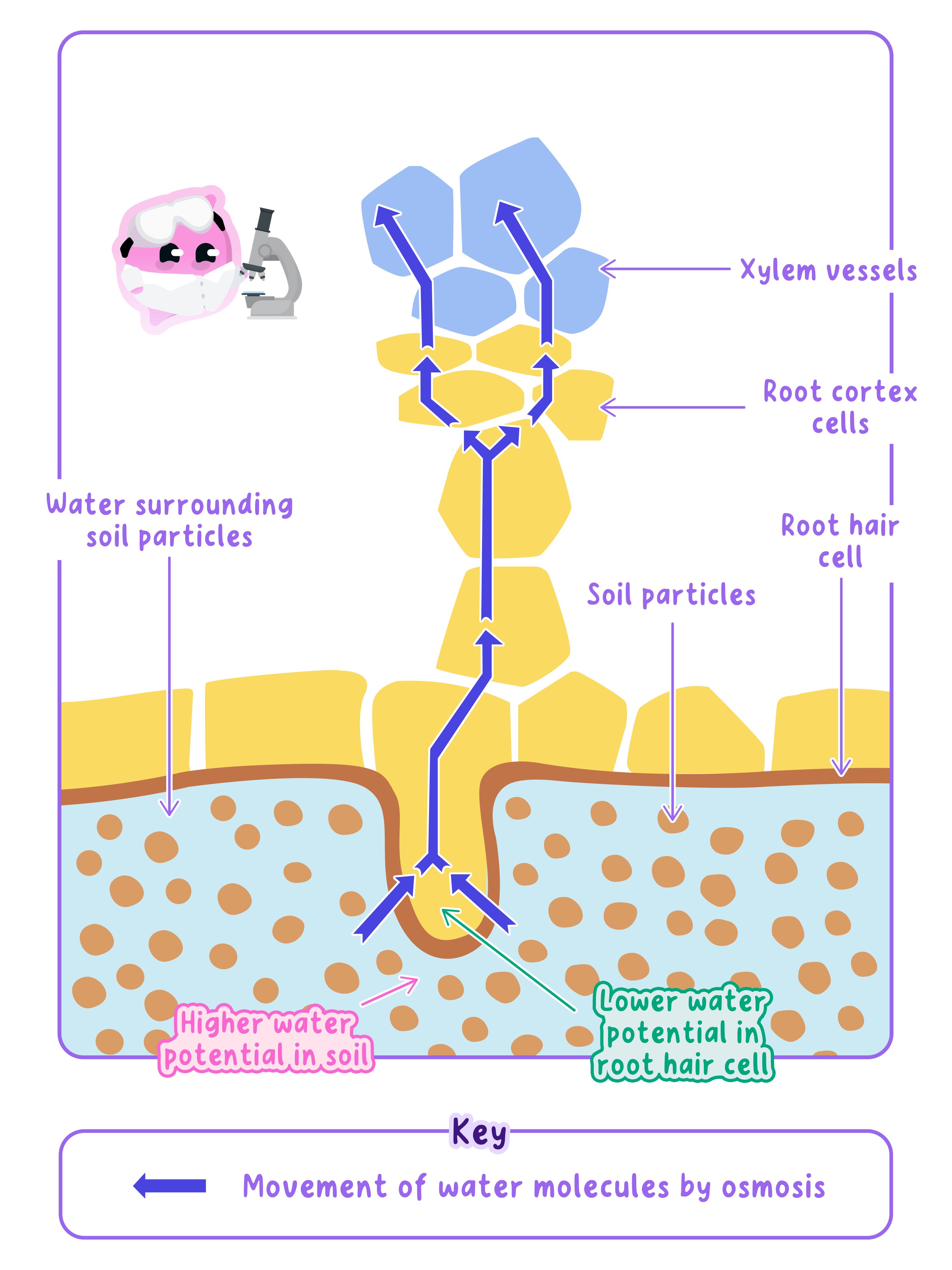
Water enters by osmosis
Osmosis
The net movement of water molecules from a more dilute solution to a more concentrated solution through a partially permeable membrane.
- Osmosis is the net movement of water molecules from a dilute solution to a more concentrated solution through a partially permeable membrane.
- Soil water is usually more dilute than the cell sap, so water moves into the root hair cell across its cell membrane.
- This movement is passive and does not require energy from respiration.
Do not write that roots suck up water or that mineral ions enter by osmosis.
Mineral ions enter by active transport
Active transport
The movement of a substance against its concentration gradient, from a lower to a higher concentration, using energy released by respiration.
- Active transport is the movement of particles from a lower concentration to a higher concentration using energy released by respiration.
- Mineral ions can be less concentrated in the soil than inside the root hair cell, so diffusion cannot move them into the cell.
- Carrier proteins in the cell membrane move ions such as nitrate and magnesium ions against their concentration gradient.
- Nitrate ions are needed to make amino acids and proteins, while magnesium ions are needed to make chlorophyll.
Example: if the nitrate ion concentration is lower in the soil than in the root hair cell, the ions still enter because active transport uses energy.
- Full-credit wording: the root hair extension increases surface area, so more water and mineral ions can be absorbed at the same time.
- Common lost mark: naming many mitochondria without linking them to respiration and active transport.
- Connect each structure to its function and each transport process to its direction, material and energy requirement.
- What is a root hair cell?
- Why does its long extension increase uptake?
- How does water enter a root hair cell?
- Why is energy needed to absorb some mineral ions?
