Transpiration: water loss pulls water upwards
Definition
Transpiration
The loss of water vapour from the surfaces of a plant, mainly through the stomata of the leaves.
Definition
Transpiration stream
The continuous flow of water drawn up the xylem from the roots to the leaves that replaces the water lost by transpiration.
- Transpiration is the loss of water vapour from the aerial parts of a plant, mainly through the stomata in leaves.
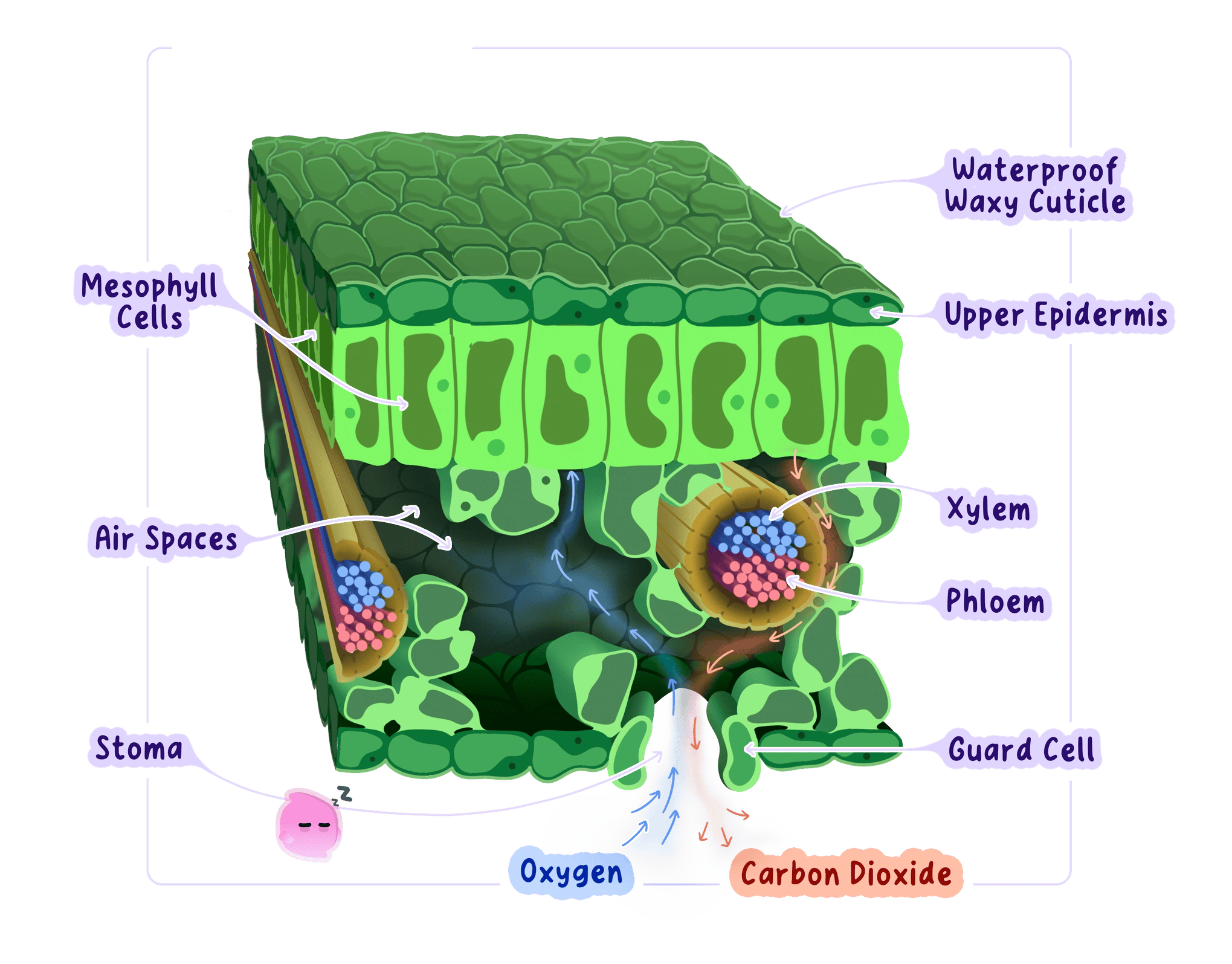
- Water evaporates from the moist cell walls of mesophyll cells into the leaf air spaces.
- Water vapour then diffuses out through open stomata because its concentration is higher inside the leaf than outside.
- Water lost from mesophyll cells is replaced by water from the xylem, maintaining a continuous transpiration stream.
- Cohesion between water molecules helps keep an unbroken column of water in the xylem as it is pulled upwards.
Key Idea
Causal chain: evaporation from mesophyll, diffusion through stomata, water drawn from xylem, water pulled up from roots.
Stomata control gas exchange and water loss
Definition
Stomata
The small pores in the surface of a leaf, each called a stoma, through which gases are exchanged and water vapour is lost.
- Stomata are pores in the leaf epidermis through which carbon dioxide, oxygen and water vapour diffuse.
- Each stoma is surrounded by two guard cells that change shape to open or close the pore.
- In light and when water is available, guard cells become turgid and curve apart, opening the stoma for carbon dioxide uptake.
- When water is scarce, guard cells lose turgor and the stoma closes, reducing water loss but also limiting photosynthesis.
Common Mistake
Do not confuse evaporation from mesophyll surfaces with diffusion of water vapour out through stomata.
Practical
Investigating water uptake with a potometer
- Aim: to compare the rate of water uptake by a leafy shoot under different environmental conditions.
- Apparatus: bubble potometer, freshly cut leafy shoot, water, beaker, sharp blade, petroleum jelly, ruler, stop clock, lamp, fan and eye protection.
- Method:
- Fill the apparatus completely with water.
- Cut the shoot under water at an angle and fit it into the tubing without allowing air into the xylem.
- Seal every joint with petroleum jelly.
- Introduce one air bubble into the capillary tube and mark its starting position.
- Measure the distance moved in a fixed time.
- Reset the bubble and repeat at least three times.
- Change one factor, such as lamp distance or air movement, and allow the shoot to settle before repeating.
- Variables: change one environmental factor and measure bubble distance per unit time; keep leaf area, shoot species, time, temperature and the rest of the apparatus constant.
- Results: faster bubble movement shows faster water uptake, which estimates transpiration rate but is not a direct measurement of water loss.
- Maths: calculate rate=distance movedtime\text{rate}=\frac{\text{distance moved}}{\text{time}}rate=timedistance moved, or volume=πr2l\text{volume}=\pi r^{2}lvolume=πr2l and then rate=volumetime\text{rate}=\frac{\text{volume}}{\text{time}}rate=timevolume.
- Watch out: an air leak or extra bubble breaks the water column; seal joints and cut the shoot under water.
- Safety: cut the shoot on a tile with the blade moving away from your fingers, keep water away from electrical equipment and wear eye protection.
Example
- Question: a bubble moves 48 mm48\,\text{mm}48mm in 6 min6\,\text{min}6min.
- Calculation: rate=486=8 mm min−1\text{rate}=\frac{48}{6}=8\,\text{mm min}^{-1}rate=648=8mm min−1.
Exam technique
Writing transpiration explanations
- Explain questions: give the full sequence from evaporation to diffusion and replacement from the xylem.
- Practical questions: identify the independent, dependent and controlled variables, then explain how a named error changes the result.
Self review
- What is transpiration?
- Where does water evaporate inside a leaf?
- How do guard cells reduce water loss?
- Why is a potometer an indirect measure of transpiration?
- How is bubble movement converted into a rate?
