Question 3
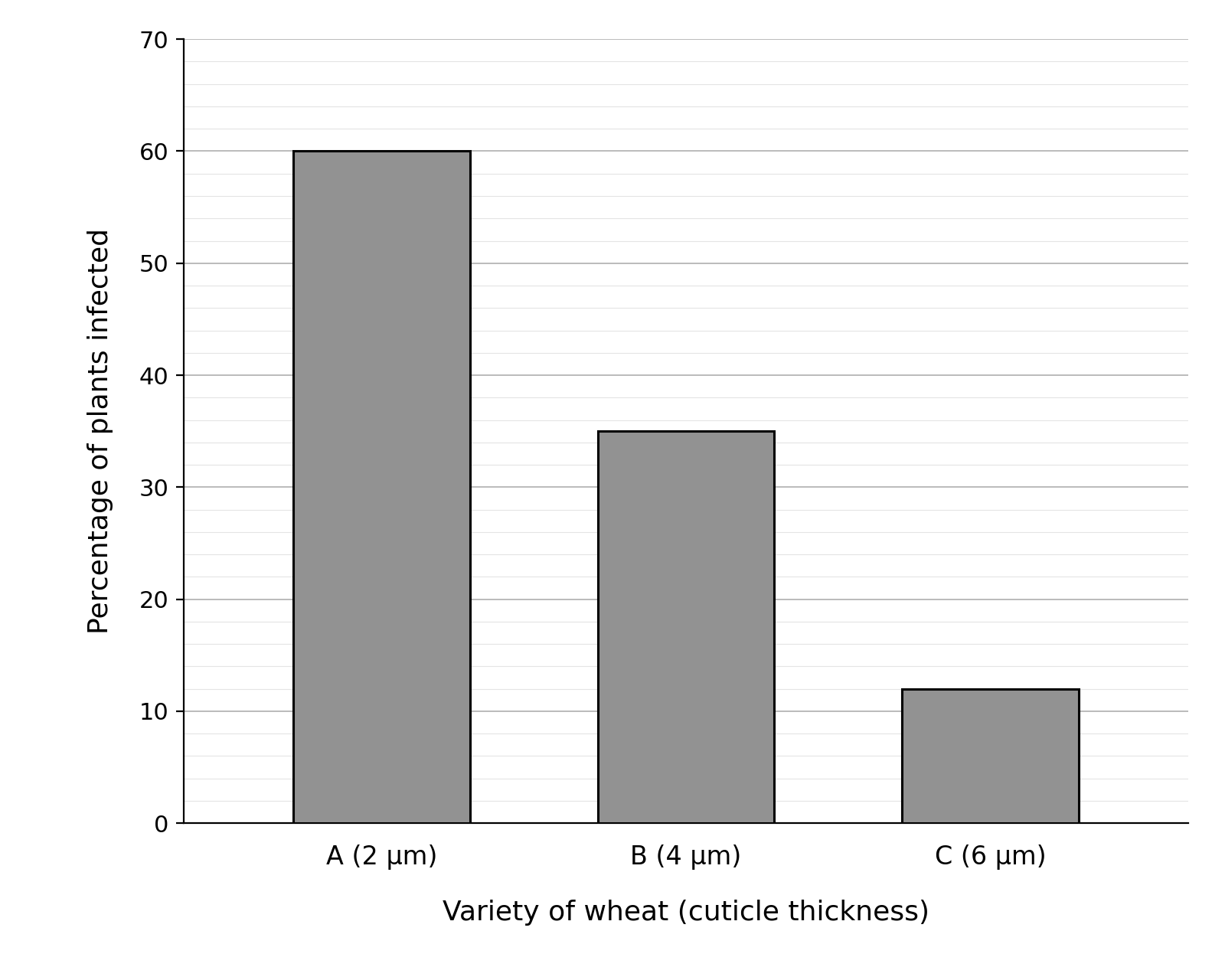
FScientists investigated three varieties of wheat, A, B and C. Each variety has a different thickness of leaf cuticle.
The scientists grew the varieties in the same field and recorded the percentage of plants infected by a fungus.
The Figure shows the results.
Figure
a.[1]
Describe the relationship between cuticle thickness and the percentage of plants infected.
b.[2]
Calculate how many times greater the percentage of plants infected was for variety A than for variety C.
c.[2]
Explain why variety C had the lowest percentage of plants infected.
d.[2]
A farmer says:
"If I grow variety C, my wheat will never get this fungal disease."
Explain why the farmer is wrong.
e.[1]
Suggest one difference, other than cuticle thickness, that could explain why fewer plants of variety C were infected.
5.2 Plant and body defences Questions
45 exam-style questions on Edexcel GCSE Biology 5.2 Plant and body defences, covering 5.2.1 Physical plant defences, 5.2.2 Chemical plant defences, 5.2.3 Detecting plant diseases, and 5.2.4 Human physical and chemical defences. Each one has a worked solution and a mark scheme showing where the marks go.