Question 10
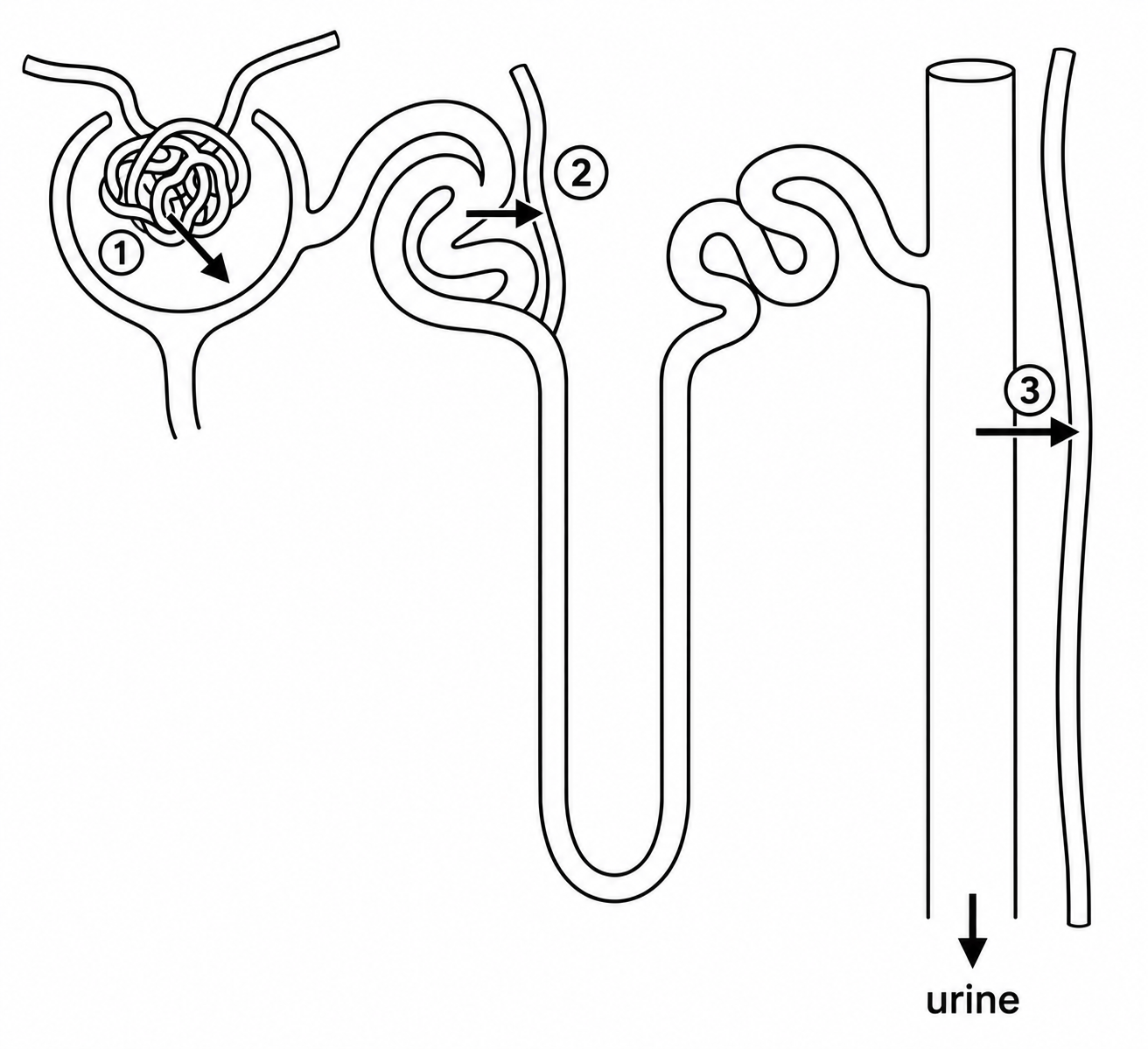
HThe Figure shows a nephron. Arrows 1, 2 and 3 show the movement of substances.
Figure
a.[1]
Name the process shown by arrow 1.
b.[3]
Arrow 2 shows the selective reabsorption of glucose. The cells lining the tubule at arrow 2 contain many mitochondria. Explain why.
c.[3]
Arrow 3 shows the reabsorption of water from the collecting duct. Explain how ADH affects the movement shown by arrow 3 when the water content of the blood is low.
d.[2]
A drug stops the movement shown by arrow 2. Predict the effect of this drug on the urine and explain your answer.
7.4 Blood glucose and the urinary system Questions
45 exam-style questions on Edexcel GCSE Biology 7.4 Blood glucose and the urinary system, covering 7.4.1 Insulin and blood glucose control, 7.4.2 Glucagon and blood glucose regulation, 7.4.3 Type 1 and type 2 diabetes, 7.4.4 Structure of the urinary system, 7.4.5 Structure and function of the nephron, 7.4.6 ADH and water regulation, 7.4.7 Treatments for kidney failure, and 7.4.8 Production of urea in the liver. Each one has a worked solution and a mark scheme showing where the marks go.