The Leaf Is a Plant Organ Made of Tissues
- In a plant, similar specialised cells group into tissues, and different tissues group into organs.
- The leaf is a plant organ, made of several tissues working together.
- Its main job is photosynthesis, so many of its tissues are adapted for this.
- The plant tissues to know are epidermal, palisade mesophyll, spongy mesophyll, xylem, phloem and meristem.
In a leaf, each tissue has a structure that suits its particular job.
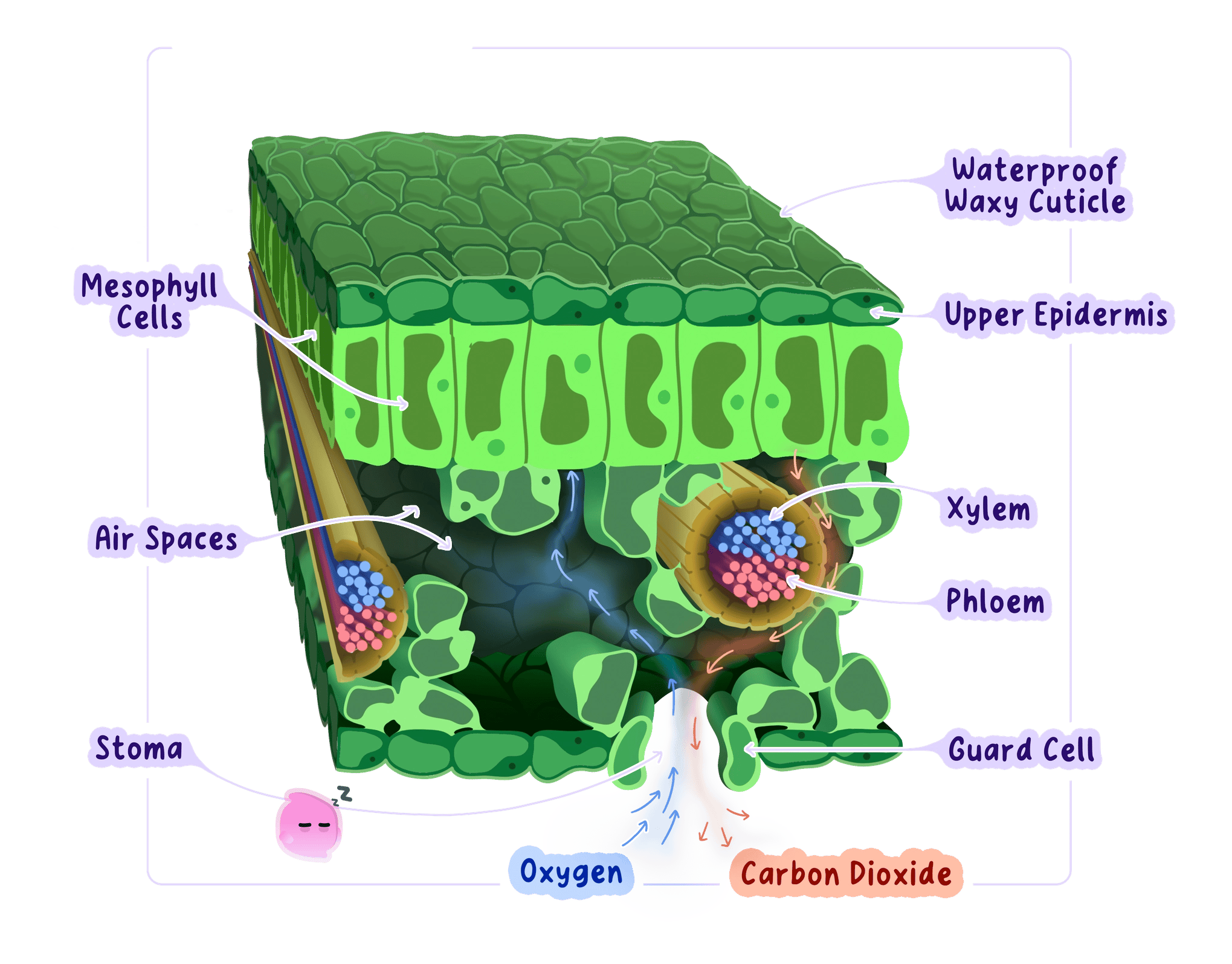
The Tissues of a Leaf
Epidermal tissue
Epidermal tissue
The tissue that covers and protects the surfaces of a plant; on the leaf it often makes a waxy, waterproof layer.
- Epidermal tissue covers and protects the surfaces of the leaf.
- It makes a waxy cuticle that waterproofs the leaf and reduces water loss.
- The upper epidermis is transparent, so light can pass through to the cells below.
The upper epidermis has no chloroplasts, which lets light reach the palisade layer beneath.
Palisade mesophyll
Palisade mesophyll
The tissue near the top of a leaf packed with chloroplasts, where most of the leaf's photosynthesis takes place.
- Palisade mesophyll is found near the top of the leaf.
- Its column-shaped cells are packed with chloroplasts.
- This is where most of the leaf's photosynthesis takes place, close to the light.
Spongy mesophyll
Spongy mesophyll
The tissue in the lower part of a leaf with large air spaces that let gases diffuse in and out.
- Spongy mesophyll lies below the palisade layer.
- It has some chloroplasts, but its cells are loosely packed with large air spaces.
- The air spaces and large surface area let gases diffuse in and out easily.
Carbon dioxide diffuses in, while oxygen and water vapour diffuse out, through these air spaces.
Guard cells and stomata
Guard cell
One of a pair of cells that surround a stoma and control whether it is open or closed.
- The lower epidermis contains tiny openings called stomata.
- Each stoma is surrounded by two guard cells.
- The guard cells open and close the stoma to control gas exchange and water loss.
Most stomata are on the underside of the leaf, away from direct sunlight, which reduces water loss.
Xylem and phloem
Xylem
A plant transport tissue of hollow, dead tubes strengthened with lignin that carry water and mineral ions from the roots to the stems and leaves.
- Xylem and phloem are the transport tissues that run through the leaf in the veins.
- Xylem carries water and mineral ions from the roots to the leaf.
- Phloem carries dissolved sugars made in the leaf to the rest of the plant.
Observing a Leaf Section
- Aim: to observe and draw the tissues in a transverse section of a leaf.
- Cut a very thin slice across a leaf, or use a prepared slide of a leaf section.
- Place it on a slide with a drop of water and a coverslip, and view it with a light microscope at low power first.
- Make a clear, labelled biological drawing showing the epidermis, palisade and spongy mesophyll, and a vein.
- Add a scale or magnification to the drawing.
Meristem Tissue
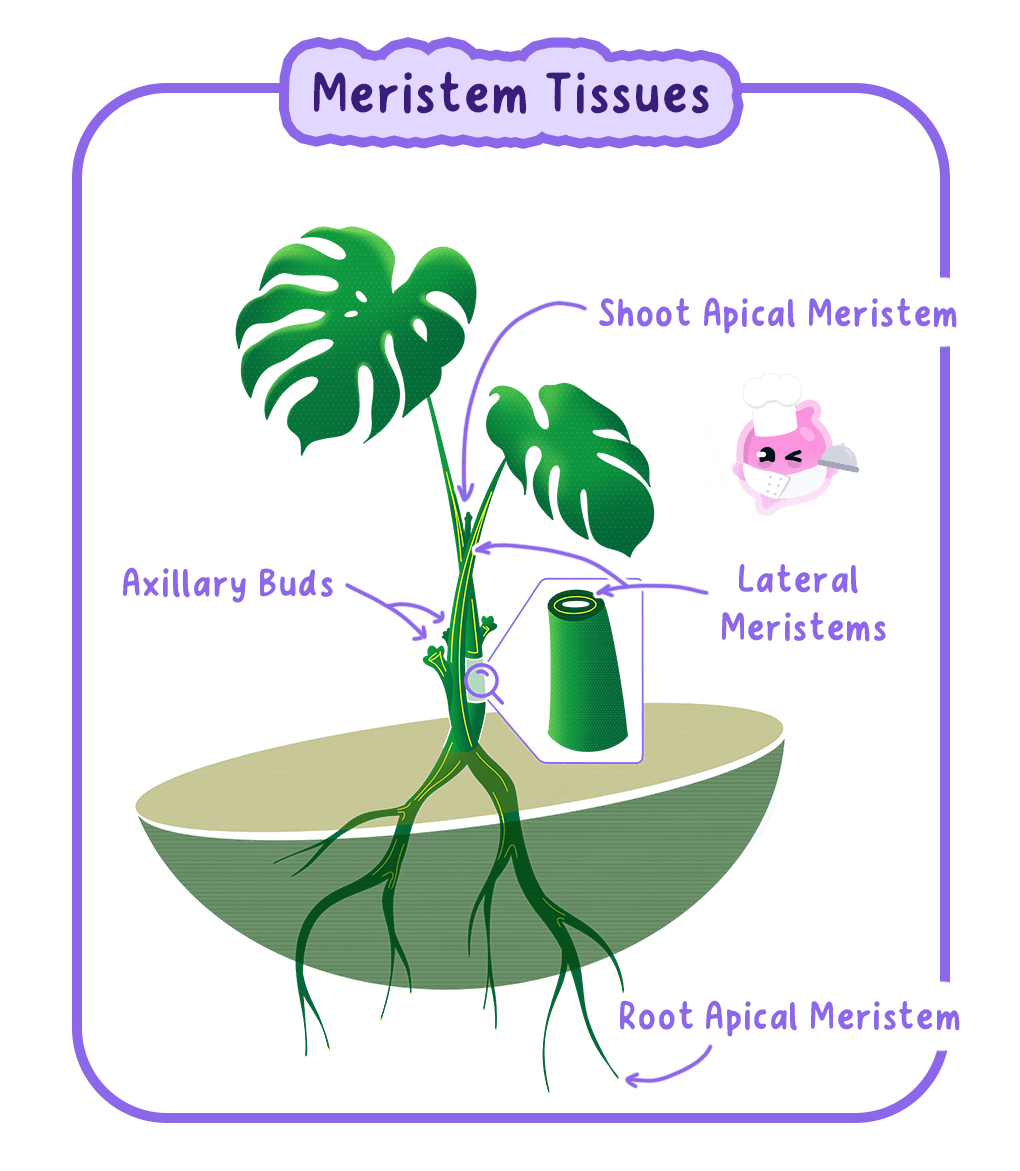
Meristem
Plant tissue at the tips of roots and shoots, made of cells that can divide and differentiate throughout the plant's life.
- Meristem tissue is found at the growing tips of shoots and roots.
- It is made of cells that divide rapidly.
- These new cells then grow and differentiate into all the other types of plant cell.
- This is how a plant grows and makes new tissues throughout its life.
- Name the plant tissues you need to know in a leaf.
- How is the palisade mesophyll adapted for photosynthesis?
- How is the spongy mesophyll adapted for gas exchange?
- What is the job of the guard cells?
- Where is meristem tissue found, and what does it do?
