Roots, Stem and Leaves Form a Transport System
- The roots, stem and leaves of a plant form an organ system for transporting substances around the plant.
- The roots absorb water and mineral ions, and the leaves make sugars.
- These substances have to be moved to wherever they are needed.
- Two transport tissues do this: xylem and phloem.
A plant has two transport tissues: xylem carries water and mineral ions upwards, and phloem carries dissolved sugars in all directions.
Root Hair Cells Absorb Water and Minerals
Root hair cell
A plant cell with a long, thin extension that gives a large surface area for absorbing water and mineral ions from the soil.
- Root hair cells cover the surface of the roots and absorb water and mineral ions from the soil.
- Each has a long, thin extension that gives a large surface area for absorption.
- Water is absorbed by osmosis, from the dilute soil water into the cell.
- Mineral ions are absorbed by active transport, against their concentration gradient.
- The cell has many mitochondria to release the energy needed for active transport.
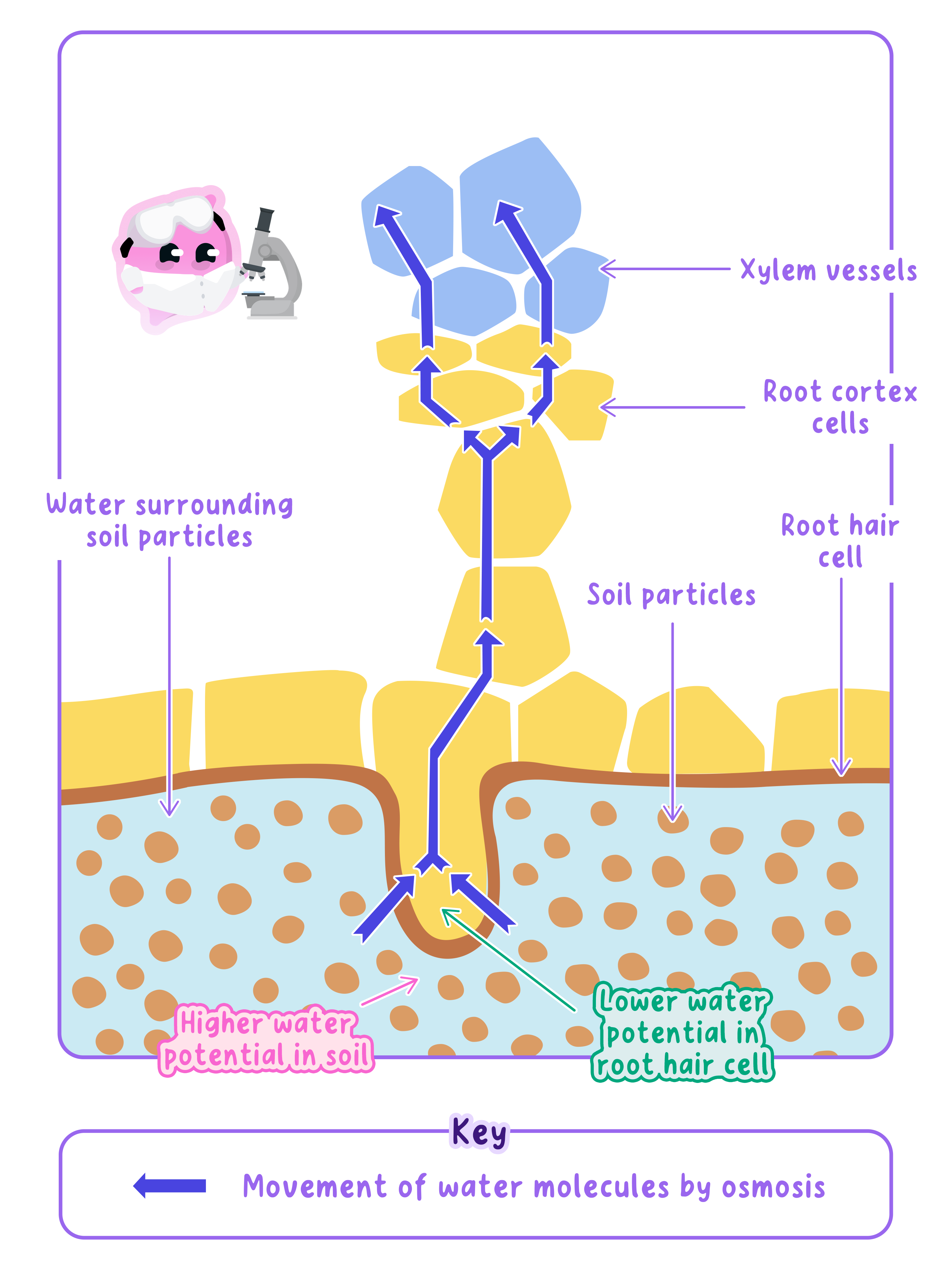
The thin cell wall gives water only a short distance to travel into the cell.
Xylem Transports Water and Minerals
Xylem
A plant transport tissue of hollow, dead tubes strengthened with lignin that carry water and mineral ions from the roots to the stems and leaves.
- Xylem tissue transports water and mineral ions from the roots up to the stems and leaves.
- It is made of hollow tubes formed from dead cells joined end to end, with no end walls between them.
- The walls are strengthened with lignin, which supports the plant and keeps the tubes open.
- Water moves up the xylem in one direction only, in the transpiration stream.
Standing a stick of celery in coloured water stains lines up the stem, showing where the xylem has carried the water.
Phloem Transports Sugars by Translocation
Translocation
The transport of dissolved sugars through the phloem, from the leaves to the rest of the plant for use or storage.
- Phloem tissue transports the dissolved sugars made in the leaves to the rest of the plant.
- The sugars are used straight away for respiration and growth, or stored, for example in the roots.
- This movement of dissolved food is called translocation.
- Phloem is made of columns of living, elongated cells joined end to end.
- Cell sap moves from one cell to the next through pores in the end walls.
Unlike xylem, phloem is made of living cells and can move food both up and down the plant.
Transpiration and the Transpiration Stream
Transpiration
The loss of water vapour from a plant, mostly by evaporation from the leaves and diffusion out through the stomata.
- Transpiration is the loss of water vapour from a plant, mostly from the leaves.
- Water evaporates from the cells inside the leaf into the air spaces.
- It then diffuses out through the open stomata as water vapour.
- As water is lost, more water is pulled up the xylem to replace it, forming the transpiration stream.
- The transpiration stream carries water and dissolved mineral ions from the roots to the leaves.
Measuring the Rate of Transpiration
- Aim: to measure the rate of transpiration from how fast a leafy shoot takes up water.
- A leafy shoot is fixed into a potometer, a water-filled tube with a scale.
- As the shoot transpires, it draws water up and an air bubble moves along the scale.
- The rate is found from how far the bubble moves in a set time.
- One factor, such as temperature or air movement, is changed while the others are kept the same.
Stomata and Guard Cells Control Gas Exchange and Water Loss
Stoma
A small opening on the surface of a leaf, usually the underside, that lets gases move in and out; the plural is stomata.
- Stomata are tiny openings, mostly on the underside of the leaf.
- Each stoma is surrounded by two guard cells that open and close it.
- When the stomata are open, carbon dioxide diffuses in for photosynthesis and oxygen diffuses out.
- Water vapour is also lost through open stomata, which is transpiration.
- The guard cells close the stomata to reduce water loss when water is short.
Investigating Stomata on a Leaf
- Aim: to investigate the number and distribution of stomata on a leaf.
- Paint clear nail varnish onto the leaf surface, let it dry, then peel it off to make an impression.
- Place the peel on a slide and count the stomata seen in the field of view under the microscope.
- Repeat for several areas and find the mean number of stomata per unit area.
- Compare the upper and lower surfaces, which usually have different numbers of stomata.
Factors That Affect the Rate of Transpiration
- Four environmental factors change how fast a plant transpires.
- Temperature:
- A higher temperature gives the water molecules more energy, so they evaporate and diffuse out faster.
- Humidity:
- More humid air holds more water vapour, so the gradient out of the leaf is smaller and transpiration is slower.
- Air movement:
- Wind carries away the water vapour outside the leaf, keeping a steep gradient, so transpiration is faster.
- Light intensity:
- Brighter light makes more stomata open for photosynthesis, so more water is lost.
- How is a root hair cell adapted to absorb water and mineral ions?
- Give two ways xylem is adapted to transport water.
- What is translocation, and which tissue carries it out?
- What is transpiration, and what is the transpiration stream?
- Name the four factors that affect the rate of transpiration and say how each changes it.
