Cancer Is the Result of Uncontrolled Cell Division
Tumour
A mass of abnormal cells produced by uncontrolled cell division.
- Normally cells divide in a controlled way by mitosis for growth and repair, controlled by genes in the cell cycle.
- Cancer is caused by changes in cells that make them divide uncontrollably.
- This uncontrolled division forms a mass of cells called a tumour.
Cancer is the result of changes in cells that lead to uncontrolled growth and division.
Benign Tumours Stay in One Place
Benign tumour
A tumour whose cells stay in one place, often inside a membrane, and do not invade other parts of the body.
- A benign tumour is a growth of abnormal cells contained in one area, usually within a membrane.
- Its cells do not invade other parts of the body.
- A benign tumour can still be dangerous if it grows large and presses on an organ, for example in the brain.
Benign does not always mean harmless; a large benign tumour can damage an organ by pressing on it.
Malignant Tumours Spread and Form Secondary Tumours
Malignant tumour
A cancerous tumour whose cells invade neighbouring tissues and spread in the blood or lymph to form secondary tumours elsewhere in the body.
- Malignant tumour cells are cancers, and they invade neighbouring healthy tissues.
- Cells can break off and spread through the blood or lymphatic system to other parts of the body.
- There they lodge and grow into secondary tumours, which makes malignant tumours dangerous and hard to treat.
Only malignant tumours are cancer; benign tumours are not, so do not call every tumour cancerous.
Lifestyle and Genetic Risk Factors Cause the Changes
Carcinogen
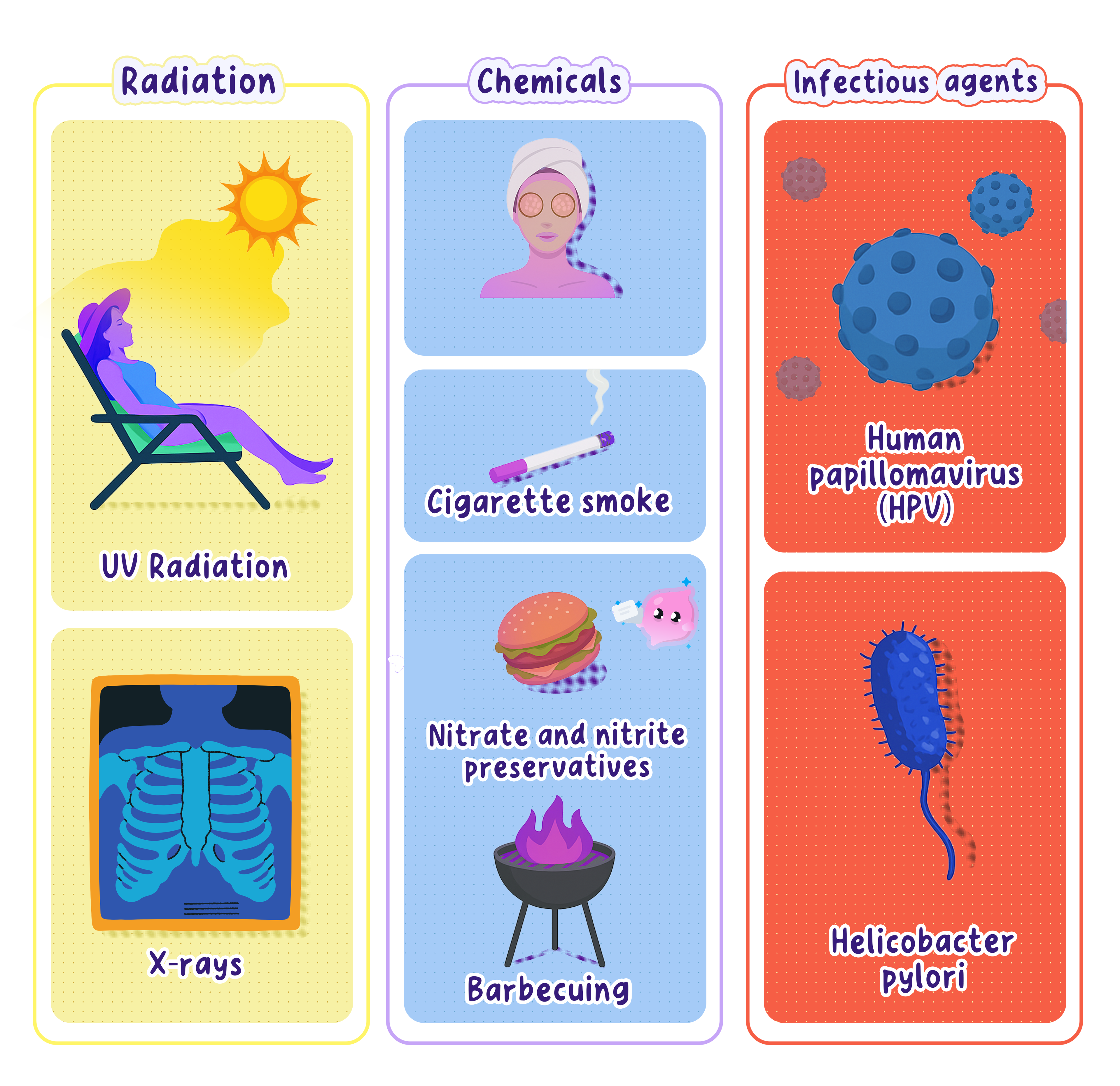
A substance or type of radiation that can cause cancer by producing mutations, such as the tar in tobacco smoke or ultraviolet light.
- Cancer begins with mutations, changes in the genes that control cell division.
- Agents that cause these mutations are called carcinogens.
- Lifestyle risk factors
- Smoking exposes the body to carcinogens in tar, raising the risk of lung, mouth and throat cancer.
- UV light from the Sun, a form of ionising radiation, raises the risk of skin cancer.
- Obesity is linked to bowel, liver and kidney cancer.
- Some virus infections raise the risk, such as HPV leading to cervical cancer.
- Genetic risk factors
- Some people inherit faulty genes, such as BRCA, that make breast and ovarian cancer more likely.
- Anyone can develop cancer, and the risk also increases with age.
- What is a tumour, and how does one form?
- Describe the difference between a benign and a malignant tumour.
- How do malignant tumour cells spread to form secondary tumours?
- Name two carcinogens and the cancer each is linked to.
- Give one genetic risk factor for cancer.
