Question 1
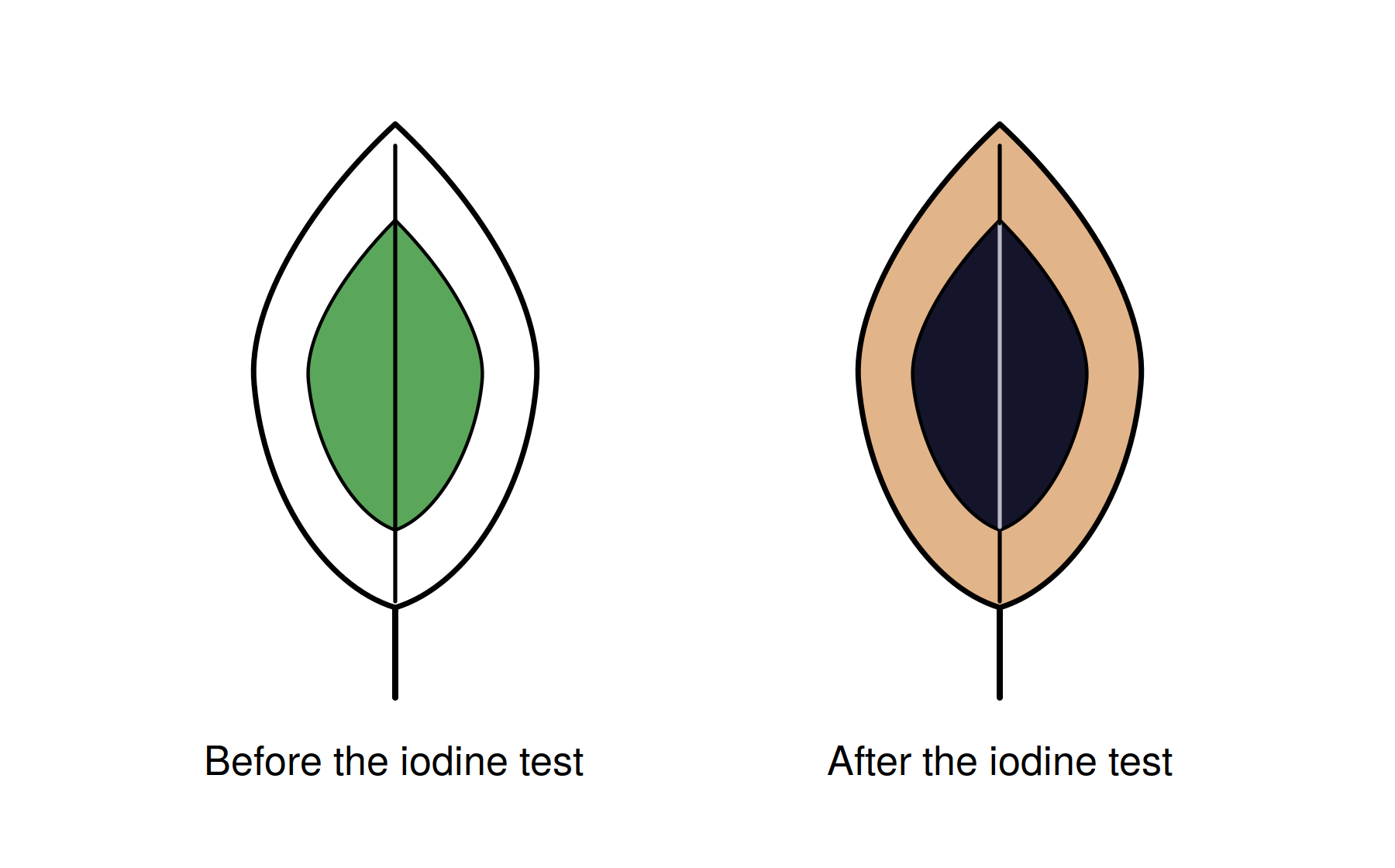
FA student investigated whether chlorophyll is needed for photosynthesis. She used a plant with variegated leaves. Part of each leaf is green and part of each leaf is white.
The student kept the plant in the dark for 48 hours. She then put the plant in bright light for 6 hours. She removed one leaf and tested it with iodine solution.
Figure: A variegated leaf from the plant before the iodine test and the same leaf after the iodine test
a.[2]
Explain why the student kept the plant in the dark for 48 hours before the investigation.
b.[1]
The green part of the leaf turned blue-black. Name the substance that this shows is present in the green part of the leaf.
c.[3]
Explain why the white part of the leaf did not turn blue-black.
d.[1]
Give one variable the student should have controlled in this investigation.
4.1 Photosynthesis Questions
40 exam-style questions on AQA GCSE Biology 4.1 Photosynthesis, covering 4.1.1 Photosynthetic reaction, 4.1.2 Rate of photosynthesis, and 4.1.3 Uses of glucose from photosynthesis. Each one has a worked solution and a mark scheme showing where the marks go.