Chromosomes Are Coiled DNA in the Nucleus
Definition
Chromosome
A long molecule of DNA, coiled up in the nucleus, that carries many genes; in body cells chromosomes are found in pairs.
- In eukaryotic cells, the nucleus contains thread-like structures called chromosomes.
- Each chromosome is a single, very long molecule of DNA, coiled up tightly.
- Chromosomes are usually too thin to see, but they condense into visible shapes when a cell is about to divide.
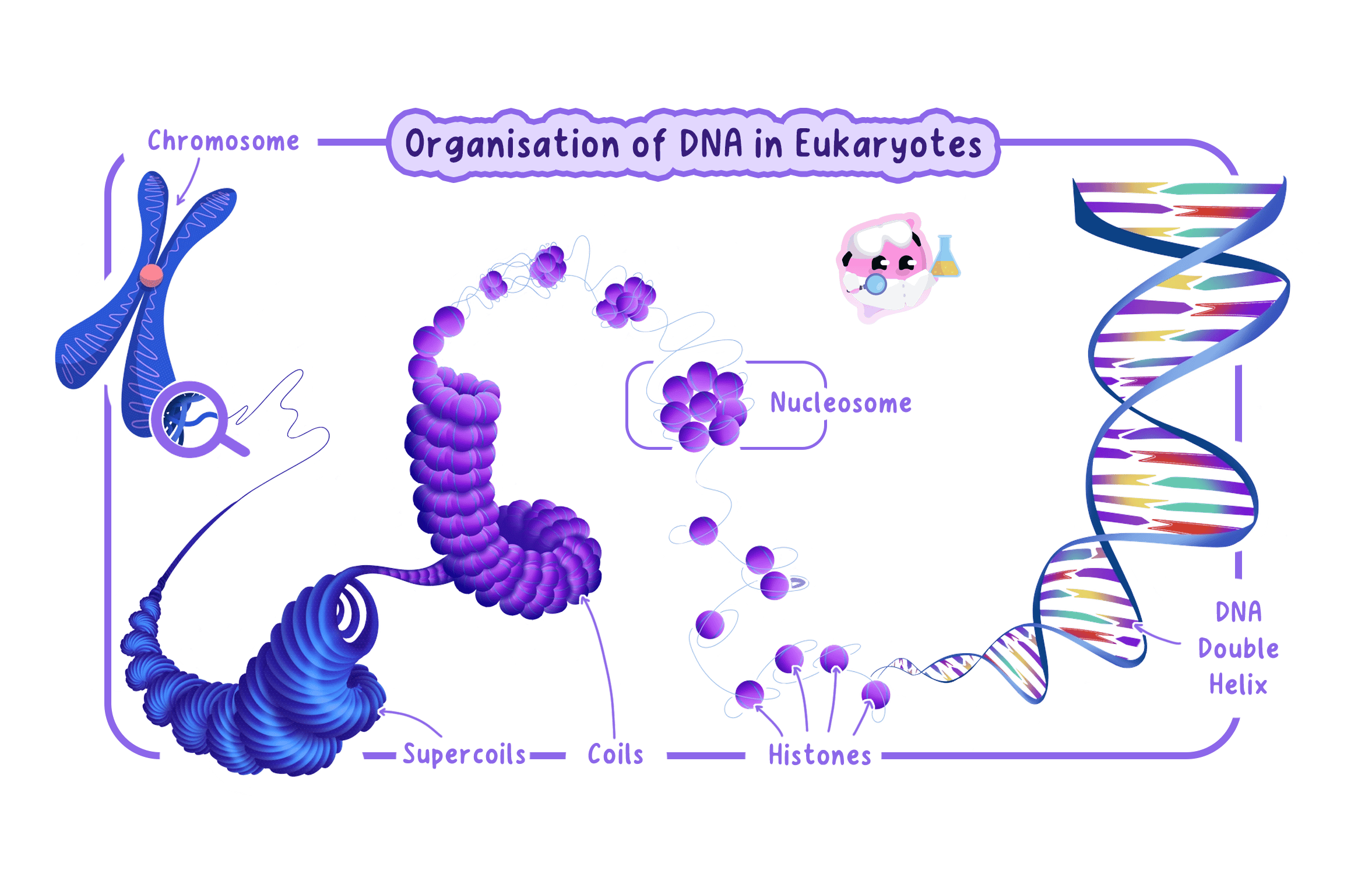
Note
The order of the DNA along a chromosome stores the coded instructions the cell needs.
Genes Are Short Sections of DNA
Definition
Gene
A short section of DNA on a chromosome that codes for a particular protein and controls a characteristic.
- A gene is a short section of the DNA on a chromosome.
- Each gene codes for a particular protein, and so controls a characteristic.
- Each chromosome carries a large number of genes along its length.
- So the parts fit inside one another: a gene is part of a DNA molecule, the DNA is coiled into a chromosome, and the chromosomes sit inside the nucleus.
Common Mistake
- Do not muddle DNA, chromosomes and genes.
- A gene is part of a chromosome, and a chromosome is one long molecule of DNA.
Chromosomes Come in Pairs
- In the body cells of most organisms, chromosomes are found in pairs.
- A human body cell has 23 pairs, which is 46 chromosomes in total.
- One chromosome of each pair is inherited from the mother and one from the father.
- A cell with its chromosomes in pairs is described as diploid.
- Different species have different numbers of chromosomes; a horse, for example, has 64 in 32 pairs.
- Red blood cells are an exception, because they lose their nucleus and so have no chromosomes.
Self review
- Put these in order from largest to smallest: gene, nucleus, chromosome.
- What is a gene, and what does it do?
- What is each chromosome made of?
- How many chromosomes are in a human body cell, and how many pairs is that?
- Why do red blood cells have no chromosomes?
