6.1.6a Genetic inheritance
Alleles
Allele
One of the different forms that a gene can take.
- Most genes come in different versions called alleles.
- You inherit two alleles of each gene, one from each parent, carried on a pair of chromosomes.
- The two alleles you have for a gene may be the same or different.
The gene for eye colour has an allele for brown eyes and an allele for blue eyes.
Dominant and recessive alleles
Dominant allele
An allele that is always expressed in the phenotype, even when only one copy is present.
Recessive allele
An allele that is only expressed in the phenotype when two copies are present.
- A dominant allele shows up in the phenotype whenever it is inherited, so a single copy is enough for its effect to appear.
- A recessive allele only affects the phenotype when both copies are recessive, because any dominant allele present will override it.
- Dominant alleles are written with a capital letter and recessive alleles with the matching lower-case letter, such as BBB and bbb.
- So an organism with the alleles BbBbBb shows the dominant feature, because the dominant BBB is expressed.
Dominant does not mean more common or stronger; it just means one copy is enough to show the feature.
Homozygous and heterozygous
Homozygous
Describes an organism that carries two identical alleles of a gene.
Heterozygous
Describes an organism that carries two different alleles of a gene.
- When both copies of a gene carry the matching allele, the organism is homozygous for that gene, for example BBBBBB or bbbbbb.
- When the two copies carry different alleles, the organism is heterozygous, for example BbBbBb.
- A homozygous recessive organism (bbbbbb) is the only genotype that shows a recessive feature.
- A dominant feature can be shown by either a homozygous dominant (BBBBBB) or a heterozygous (BbBbBb) organism.
You cannot always tell an organism's genotype from its appearance, because BBBBBB and BbBbBb look the same.
Genotype and phenotype
Genotype
The combination of alleles an organism has for a characteristic.
Phenotype
The observable characteristics of an organism, produced by its genotype and its environment.
- The genotype is the combination of alleles an organism has, such as BbBbBb.
- The phenotype is the characteristic you can actually observe, such as brown eyes.
- The phenotype is produced by the genotype together with the environment.
A pea plant with genotype TtTtTt has the phenotype tall, because TTT (tall) is dominant over ttt (short).
One gene or many genes
- A few characteristics are controlled by a single gene, such as fur colour in mice or red-green colour blindness.
- Most characteristics are controlled by several genes working together, not by one gene alone.
- Features such as height and body mass are affected by many genes and by the environment.
Do not assume every characteristic is decided by a single gene; most are the result of several genes interacting.
Genetic diagrams and family trees
Monohybrid cross
A genetic cross that follows the inheritance of a single gene.
Punnett square
A grid used to predict the possible genotypes and phenotypes of offspring from a genetic cross.
- A monohybrid cross follows the inheritance of a single gene from the parents to their offspring.
- Each parent has two alleles, but each gamete carries only one of them, because meiosis halves the number.
- A Punnett square is a grid that combines the parents' gametes to show the possible offspring genotypes.
- Write one parent's alleles along the top and the other parent's down the side, then fill each box by combining them.
- Crossing two heterozygotes (Bb×BbBb \times BbBb×Bb) gives offspring BBBBBB, BbBbBb, BbBbBb and bbbbbb, a phenotype ratio of 3:13:13:1 dominant to recessive.
- A family tree shows how a characteristic has been inherited through the generations of a real family.
- You can read a family tree to work out whether an allele is dominant or recessive and to predict genotypes.
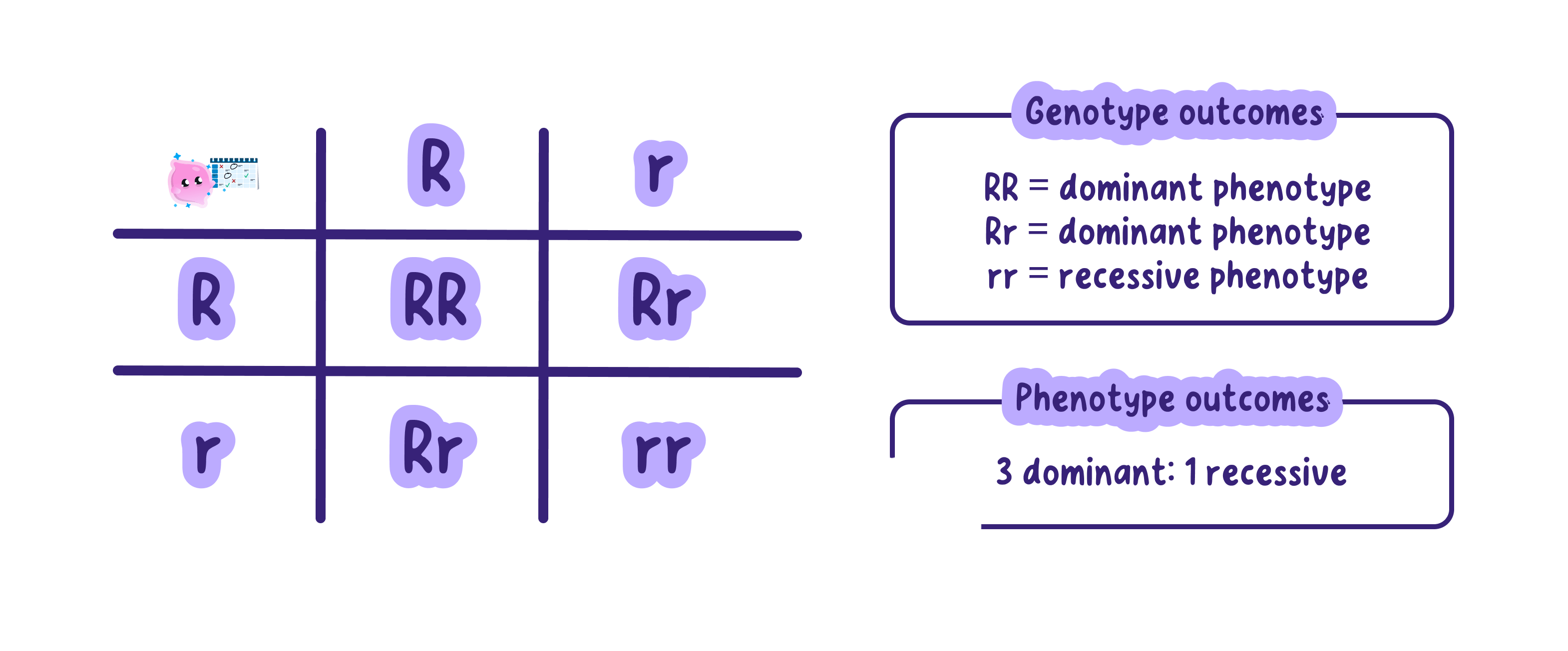
Give each gamete only one allele of the gene, never both of a parent's alleles.
- What is an allele?
- Explain the difference between a dominant and a recessive allele.
- What does it mean if an organism is heterozygous for a gene?
- What is the difference between genotype and phenotype?
- What phenotype ratio do you expect from crossing two heterozygotes?
6.1.6b Genetic inheritance (Higher tier)
Constructing a genetic cross
Punnett square
A grid used to predict the possible genotypes and phenotypes of offspring from a genetic cross.
- To construct a cross, first write the two parents' genotypes, for example Bb×BbBb \times BbBb×Bb.
- Work out the gametes: each BbBbBb parent makes gametes carrying either BBB or bbb.
- Put one parent's gametes along the top of the Punnett square and the other's down the side.
- Fill each box by combining the alleles, giving BBBBBB, BbBbBb, BbBbBb and bbbbbb.
Put single alleles on the edges of the grid, not whole genotypes, because each gamete carries only one allele.
Ratios, fractions and percentages
- From Bb×BbBb \times BbBb×Bb, three of the four boxes show the dominant feature, a ratio of 3:13:13:1 dominant to recessive.
- As a fraction, that is 34\frac{3}{4}43 dominant and 14\frac{1}{4}41 recessive.
- As percentages, that is 75%75\%75% dominant and 25%25\%25% recessive.
- The same outcome can be written as a ratio, a fraction or a percentage.
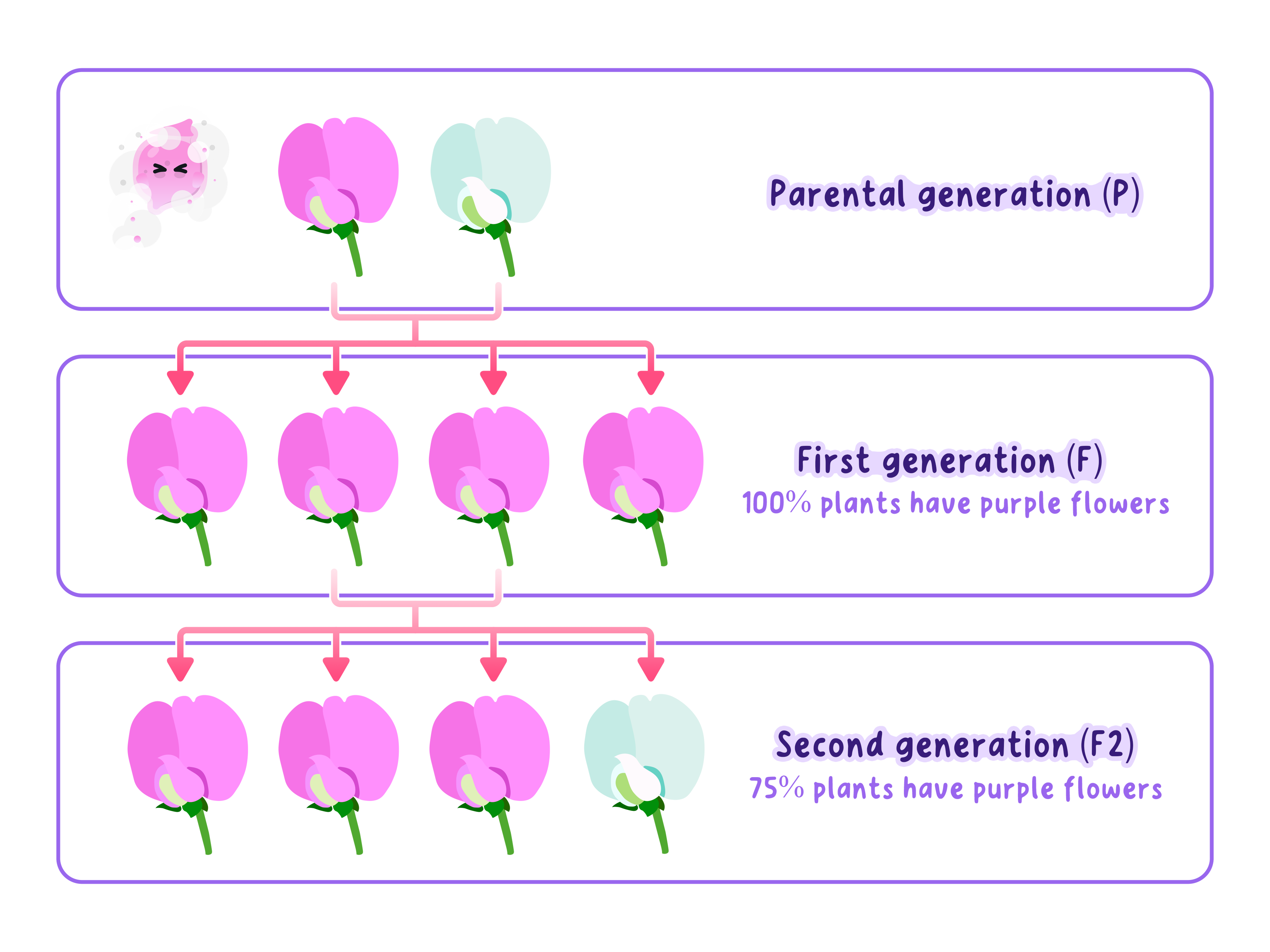
A ratio of 3:13:13:1 means 333 out of every 444, which is 34\frac{3}{4}43 or 75%75\%75%.
Using probability to predict offspring
Probability
How likely an outcome is, which can be written as a fraction, a decimal or a percentage.
- From Bb×BbBb \times BbBb×Bb, the probability that one offspring shows the recessive feature is 14\frac{1}{4}41.
- A probability can be written as a fraction, a decimal (0.250.250.25) or a percentage (25%25\%25%).
- These are expected proportions, not exact counts.
- Real offspring numbers vary by chance, and the more offspring there are, the closer the results usually get to the expected ratio.
Each offspring is a fresh event: a family with three dominant children can still have a recessive fourth.
Out of 404040 offspring from Bb×BbBb \times BbBb×Bb, you would expect about 303030 dominant and 101010 recessive.
- How do you turn the genotypes Bb×BbBb \times BbBb×Bb into a completed Punnett square?
- Write the outcome of Bb×BbBb \times BbBb×Bb as a ratio, a fraction and a percentage.
- What is the probability that one child from Bb×BbBb \times BbBb×Bb shows the recessive feature?
- Why do real offspring numbers not always match the expected ratio exactly?
