6.1.5a DNA structure
The double helix
Double helix
The twisted, two-stranded ladder shape of a DNA molecule.
- DNA is a polymer, a long molecule built from many small repeating units joined together.
- A DNA molecule is made of two strands lying alongside each other.
- The two strands are twisted around each other into a spiral shape called a double helix.
Picture a twisted ladder: the two long sides are the strands, spiralling around each other.
Nucleotides make up DNA
Nucleotide
The repeating unit that DNA is built from, each made of a sugar, a phosphate group and one of four bases.
- DNA is built from repeating units called nucleotides.
- Every nucleotide is built from three parts: a sugar, a phosphate group, and one base chosen from four.
- The sugars and phosphates join up to form a sugar-phosphate backbone that runs along the outside of each strand.
- The bases are attached to the sugars and point inwards, towards the other strand.
- A base on one strand pairs with a base on the other, and these base pairs form the rungs that hold the two strands together.
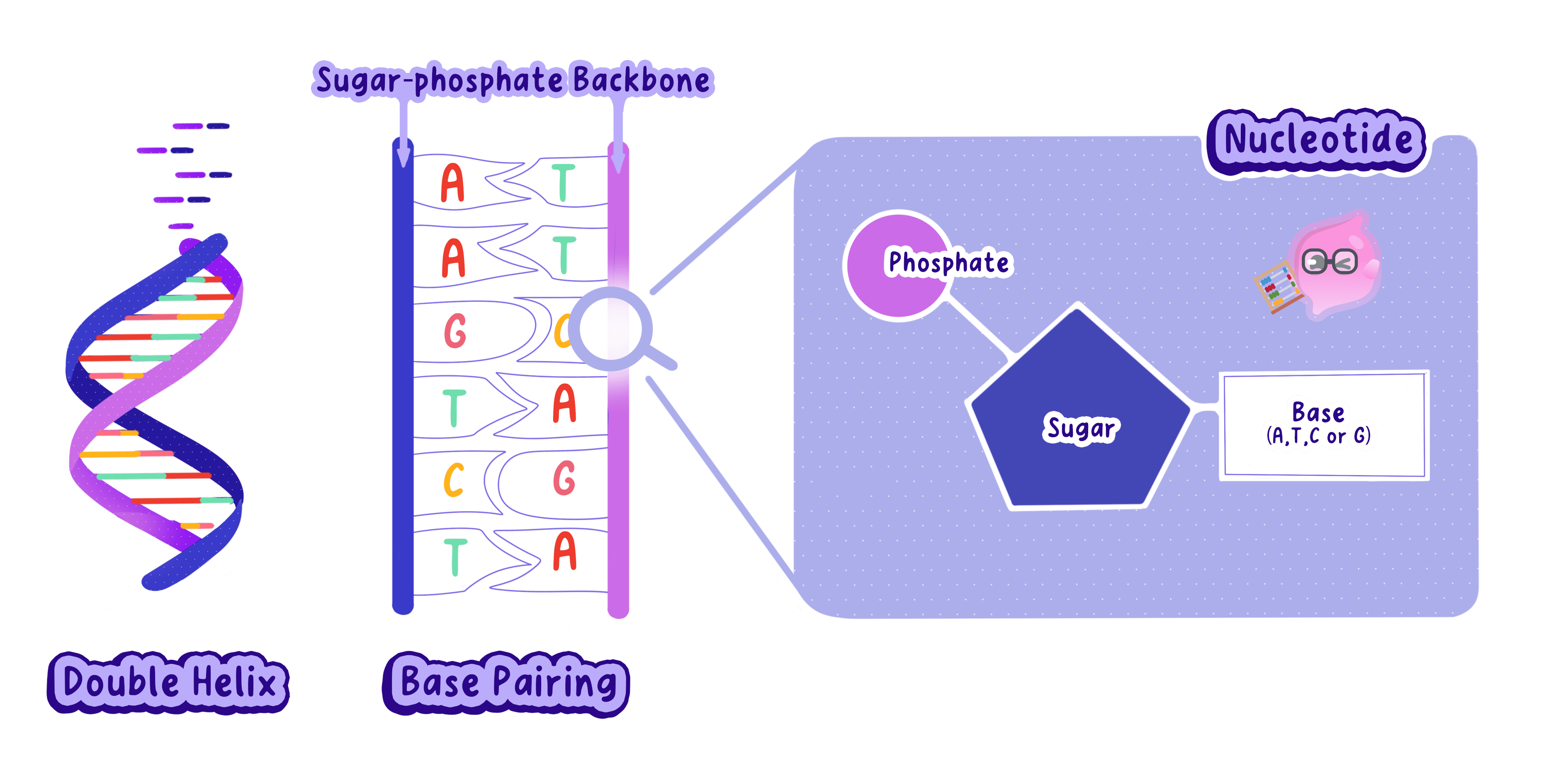
Do not say the backbone joins the two strands; it is the base pairs in the middle that link one strand to the other.
How DNA codes for a protein
- The four bases are known by their initials: A, C, G and T.
- The order of the bases along a gene acts as a code.
- Read in groups of three, each triplet of bases stands for one amino acid.
- So the order of the bases sets the order of the amino acids, and that decides which protein is built.
The sequence of bases in a gene is the instruction for building one protein.
- What shape is a DNA molecule described as?
- What three parts make up a nucleotide?
- Name the four bases found in DNA.
- How many bases code for one amino acid?
- How does the order of bases decide which protein is made?
6.1.5b DNA structure (Higher tier)
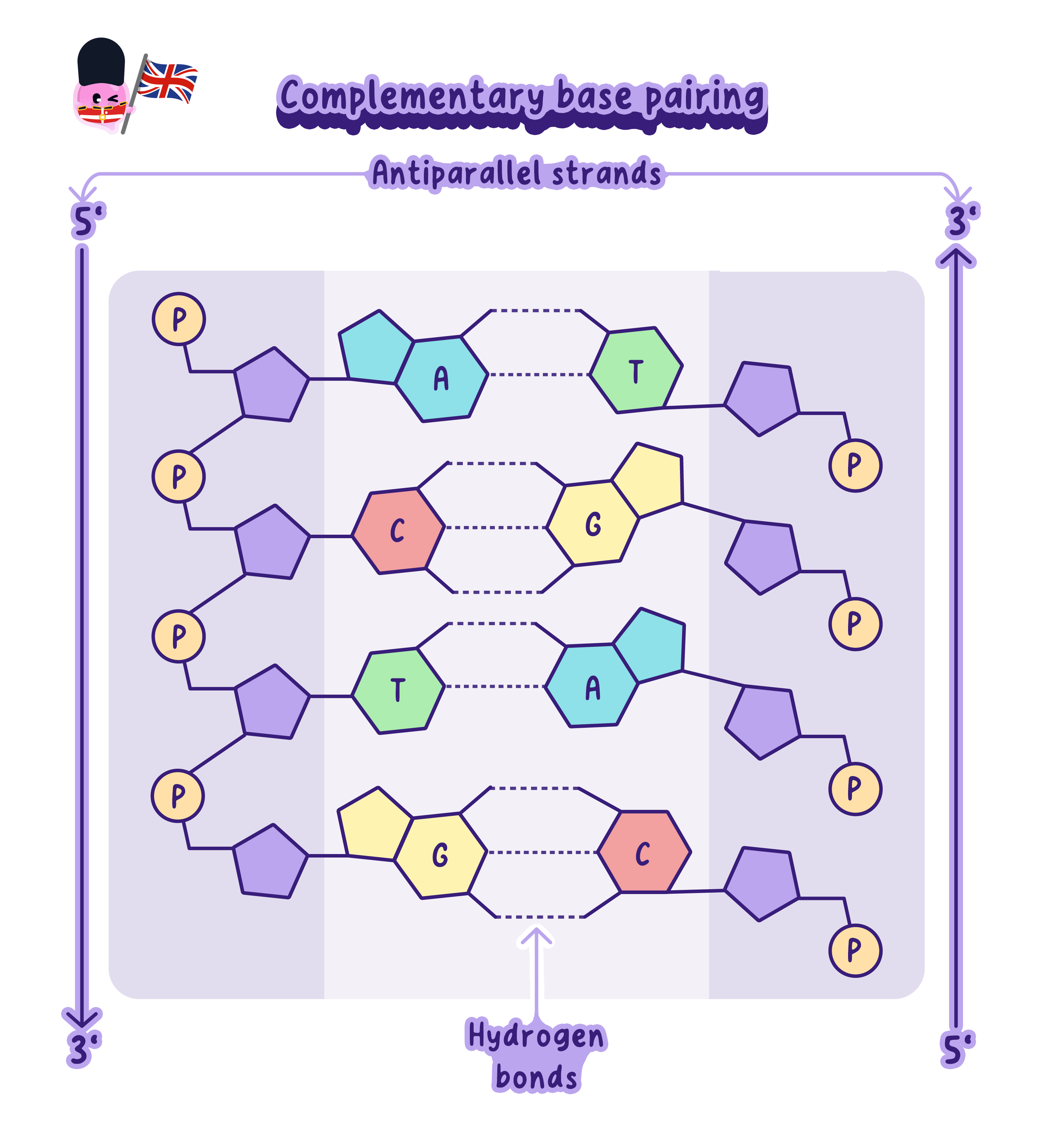
Complementary base pairing
Complementary base pairing
The rule that in DNA the base A always pairs with T, and C always pairs with G, holding the two strands together.
- The two strands of DNA are held together by pairs of bases.
- The pairing always follows the same rule: A always pairs with T, and C always pairs with G.
- These are called complementary base pairs.
- Because the pairing is fixed, the base sequence on one strand sets the sequence on the other.
If one strand reads A-C-G, the opposite strand must read T-G-C.
Transcription: copying the gene into mRNA
Transcription
The stage of protein synthesis in which the base sequence of a gene is copied into a molecule of mRNA.
- A gene's base sequence is the code for a protein, but proteins are built in the cytoplasm, not in the nucleus.
- So a copy of the gene is first made inside the nucleus, in a step called transcription.
- The two DNA strands unzip over the gene, and a matching copy is built against one strand using complementary base pairing.
- This copy is a molecule of mRNA (messenger RNA), which is a single strand, unlike the double-stranded DNA.
- The mRNA carries the same coded message as the gene, but in a form small enough to leave the nucleus.
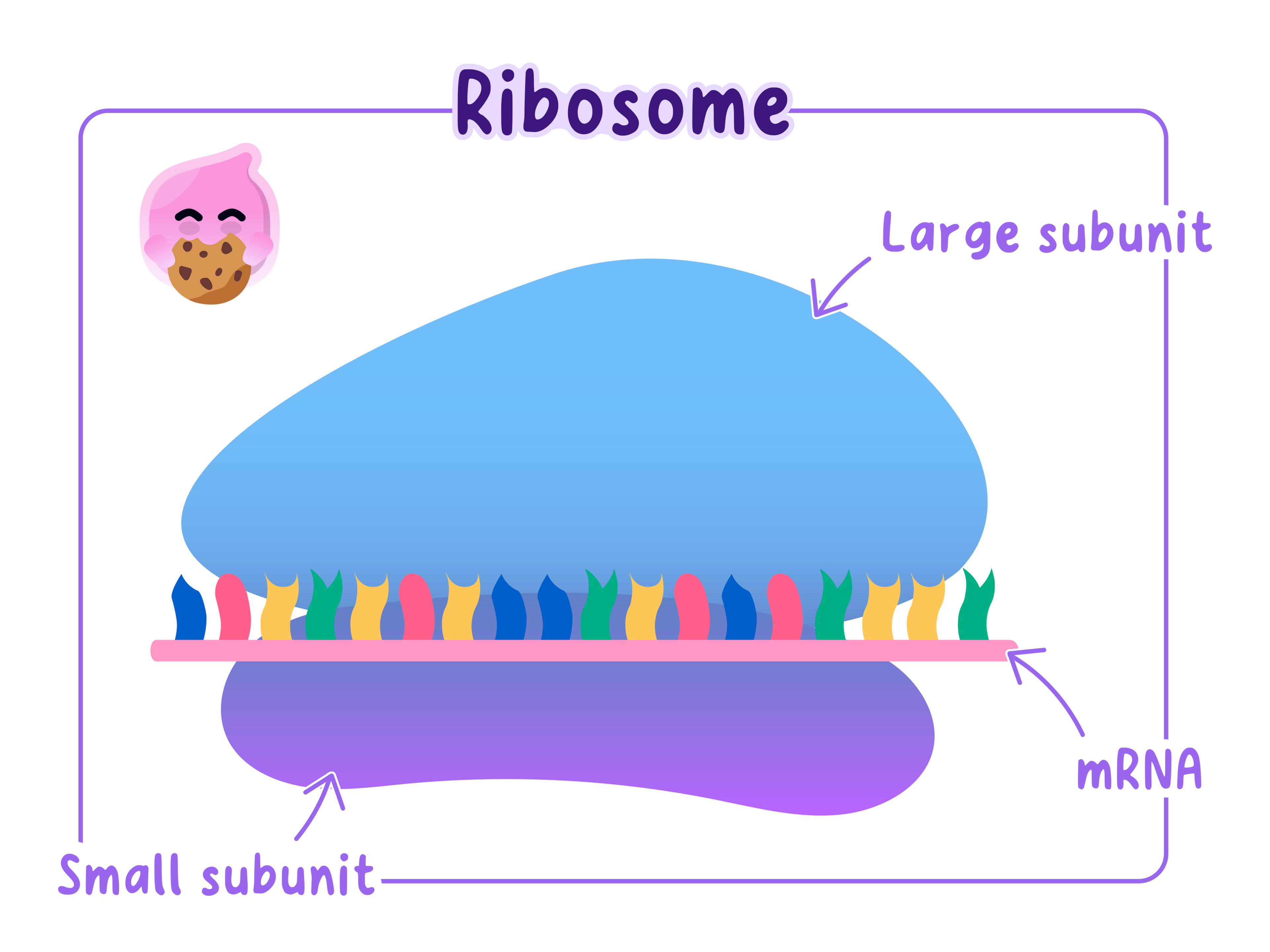
- The mRNA then travels out into the cytoplasm and attaches to a ribosome.
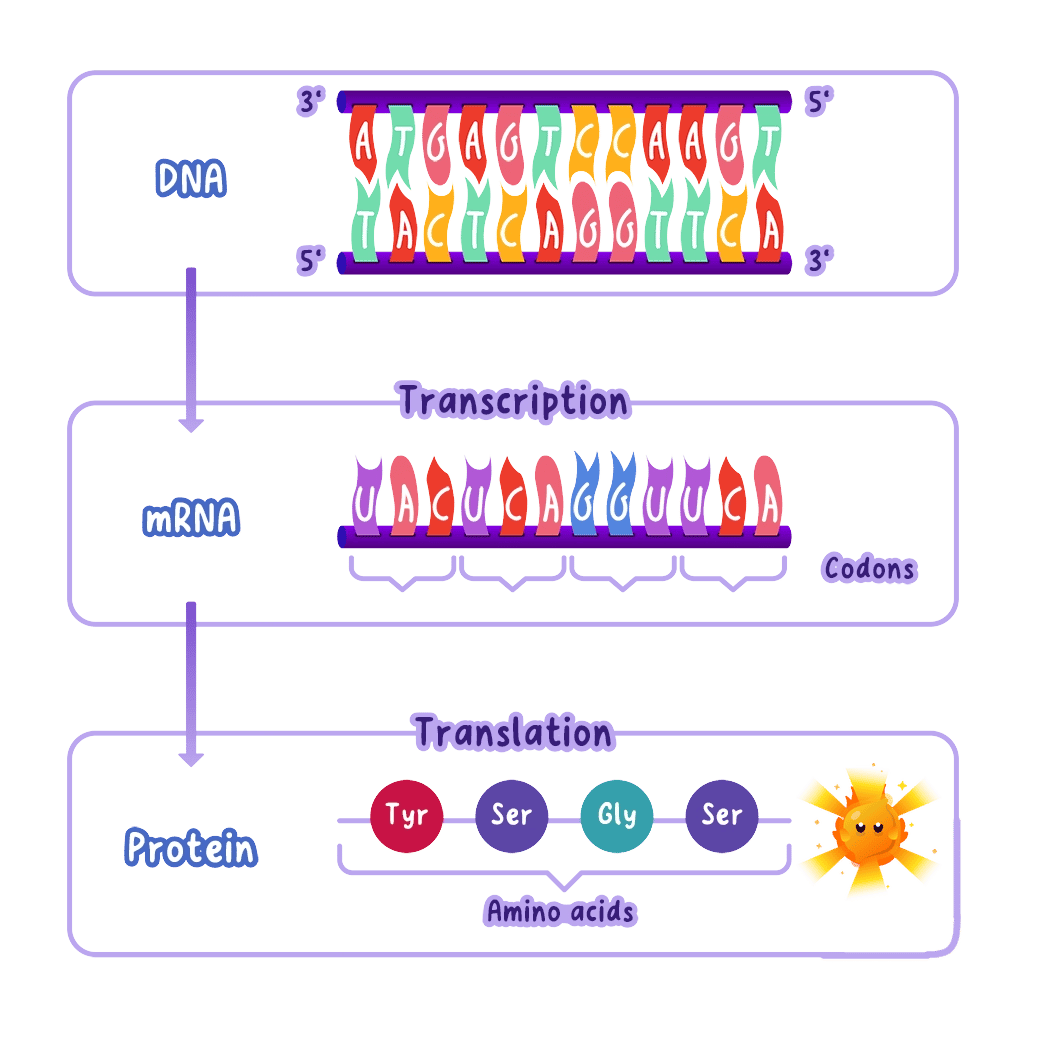
Only the gene being used is copied into mRNA, not the whole chromosome.
Translation: building the protein
Translation
The stage of protein synthesis in which the base sequence of mRNA is used at a ribosome to join amino acids in the correct order.
- At the ribosome, the mRNA code is read in order, in groups of three bases, and each group codes for one amino acid.
- Carrier molecules bring the matching amino acids to the ribosome in the order set by the code.
- The ribosome joins the amino acids together, one after another, into a chain; this stage is called translation.
- This builds a chain of amino acids in the exact order set by the gene.
- When the protein chain is complete, it folds up into a unique three-dimensional shape.
- The way it folds depends on the order of the amino acids, so the gene ultimately decides the protein's shape.
- This unique shape lets the protein do its job as an enzyme, a hormone, or a structural protein such as collagen.
An enzyme's shape gives it an active site that fits its substrate, while collagen's shape forms strong fibres in skin, tendons and bone.
Do not mix up the stages: transcription makes mRNA in the nucleus, translation builds the protein at the ribosome.
Mutations
Mutation
A change in the base sequence of DNA, which occurs continuously and may or may not change the protein that is produced.
- A mutation is a change in the base sequence of DNA, and mutations happen continuously.
- A point mutation is a change to a single base, and it can happen in three ways.
- Substitution: one base is swapped for a different base.
- Insertion: an extra base is added into the sequence.
- Deletion: a base is removed from the sequence.
- An insertion or a deletion shifts how all the bases after it are read in threes, so it can change many of the amino acids that follow.
- Most mutations do not change the protein, or change it so slightly that its function is unaffected.
- A few change the protein's shape, so an enzyme may no longer fit its substrate, or a structural protein may lose its strength.
Do not assume every mutation is harmful; most have no effect on the protein at all.
Non-coding DNA
Non-coding DNA
Sections of DNA that do not code for a protein, some of which switch genes on and off.
- Not all of the DNA codes for proteins.
- These non-coding parts of DNA can switch genes on and off.
- A variation in one of these regions can change how a gene is expressed, meaning whether a protein is made and how much.
- This is one reason cells with the same DNA can develop into different specialised types.
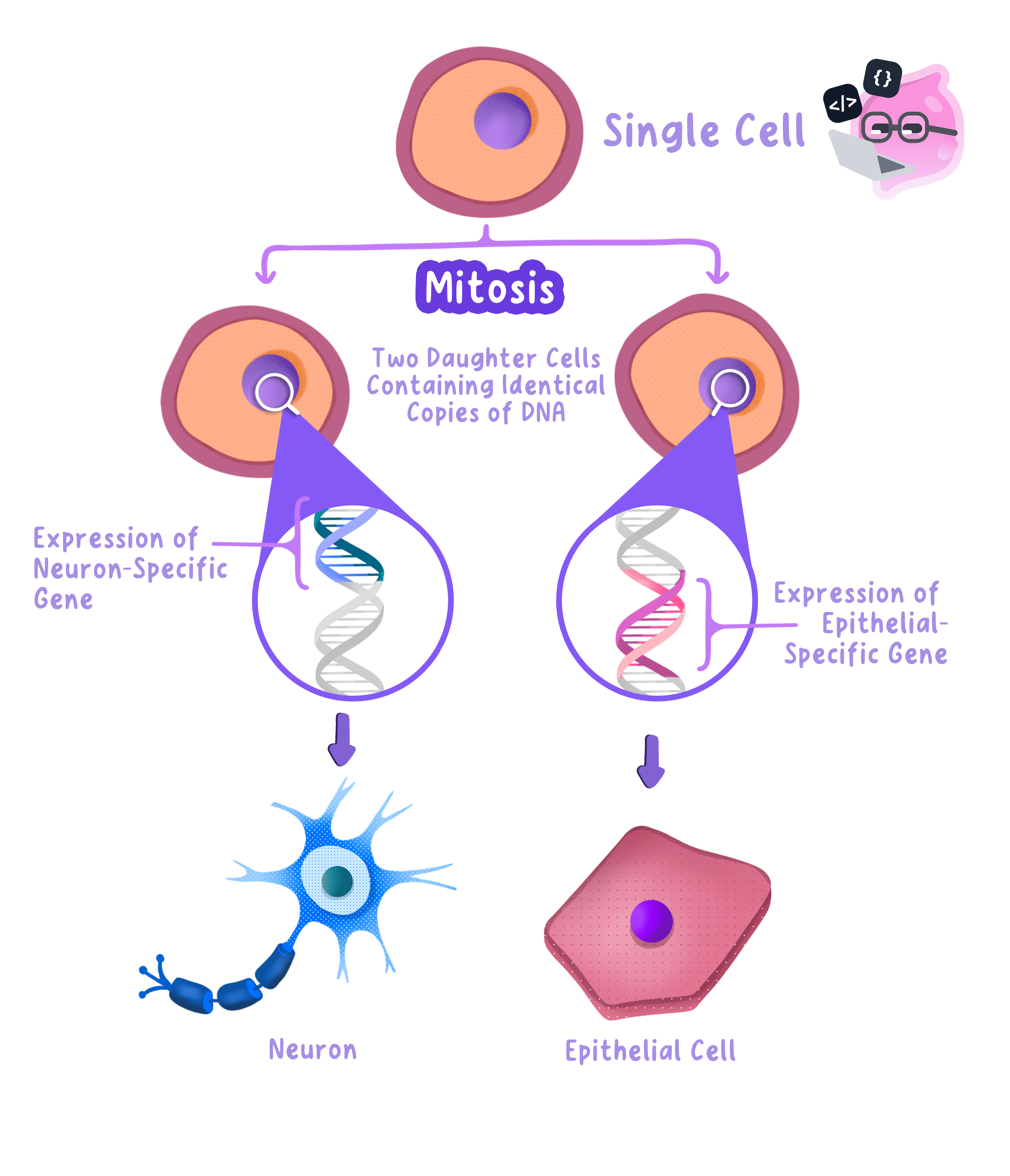
A genetic variant can change an organism either by altering a protein (coding DNA) or by changing how genes are switched on and off (non-coding DNA).
- In DNA, which base pairs with A, and which pairs with C?
- What is mRNA, and how does it differ from DNA?
- How is the order of amino acids in a protein decided?
- Why does a protein need to fold into a particular shape?
- Name the three types of point mutation.
