Inherited disorder
A condition caused by a faulty allele that is passed from parents to their offspring.
- An inherited disorder is a condition caused by a faulty allele passed from parents to offspring.
- Some disorders are caused by a recessive allele, so a person needs two copies to have the disorder.
- Others are caused by a dominant allele, so a person needs only one copy to have the disorder.
An inherited disorder is passed on through alleles, so it is not caught like an infectious disease.
Cystic fibrosis and polydactyly
Recessive allele
An allele that is only expressed in the phenotype when two copies are present.
Carrier
A person who has one recessive allele for a disorder but does not have the disorder, and can pass the allele on.
- Cystic fibrosis is a disorder of the cell membranes that causes thick, sticky mucus in the lungs and digestive system.
- It is caused by a recessive allele, so a child only has it if they inherit the faulty allele from both parents.
- A person with just one faulty recessive allele is a carrier: they do not have the disorder but can pass the allele on.
- Polydactyly, having extra fingers or toes, is caused by a dominant allele.
- Because the allele is dominant, a child can inherit polydactyly from just one affected parent.
Do not call a carrier affected: a carrier has one recessive allele and does not show the disorder.
Working out the risk
Genotype
The combination of alleles an organism has for a characteristic.
- Write the parents' genotypes using allele symbols, such as FFF for the normal allele and fff for the cystic fibrosis allele.
- Work out the gametes and combine them in a Punnett square.
- Count the offspring genotypes to find the chance of an affected child.
- For two carriers (Ff×FfFf \times FfFf×Ff), the offspring are FFFFFF, FfFfFf, FfFfFf and ffffff, so 14\frac{1}{4}41 (25%25\%25%) are affected and 12\frac{1}{2}21 are carriers.
- For a dominant disorder, a single faulty allele is enough for the child to show it.
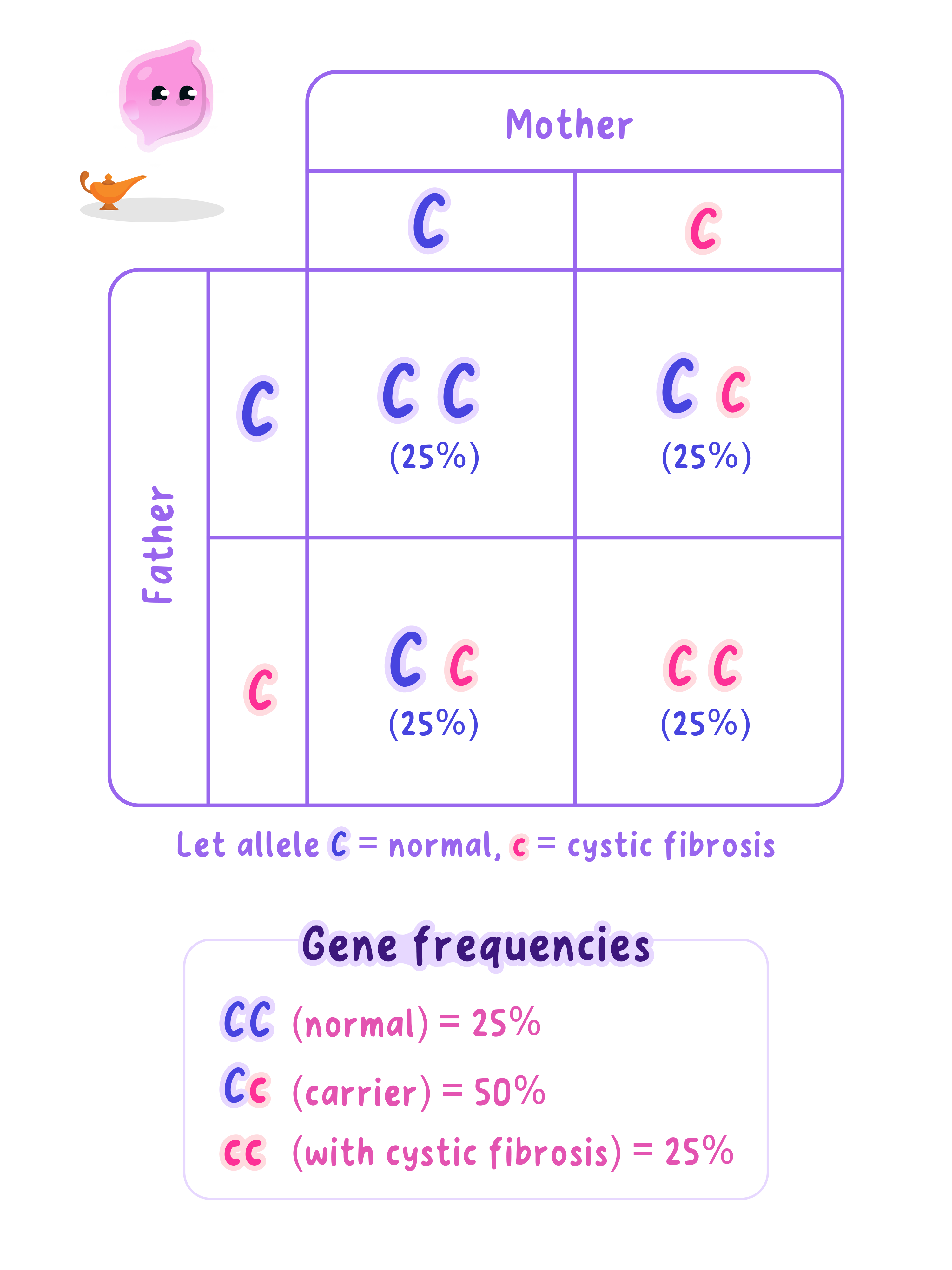
For a recessive disorder, an unaffected child can still be a carrier, so do not count carriers as affected.
Embryo screening
Embryo screening
Testing the cells of an embryo for faulty alleles before it develops, so embryos carrying a genetic disorder can be identified.
- In embryo screening, embryos made by IVF are tested for faulty alleles before one is placed in the womb.
- Embryos carrying an allele for a serious disorder can be identified and not used.
- Arguments for: it can stop children being born with serious genetic disorders and may reduce suffering and the cost of long-term treatment.
- Arguments against: it is expensive, and some people believe it is unethical to test and reject embryos.
- There are also fears that screening could later be used to choose other features, leading to so-called designer babies, or that people carrying alleles could face discrimination.
- To evaluate the issue, you weigh these economic, social and ethical points and then reach a clear judgement.
If a question says evaluate, give points for and against and finish with a conclusion, or you cap your marks.
Gene therapy
Gene therapy
An experimental treatment that tries to correct an inherited disorder by inserting a working copy of a gene into a person's cells.
- Scientists are also researching gene therapy as a way to treat some inherited disorders.
- The idea is to insert a working copy of the faulty gene into the affected person's cells.
- If the cells then make the correct protein, the symptoms of the disorder could be reduced.
- Gene therapy is still experimental and is not yet a reliable, routine cure.
Gene therapy treats the person who has the disorder; it does not remove the faulty allele from their eggs or sperm, so it can still be passed on.
- What is an inherited disorder?
- Why must the cystic fibrosis allele be inherited from both parents to cause the disorder?
- Why does polydactyly need only one allele to appear?
- What is the chance of an affected child from two cystic fibrosis carriers?
- Give one argument for and one against embryo screening.
- What is gene therapy, and how does it aim to treat an inherited disorder?
