Question 11
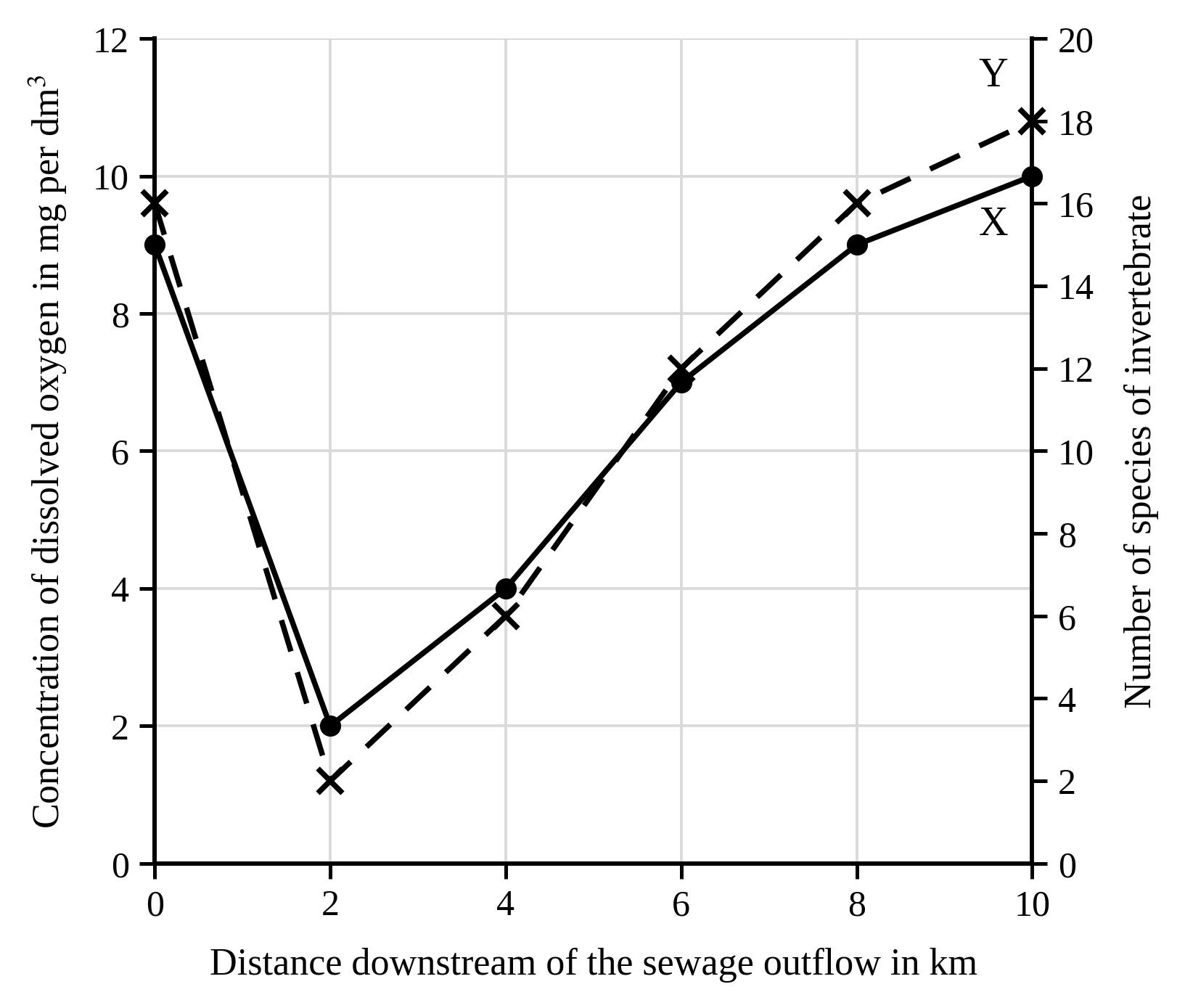
HUntreated sewage flows into a river at one point. Bacteria in the river feed on the sewage. Scientists measured the concentration of dissolved oxygen in the water and the number of species of invertebrate found, at six distances downstream of the sewage outflow. The results are shown in the figure.
Figure: The concentration of dissolved oxygen, line X, and the number of species of invertebrate, line Y, at six distances downstream of a sewage outflow
a.[3]
Explain why the concentration of dissolved oxygen falls between 0 km and 2 km downstream of the outflow.
b.[2]
Explain why the number of species of invertebrate is lowest at 2 km downstream of the outflow.
c.[3]
A water company claims that the river has fully recovered by 10 km downstream of the outflow. Use the figure to evaluate this claim.
7.1 Adaptations, interdependence and competition Questions
40 exam-style questions on AQA GCSE Biology 7.1 Adaptations, interdependence and competition, covering 7.1.1 Communities, 7.1.2 Abiotic factors, 7.1.3 Biotic factors, and 7.1.4 Adaptations. Each one has a worked solution and a mark scheme showing where the marks go.