Why Choose GCSE Geography? What Students Value
Why choose GCSE Geography? Explore fieldwork, real-world topics, useful maths skills and why many students find the subject worth taking at GCSE.
Choosing GCSE options can feel strangely permanent. You are asked to predict which subjects your future self will enjoy, often before you have seen what the full courses involve. If you are wondering why choose GCSE Geography, the short answer is that it combines real-world issues, fieldwork, data, maps and reasoned argument. Students who enjoy it often value the variety: one lesson may examine a changing city, while the next explores rivers, natural hazards or climate.
It is not the right option for everyone. There is subject knowledge to remember, case-study detail to organise and extended writing to master. Yet for students who like asking why places differ, and using evidence rather than guesses to answer that question, Geography can be a rewarding choice.
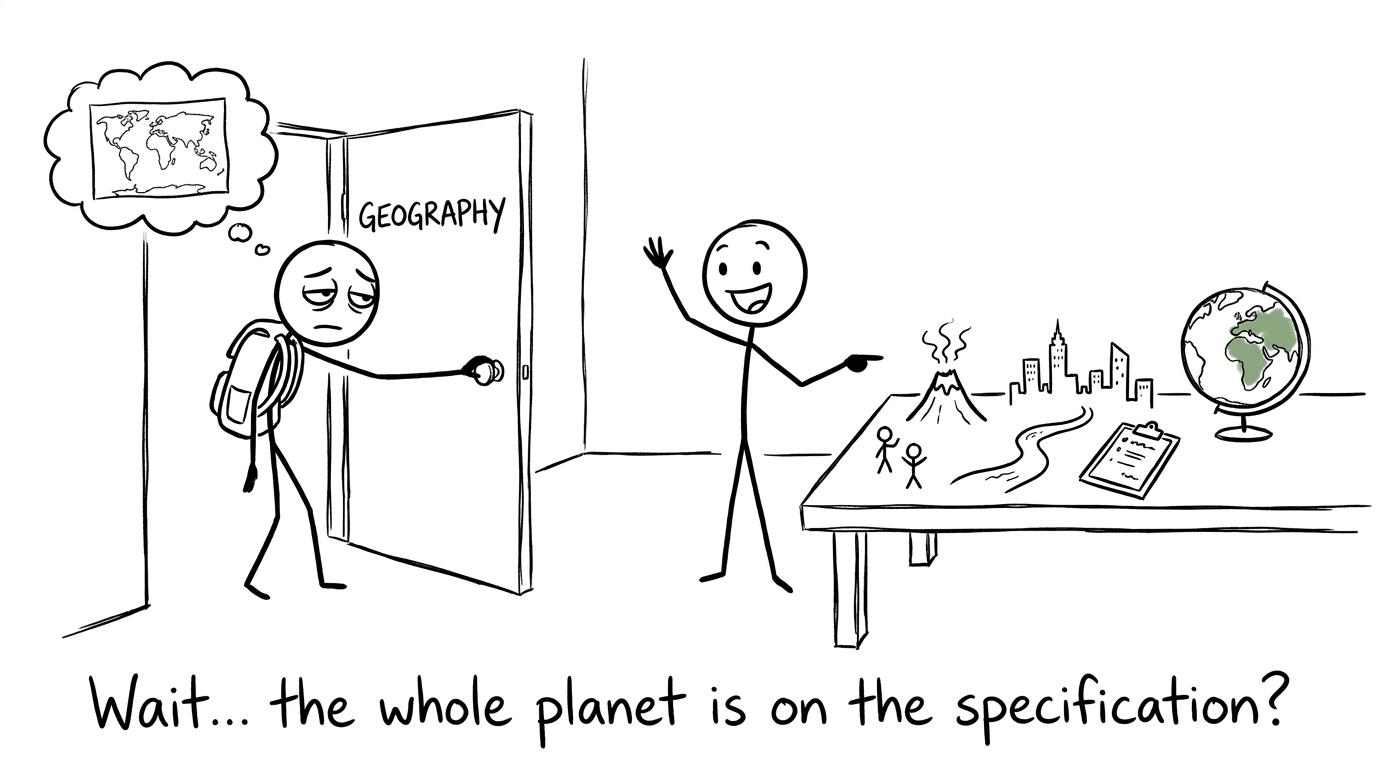 A student discovers how much of the planet appears in Geography
GCSE Geography at a glance
Before choosing, check whether the following features sound interesting to you:
- studying physical processes, people, places and environments
- investigating contemporary geographical issues
- completing fieldwork outside the classroom
- interpreting maps, photographs, graphs and numerical data
- learning named examples and case studies
- explaining connections between human and physical geography
- comparing viewpoints before reaching a justified conclusion
- writing both short answers and extended responses
The precise topics and assessment structure depend on your school and exam board. AQA, Edexcel, OCR and Eduqas specifications are not identical, so read the option booklet and ask which course your school teaches. Do not choose from the subject name alone; choose with a clear picture of the actual specification.
Why students find GCSE Geography worth choosing
It explains events beyond the classroom
Geography gives structure to questions students already encounter. Why do some communities face greater flood risk? Why do cities grow unevenly? How do coastlines change? Why can one solution help one group while creating problems for another?
The subject does not reduce these questions to isolated facts. It asks students to examine processes, evidence, impacts and possible responses. That makes the course feel connected to the world beyond an exercise book.
Students who enjoy Geography often appreciate this sense of relevance. A river is not merely a labelled diagram. It can influence settlements, habitats, farming, transport and flood management. A city is not simply a collection of buildings. It is a changing system shaped by population, employment, inequality and decisions about land.
The course contains genuine variety
Some subjects build steadily around one central language. Geography is broader. It brings together elements of science, social science, numeracy and extended writing.
Physical geography may include weather hazards, ecosystems, rivers, coasts and landscapes. Human geography may examine urban change, development, resource management and economic activity. The exact selection varies by specification, but the movement between different kinds of question is part of the appeal.
That variety can suit students who dislike spending every lesson doing the same type of task. It also means that one difficult topic does not define the whole course. A student who finds atmospheric processes demanding may feel more confident when evaluating urban regeneration or analysing fieldwork data.
Fieldwork turns ideas into something observable
Official GCSE Geography requirements in England give fieldwork an important place in the course. Students are expected to receive opportunities to investigate contrasting environments, including human and physical contexts. Their understanding of fieldwork is then assessed through examinations.
Fieldwork is more than leaving school for a day. It involves forming an enquiry question, choosing data-collection methods, considering sampling, presenting results, identifying patterns, drawing conclusions and evaluating reliability.
Students who enjoy it often remember the moment when an abstract process becomes visible. Measuring, observing and recording a real environment creates a different relationship with the content. You are no longer accepting a conclusion because it appears in a textbook; you are considering whether the evidence supports it.
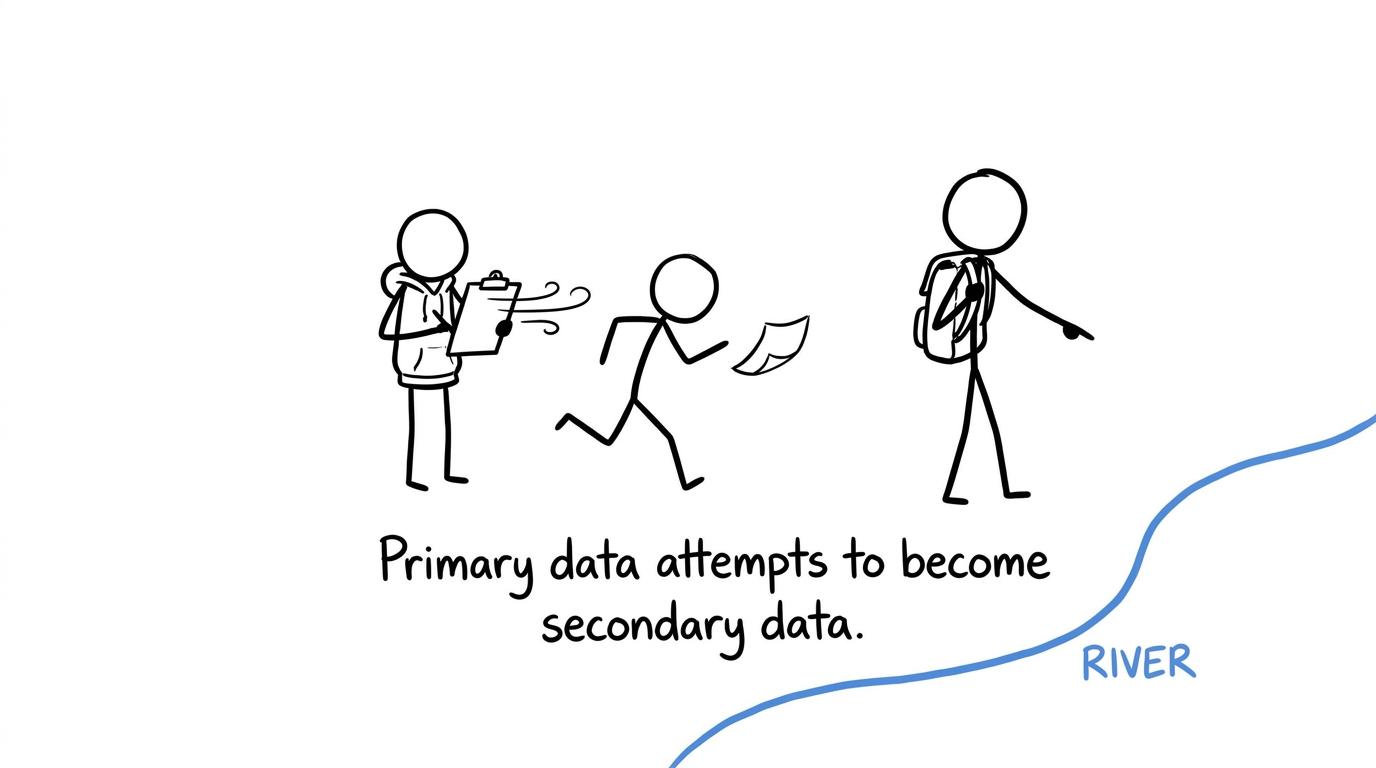 Students attempt to keep fieldwork data under control
GCSE Geography uses more maths than many expect
For GCSE Geography qualifications regulated in England, at least 10%10\%10% of the subject marks must assess appropriate mathematical and statistical techniques. That is one reason the subject can complement GCSE Maths so well.
Geographical numeracy can involve:
- ratios, proportions and percentages
- percentage increase and decrease
- mean, median, mode and range
- quartiles and interquartile range
- map scales, distance and area
- coordinates, gradients and contours
- frequency and magnitude
- scatter graphs, trend lines and relationships
- interpreting tables, charts and unfamiliar data
- considering accuracy, sample size and reliability
These are not separate pieces of maths added without purpose. They help geographers make sense of evidence. Averages can summarise fieldwork results, scale can turn a map measurement into a real distance, and a scatter graph can suggest whether two variables may be related.
If these areas feel uncertain, MathsGenie provides free lessons and practice on ratio, percentages, averages and scatter graphs. Strengthening them for maths can make geographical data questions feel much less intimidating.
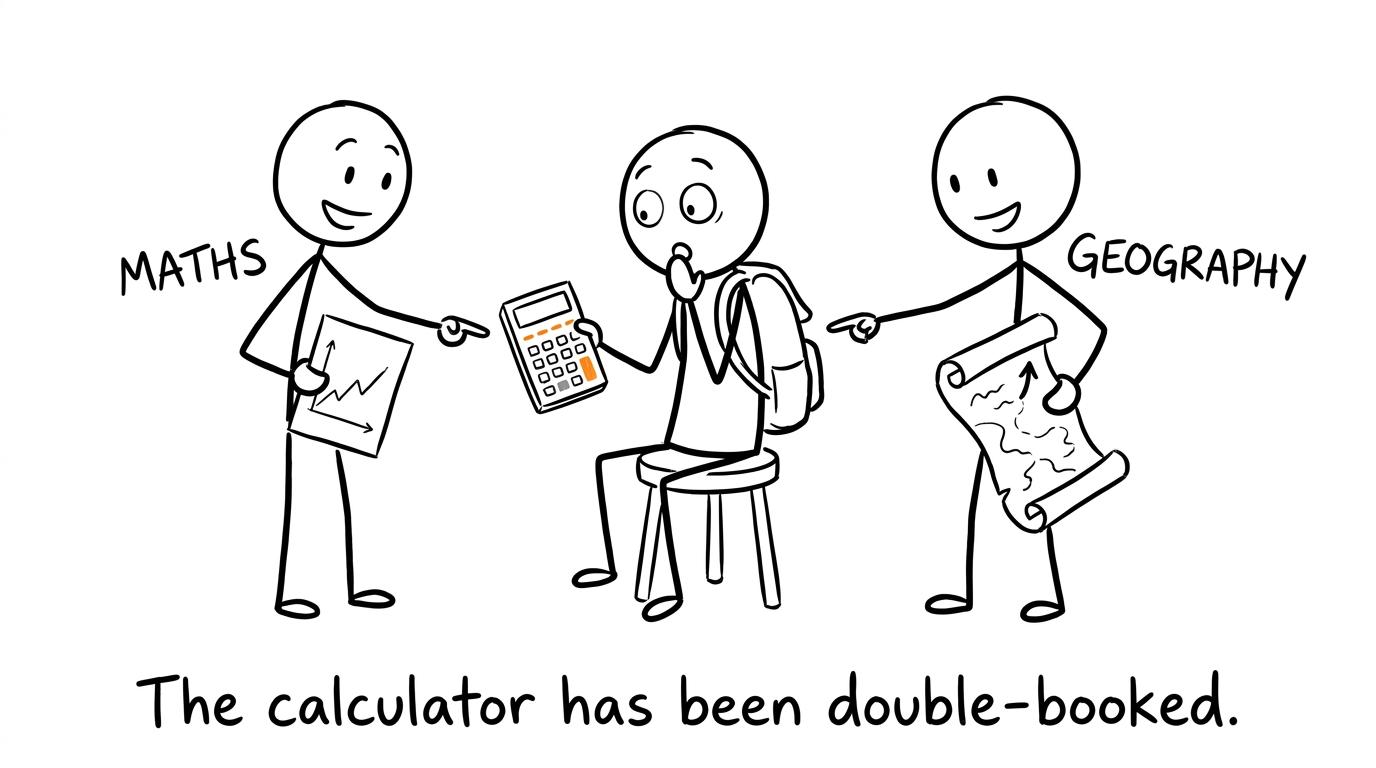 Maths and Geography discover they need the same calculator
Geography develops evidence-based writing
A strong Geography answer does more than list facts. It explains relationships, applies knowledge to a particular place or resource, weighs competing evidence and reaches a supported judgement.
This is one of the reasons students sometimes become more positive about the subject as the course progresses. At first, an extended question can look like a memory test. In reality, high-quality responses depend on selection. You must decide which knowledge is relevant, connect it to the question and explain why the evidence matters.
Geography therefore rewards a balance of knowledge and reasoning. Case studies matter, but memorising a collection of disconnected statistics is not enough. You also need to understand the process or issue those details help to explain.
This ability to build an evidence-based argument is useful across GCSE subjects. It encourages you to distinguish between description, explanation, evaluation and judgement rather than treating every command word as if it asks for the same response.
The subject encourages you to question data
Geography is not only about reading a graph correctly. It asks whether the graph tells the whole story.
Was the sample large enough? Were locations selected fairly? Could the weather have affected the measurements? Is an average hiding variation? Does a pattern demonstrate causation, or only an association? What information is missing?
These questions are central to fieldwork evaluation, but their value extends further. Maps, statistics and photographs can appear authoritative even when they present only part of an issue. Geography encourages students to inspect the source, scale, method and context before accepting a conclusion.
That habit supports maths revision too. When checking a statistical answer, consider whether the measure is suitable and whether the result makes sense. MathsGenie's GCSE Maths revision resources can help you practise the underlying techniques before applying them in geographical contexts.
When GCSE Geography may suit you
Geography may be a sensible option if you enjoy a mixture of learning rather than one narrow task. You do not need to be equally confident with essays, calculations and maps at the beginning. Those are skills the course develops.
It may suit you if you:
- are curious about how people and environments affect one another
- like interpreting evidence and spotting patterns
- are willing to learn case-study detail accurately
- enjoy discussing solutions where there is no perfect answer
- can explain ideas in writing
- want a subject combining quantitative and qualitative information
However, interest alone should not replace practical research. Ask your teacher which topics are selected, what local fieldwork normally involves and how the exam papers are structured. Exam boards can organise content and assessment differently, and specifications can change over time. Use the current information supplied by your school.
Common mistakes when deciding whether to choose Geography
Choosing it only because of a field trip
Fieldwork can be memorable, but it is one part of a substantial academic course. You will also analyse unfamiliar resources, revise processes, learn examples and write extended answers. Choose the whole subject, not one day outside school.
Assuming Geography contains no maths
Numerical and statistical skills are formally assessed. Avoiding them is not a viable revision strategy. Instead, build confidence gradually through GCSE practice questions and revisit weak topics before they appear inside a complicated geographical resource.
Thinking it is just case-study memorisation
Accurate knowledge matters, but many marks reward application, analysis, evaluation and skills. A remembered fact gains value when it is relevant and used to support an explanation or judgement.
Ignoring the specification taught by your school
AQA, Edexcel, OCR and Eduqas courses have different structures and topic choices. Advice about one course may not describe yours accurately. Check the exam board and current specification before making assumptions.
Letting one weak skill make the decision
A student can improve graph interpretation, map skills or extended writing. The better question is whether the subject's central way of thinking interests you enough to practise those weaker areas.
How Geography and Maths revision can support each other
The overlap between the subjects creates a useful revision opportunity. When you practise percentage change in maths, think about how the same skill might appear in population or environmental data. When you interpret a scatter graph in Geography, apply the same care you would use in a GCSE Maths question.
You can reinforce this connection by using GCSE past papers to practise under timed conditions. Pay attention to scales, units, calculator accuracy and the wording of conclusions. MathsGenie's predicted GCSE papers can provide further exam-style practice, while topic lessons and video solutions help diagnose the reason behind an error.
The aim is not to turn Geography into another maths lesson. It is to make sure the mathematics never blocks you from showing your geographical understanding.
A choice based on curiosity and evidence
So, why choose GCSE Geography? Choose it if you want to understand places, investigate real environments, analyse data and consider how decisions affect different people. Students who enjoy the course often value precisely that combination: the world is complicated, and Geography gives them tools for making its patterns a little clearer.
Make the decision as a geographer would. Gather reliable information, compare the advantages and demands, check your school's course and reach a justified conclusion.
Then keep the mathematical side of your revision moving. Use MathsGenie's free revision lessons, video solutions, mini tests, practice questions, mark schemes, past papers and predicted papers to strengthen the numerical skills shared by both subjects. Start with the GCSE Maths revision hub, identify one weak area and take the next manageable step.