

Who Can Sit the November GCSE Maths Resit?
Who can sit the November GCSE Maths resit? Check the age rule, entry process, tiers, private candidate options and how to prepare effectively.
A November exam can feel strangely close. One moment you are opening your summer results; the next, a teacher or exams officer is asking whether you want another attempt.
So, who can sit the November GCSE Maths resit? In England, the November GCSE maths series is available to students who are aged at least 161616 on 313131 August in the year of the exam. This includes eligible students at schools and colleges, as well as private candidates entered through an approved exam centre. It is commonly called a resit, but a previous attempt is not necessarily the deciding factor. The age rule is what matters.
For a post-16 student, the practical questions are just as important: who makes the entry, which tier should you take, and what happens if your college has already enrolled you?
November resit eligibility at a glance
Before making revision plans, check these essentials:
- You must have been aged 161616 or over on 313131 August in the year of the November exam.
- The November series includes GCSE mathematics, but availability depends on your exam board and centre.
- Your school or college can normally enter you if it offers the relevant qualification.
- Private candidates need to find an approved centre willing to accept their entry.
- You can take foundation or higher tier, subject to the options offered by your centre.
- You should confirm your exam board, specification, tier and entry status rather than assuming they remain unchanged.
- Entry deadlines come before the exams, so speak to the exams officer promptly.
The official Ofqual student guidance confirms the age rule for the November GCSE mathematics series. Exact dates, entry deadlines and administrative arrangements can change each year, so your exams officer and current exam-board information should be your final checks.
The age rule explained
Imagine a student leaving Year 11 with a GCSE maths grade that does not open the door they need. They enrol at college in September and begin a resit course. Although the course is new, their mathematical knowledge is not starting from zero. They already have a result, a set of experiences and some evidence about where marks were lost.
If that student was at least 161616 on 313131 August, they meet the age condition for the November series. The rule applies to age on that specific date, not age on the day of the first paper.
This distinction matters for younger students. Someone who turns 161616 during September, October or November does not meet that year's November age requirement because they were still 151515 on 313131 August. They would normally need to consider a later exam series instead.
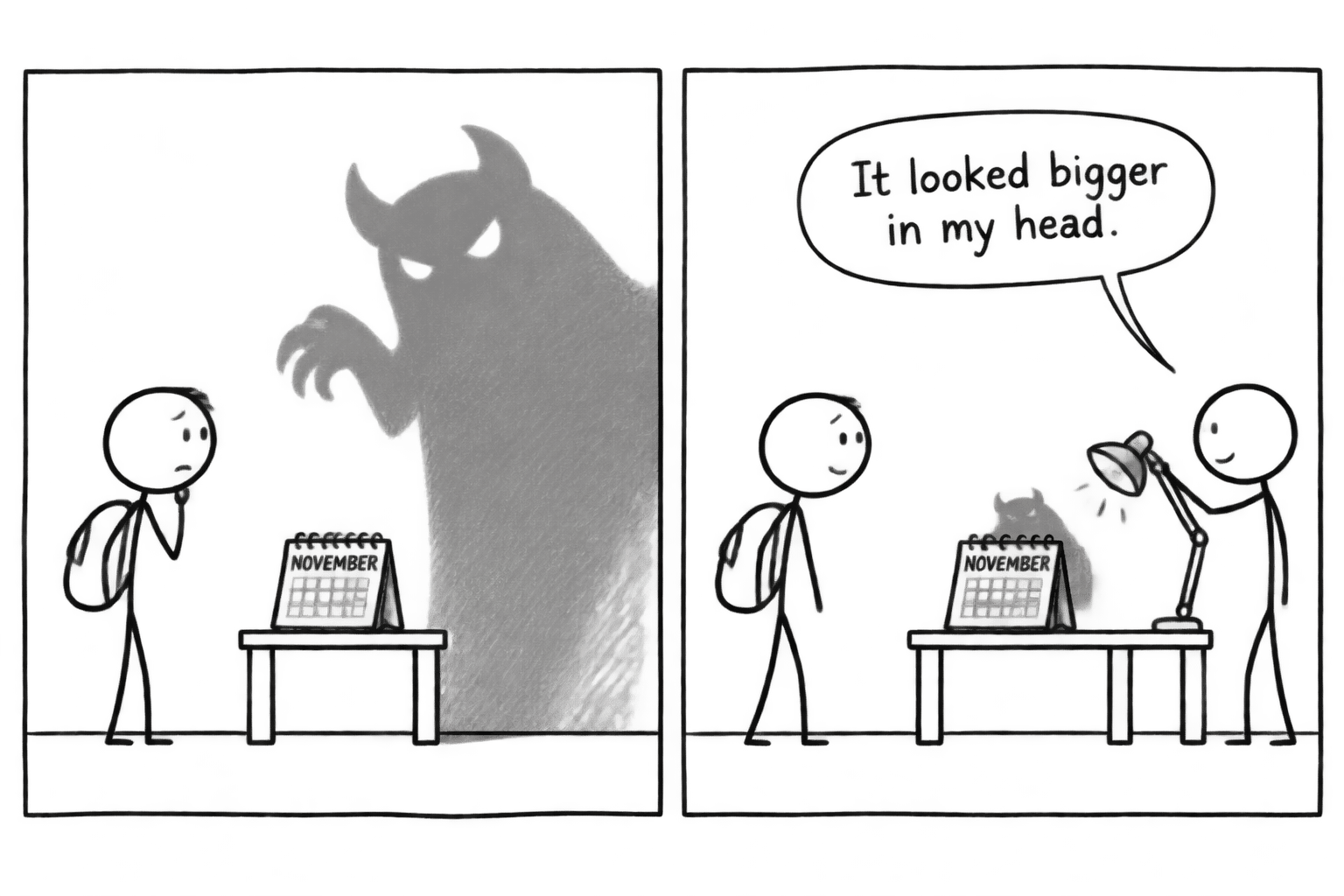 A November exam casts a much larger shadow than its calendar deserves
Do you need to have taken GCSE maths before?
The November sitting is routinely described as a GCSE maths resit because most entrants are improving a previous result. However, official guidance frames eligibility through the age restriction rather than requiring every candidate to prove a previous GCSE maths attempt.
That means an eligible candidate may be able to enter even if it is their first attempt at that particular specification. The centre still has to offer the qualification, accept the entry and complete the exam-board administration.
Do not confuse eligibility with automatic entry. Being old enough means you may be entered. It does not mean an exam board has already received your details.
How post-16 students are entered
If you attend a college or sixth form
Your college will usually decide how GCSE maths resit entries are managed. Start with your maths teacher, course tutor or exams officer. Ask them to confirm:
- whether you are entered for November;
- which exam board you will take;
- whether you are entered for foundation or higher tier;
- the dates and location of all papers;
- whether approved access arrangements are in place.
Some students are better served by a later summer entry because it provides more teaching time. November is not automatically the right choice simply because it arrives sooner. Your centre may consider your existing grade, current assessment evidence and timetable before recommending an exam series.
If you are not enrolled at a centre
A private candidate cannot enter directly without a centre. You need a school, college or independent exam centre that accepts private candidates and offers your chosen exam board and specification.
Ask for the full fee, entry deadline, paper dates and access-arrangement process before committing. Centres set their own administrative charges and do not all accept private candidates, so availability and cost vary.
Can you choose foundation or higher tier?
GCSE maths is available at foundation and higher tier. Foundation tier awards grades 111 to 555, while higher tier awards grades 444 to 999, with a narrowly missed grade 444 potentially receiving grade 333 under exam-board rules.
For many post-16 students working towards grade 444, foundation may offer the most appropriate route. But tier choice should be based on evidence, not pride. A higher paper is not a more respectable paper. It is simply designed to assess a different grade range.
Use recent assessments and full papers to judge whether you can collect marks consistently across the chosen tier. MathsGenie's GCSE maths past papers provide realistic practice, while the GCSE revision resources let you repair individual gaps before attempting another paper.
Your centre makes the formal entry, so discuss any tier change before its deadline.
A practical November resit plan
The short gap between summer results and November makes selectivity valuable. You do not need to relearn every page of GCSE maths in order. You need to identify which topics can return the most marks for the time available.
Diagnose before revising
Sit one suitable paper in timed conditions. Mark it carefully using the mark scheme and record why each mark was lost. Useful categories include:
- knowledge gap;
- incorrect method;
- calculator or arithmetic error;
- misread question;
- incomplete working;
- poor time management.
A list of weak topics is more useful than a vague feeling that you are “bad at algebra”.
Repair specific gaps
Use the MathsGenie GCSE revision page to find targeted revision lessons, videos and exam-style questions. Complete the questions without copying the method, mark them, and return to errors after a gap.
Mini tests and focused practice are especially useful when college lessons, work and travel compete for your time. A short session with a clear purpose often tells you more than an evening spent rereading notes.
Rehearse complete papers
As the exam approaches, practise the whole experience: the correct time limit, calculator rules and paper order. Use GCSE past papers and mark schemes to learn how marks are awarded, not merely whether your final answer matches.
Then use MathsGenie's GCSE Mock Exam Builder to build a targeted practice paper from past-paper questions. Choose the topics exposed by your diagnosis, sit the paper properly, and get it marked. This turns revision from a general intention into a precise response.
Common mistakes when arranging a November resit
Assuming college enrolment means exam entry
Attending a resit class does not by itself prove that an entry has been submitted. Request confirmation from the exams officer.
Missing the entry deadline
Exam boards set entry deadlines, while centres may use earlier internal deadlines. Contact the centre as soon as possible rather than waiting until revision feels complete.
Revising for the wrong board or tier
Specifications overlap substantially, but paper styles and resources differ. Confirm the exam board and tier before printing papers or building a mock.
Treating November as the only chance
November is an opportunity, not a verdict. If your centre recommends a later series, the additional teaching time may be useful. The best date is the one that gives you a credible chance of demonstrating secure knowledge.
Repeating old revision habits unchanged
More revision is not always better revision. If previous preparation consisted mainly of watching solutions, your resit plan should include independent questions, timed papers, marking and deliberate correction.
Your next step
A GCSE maths resit often sits beside a new college course, a job or responsibilities that did not exist in Year 11. That changes the shape of revision. It does not reduce what you can achieve; it makes precision more important.
First, confirm that you satisfy the age rule and that your centre has entered you for the correct exam board and tier. Then turn your previous result into useful information. Identify the marks that slipped away and practise retrieving them under exam conditions.
Start with the MathsGenie Mock Exam Builder and create a targeted practice paper around the topics you need most. Sit it, mark it and let the result decide what you revise next.















