

Which Exam Board Is Hardest for GCSE Maths?
GCSE exam board difficulty explained: Edexcel vs AQA vs OCR vs Eduqas. Learn what really changes, how to revise, and practise smarter.
The question every GCSE student asks (quietly)
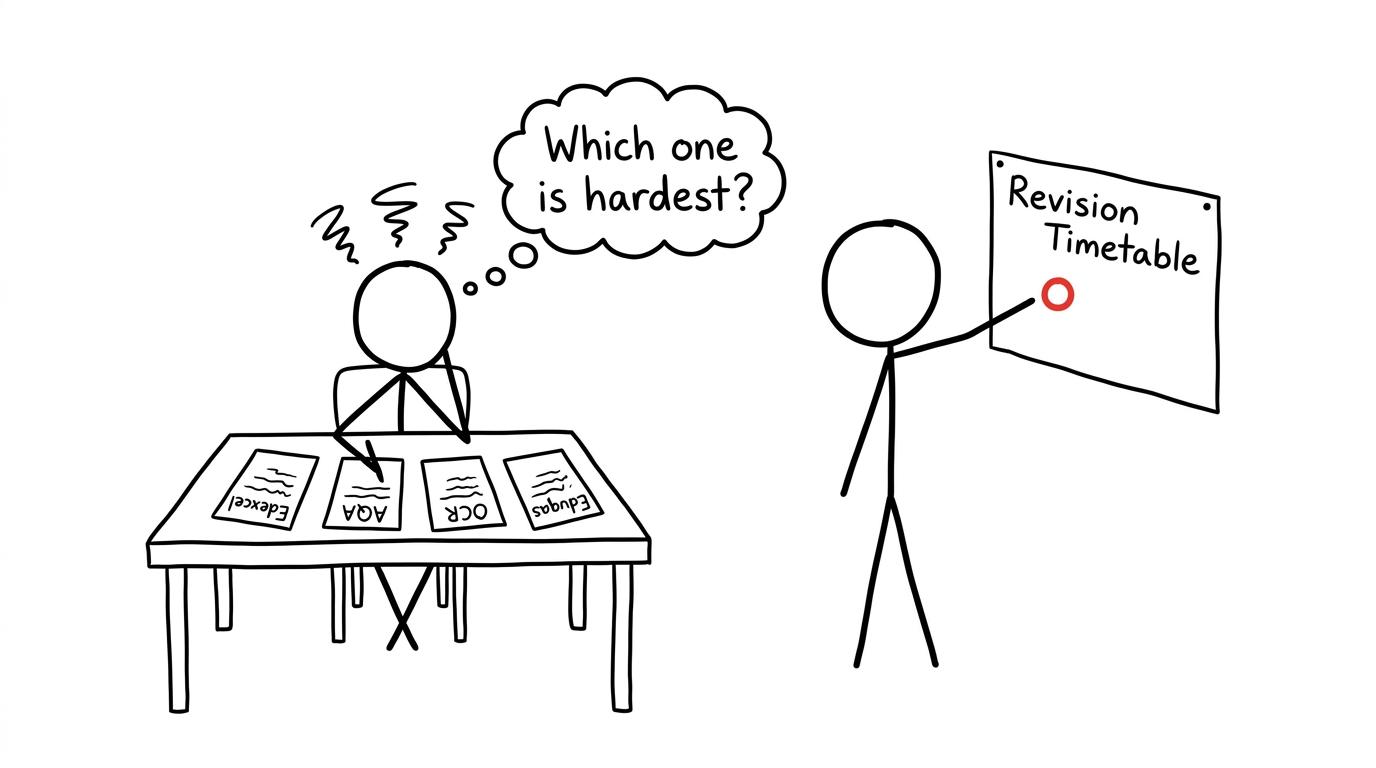
Somewhere between your first set of mocks and that moment you open a past paper and feel your stomach drop, a thought appears: which exam board is hardest? It sounds like a sensible question. If you could just name the toughest GCSE maths exam board: Edexcel, AQA, OCR or Eduqas such as you might finally understand why that last paper felt brutal.
But difficulty isn’t a fixed property of an exam board. It’s a relationship: between you, the specification, the style of questions, and the habits you’ve built. The reassuring truth is that exam boards are designed to be comparable. The useful truth is that they still feel different, and that feeling can change how you revise.
 Stressed student comparing exam boards
This post will help you:
- understand what “hardest” really means in GCSE maths
- spot the differences in question style across Edexcel, AQA, OCR and Eduqas
- use Maths Genie to revise in a way that works across boards
- practise the types of marks students tend to lose, regardless of paper
Along the way, you’ll get a couple of worked examples and a revision plan you can actually stick to.
A quick checklist before you blame the exam board
Before deciding an exam board is the villain of your story, check these first:
- Are you on foundation or higher tier? The same topic can feel completely different in the top end of higher.
- Are you mixing specifications? Some schools teach Edexcel but you might be practising AQA papers.
- Are you marking properly? If you don’t use a mark scheme, every method mark becomes invisible.
- Are you practising under time? A paper can feel “hard” when you’re simply rushed.
For practical practice that mirrors the real thing, build revision around:
- GCSE predicted papers
- GCSE target tests (grades 4-6 and 7-9)
- GCSE maths resources and revision materials
Are GCSE exam boards actually comparable?
Yes, in the way that matters most. In England and Wales, GCSE maths exam boards are regulated to ensure standards are comparable over time and across boards. Grade boundaries move because paper difficulty shifts year to year, and exam boards aim for similar outcomes.
So why do students still argue about the “hardest”?
Because difficulty has flavours:
- One board might like multi-step problem solving.
- Another might reward clear algebraic structure.
- Another might include more functional contexts.
None of that breaks comparability, but it changes what feels unfamiliar. And unfamiliar is what your brain labels as “hard”.
If you’re revising for GCSE maths, the goal is not to find the easiest board. The goal is to become the kind of student for whom any board feels readable.
What really changes between Edexcel, AQA, OCR and Eduqas?
The topics are broadly the same
At GCSE, the core content is largely shared: number, algebra, ratio and proportion, geometry and measures, probability, and statistics. Foundation vs higher changes the depth and linking, not the existence of most topics.
That’s why a solid topic-by-topic approach is so powerful. If your algebra is secure, it tends to travel well.
Use:
- GCSE maths revision to organise your topic list
- GCSE maths resources to fill in gaps
The “house style” differs
Here’s what tends to vary most:
- Question phrasing and scaffolding: some papers give more hints through structure, others expect you to choose a method earlier.
- Proportion of problem solving: higher tier papers across all boards include it, but the balance changes.
- Marking emphasis: method marks are common everywhere, but some mark schemes are more explicit about what earns them.
And crucially: your perception of difficulty will depend on which style matches how you were taught.
To practise your specific board, Maths Genie has board-specific paper pages:
If you’re not sure which one you take, check the front of your mock paper or ask your teacher. It’s a small question that saves hours.
The most honest answer: the hardest exam board is the one you haven’t practised
There’s a quiet pattern in GCSE maths revision:
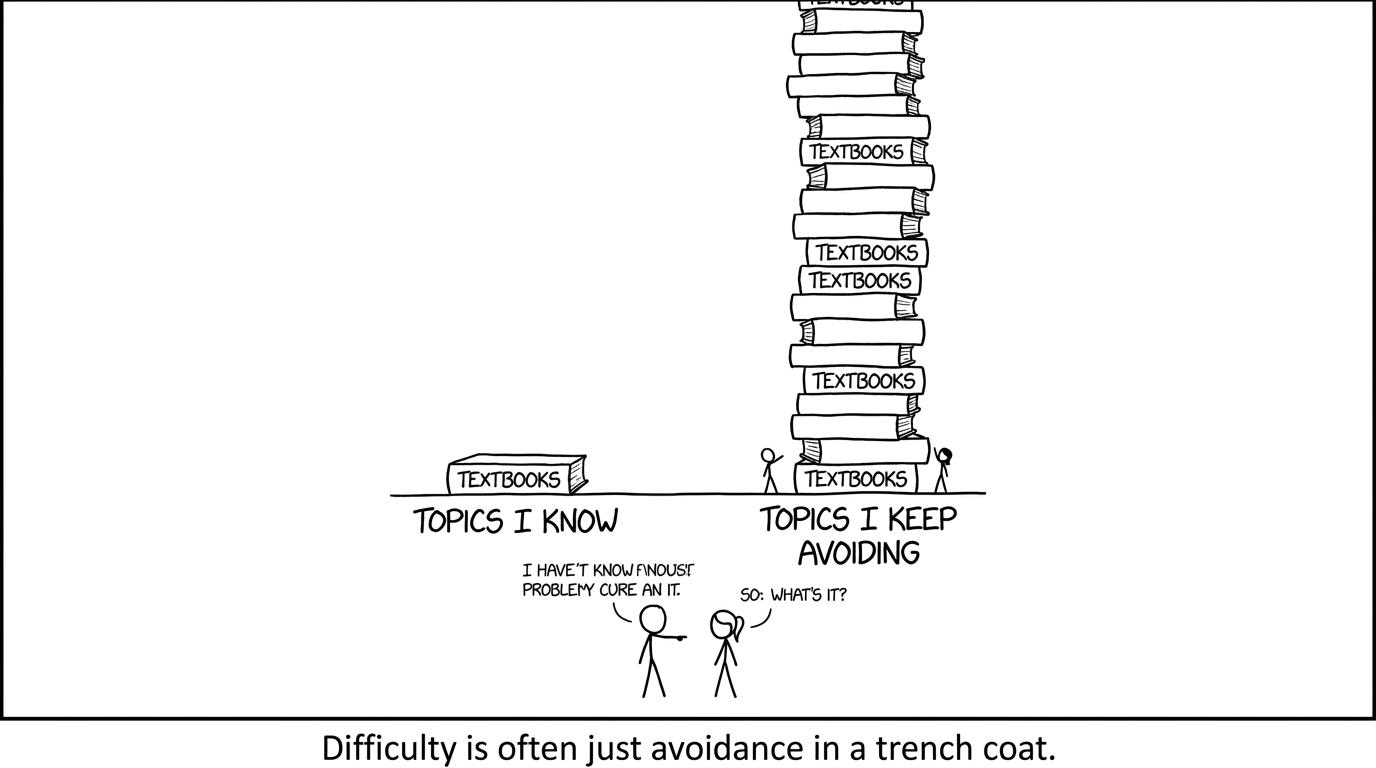
- Students do five algebra worksheets.
- They avoid geometry because it feels “wordy”.
- They do one past paper and decide the exam board is cruel.
But what’s really happened is a mismatch between your practice diet and the exam’s full menu.
 Avoided topics stack
If you want exam-board-proof revision, rotate:
- topic lessons (build skills)
- exam questions by topic (build fluency)
- full papers (build stamina and decision-making)
Maths Genie is built for exactly that workflow, especially when you combine revision lessons with mark schemes and video solutions.
Worked example: why “hard” questions are often just careful algebra
A lot of higher tier GCSE difficulty comes from linking two familiar ideas. Here’s a classic example where students feel the question is “exam board specific”, but it’s really just method.
Example 1: forming and solving a quadratic from geometry
A rectangle has sides (x+3)(x+3)(x+3) cm and (x−1)(x-1)(x−1) cm. Its area is 40 cm240\text{ cm}^240 cm2. Find xxx.
Step 1: Form the equation
Area === length ×\times× width:
(x+3)(x−1)=40 (x+3)(x-1)=40 (x+3)(x−1)=40Step 2: Expand
(x+3)(x−1)=x2−x+3x−3=x2+2x−3 (x+3)(x-1)=x^2- x+3x-3=x^2+2x-3 (x+3)(x−1)=x2−x+3x−3=x2+2x−3So:
x2+2x−3=40 x^2+2x-3=40 x2+2x−3=40Step 3: Rearrange
x2+2x−43=0 x^2+2x-43=0 x2+2x−43=0Step 4: Solve (quadratic formula)
x=−2±22−4×1×(−43)2=−2±4+1722=−2±1762 x=\frac{-2\pm\sqrt{2^2-4\times 1\times (-43)}}{2} = \frac{-2\pm\sqrt{4+172}}{2} = \frac{-2\pm\sqrt{176}}{2} x=2−2±22−4×1×(−43)=2−2±4+172=2−2±176 176=16×11=411 \sqrt{176}=\sqrt{16\times 11}=4\sqrt{11} 176=16×11=411So:
x=−2±4112=−1±211 x=\frac{-2\pm 4\sqrt{11}}{2}=-1\pm 2\sqrt{11} x=2−2±411=−1±211Step 5: Choose the valid value
Since x−1x-1x−1 must be positive, x>1x>1x>1. Therefore:
x=−1+211 x=-1+2\sqrt{11} x=−1+211That’s not “hard because OCR” or “hard because Edexcel”. It’s hard because it demands calm steps.
If quadratics are your weak spot, build it up with topic practice and exam questions on Maths Genie before returning to full papers.
Worked example: the marks you lose are usually not the big idea
For foundation and higher GCSE, a surprising number of marks disappear in small slips: unit conversions, scale factors, and rounding.
Example 2: compound measures with unit conversion
A car travels 18 km18\text{ km}18 km in 24 minutes24\text{ minutes}24 minutes. Find the average speed in m/s\text{m/s}m/s.
Step 1: Convert distance to metres
18 km=18×1000=18000 m 18\text{ km}=18\times 1000=18000\text{ m} 18 km=18×1000=18000 mStep 2: Convert time to seconds
24 minutes=24×60=1440 s 24\text{ minutes}=24\times 60=1440\text{ s} 24 minutes=24×60=1440 sStep 3: Use speed=distancetime\text{speed}=\frac{\text{distance}}{\text{time}}speed=timedistance
speed=180001440=1800144=252=12.5 \text{speed}=\frac{18000}{1440}=\frac{1800}{144}=\frac{25}{2}=12.5 speed=144018000=1441800=225=12.5So the average speed is 12.5 m/s12.5\text{ m/s}12.5 m/s.
This is exactly the kind of question students label “annoying”. But it’s also one of the easiest places to gain reliable marks in GCSE maths.
How to revise so any GCSE exam board feels fair
Use papers, but use them like a scientist
A past paper is not just a score. It’s a data set.
After each paper, write down:
- the topic you lost marks on
- whether it was method, accuracy, or exam technique
- the quickest fix you can do in the next 48 hours
Then return to practice:
- GCSE target tests for focused grade practice
- GCSE predicted papers to rehearse the feel of a real paper
Practise board style, but build universal skills
If you do AQA, do AQA papers. If you do OCR, do OCR papers. That’s sensible.
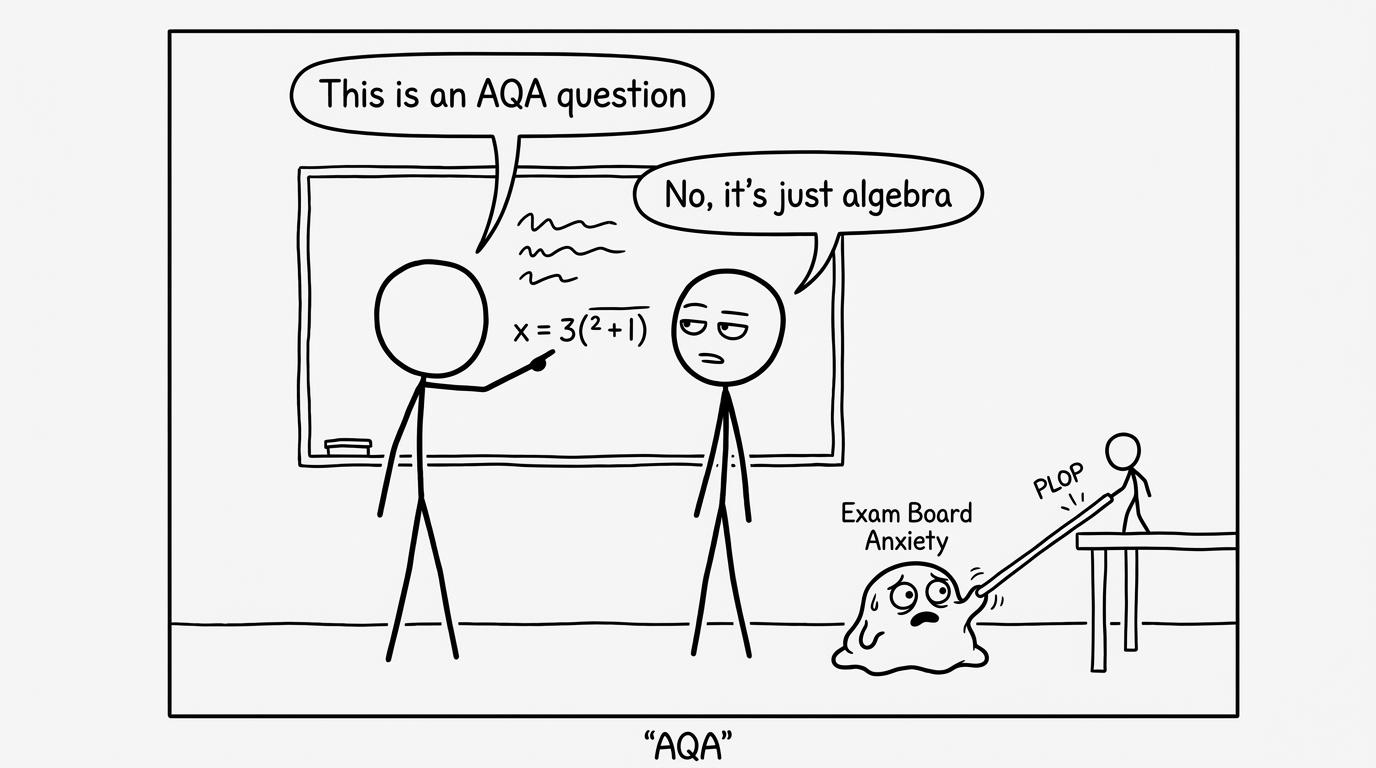
But don’t become dependent on one flavour of question layout. In the final weeks, it’s valuable to attempt a paper from another board as a stress test. If you can still find your way through, you’ve built real GCSE competence.
 Exam board anxiety creature
Don’t ignore A Level students: this mindset scales
If you’re doing A Level maths, you’ll recognise this whole debate in a new outfit. People ask which A Level board is hardest too. The same rule applies: papers feel harder when your practice doesn’t match the specification’s habits.
Maths Genie’s A Level section helps you build skills in a structured way:
Common mistakes when comparing GCSE exam boards
- Comparing one paper to an entire board: one difficult higher paper does not make a board “harder”.
- Ignoring tier: foundation papers can feel easier, but grade ceilings change what you’re aiming for.
- Not using the mark scheme: you may be losing method marks you didn’t realise you earned.
- Confusing unfamiliar wording with new content: many “new” questions are old skills in different clothing.
- Only practising your favourite topics: this creates the illusion that the exam board is unpredictable.
So, which exam board is hardest?
For GCSE maths, the hardest exam board is usually the one you’ve practised least, marked least honestly, and feared the most.
If you want the advantage that compounds, do this:
- learn the topic with Maths Genie revision lessons
- practise exam questions by topic until methods feel automatic
- sit full papers, then mark with the mark scheme and watch solutions
- repeat with predicted papers as the exams get close
Start here and keep it simple:
- GCSE maths revision
- GCSE predicted papers
- AQA GCSE papers
- OCR GCSE papers
- Eduqas GCSE papers
- GCSE target tests
- Maths Genie resources
Revision works best when it’s boring in the right way: small steps, repeated, marked carefully. Do that, and whichever exam board turns up in June won’t feel like a mystery. It’ll feel like a paper you’ve already met, just with different stationery.










