What to Revise in November of Year 13 Maths
What to revise in November of Year 13 Maths: prioritise Year 12 gaps, current topics and exam practice with a realistic weekly revision plan.
November can feel strangely early and uncomfortably late at the same time. The final exams are still months away, yet Year 13 lessons are moving quickly and earlier topics may already feel less secure than they did in summer.
If you are wondering what to revise in November of Year 13 Maths, focus on three things: repairing important Year 12 gaps, consolidating each new Year 13 topic and completing a small amount of mixed exam practice every week. This is not the month for attempting every past paper. It is the month for building a system that prevents small weaknesses from becoming spring problems.
A strong November revision plan should include:
- one short diagnostic check at the beginning of the month;
- regular retrieval of Year 12 pure maths;
- same-week practice of current Year 13 lessons;
- weekly statistics and mechanics practice;
- mixed questions completed without notes;
- time to correct errors and revisit them later.
The precise order of content differs between schools and exam boards, so use your specification and class schedule rather than assuming every Year 13 student should be revising identical chapters.
Where November fits into Year 13
Imagine a student called Sam. This is a hypothetical student, but the situation is familiar. Sam leaves each lesson understanding most of the work, finishes the assigned questions and assumes revision can begin properly after Christmas.
The difficulty is not effort. It is timing.
A Level Maths is cumulative. Differentiation can depend on confident algebra and trigonometry. Integration can expose weak manipulation of indices. Mechanics often becomes harder because the modelling is unfamiliar, even when the underlying algebra is manageable. If Sam waits until spring, revision must repair old knowledge while new content is still arriving.
November has a quieter purpose. It connects learning to remembering.
Your target is not to become exam-ready in four weeks. It is to finish the month with fewer hidden gaps, stronger recall and an honest record of what needs attention next. MathsGenie's A Level Maths revision resources provide topic-based practice for organising that process, while the revision planning guide can help you place it within the wider year.
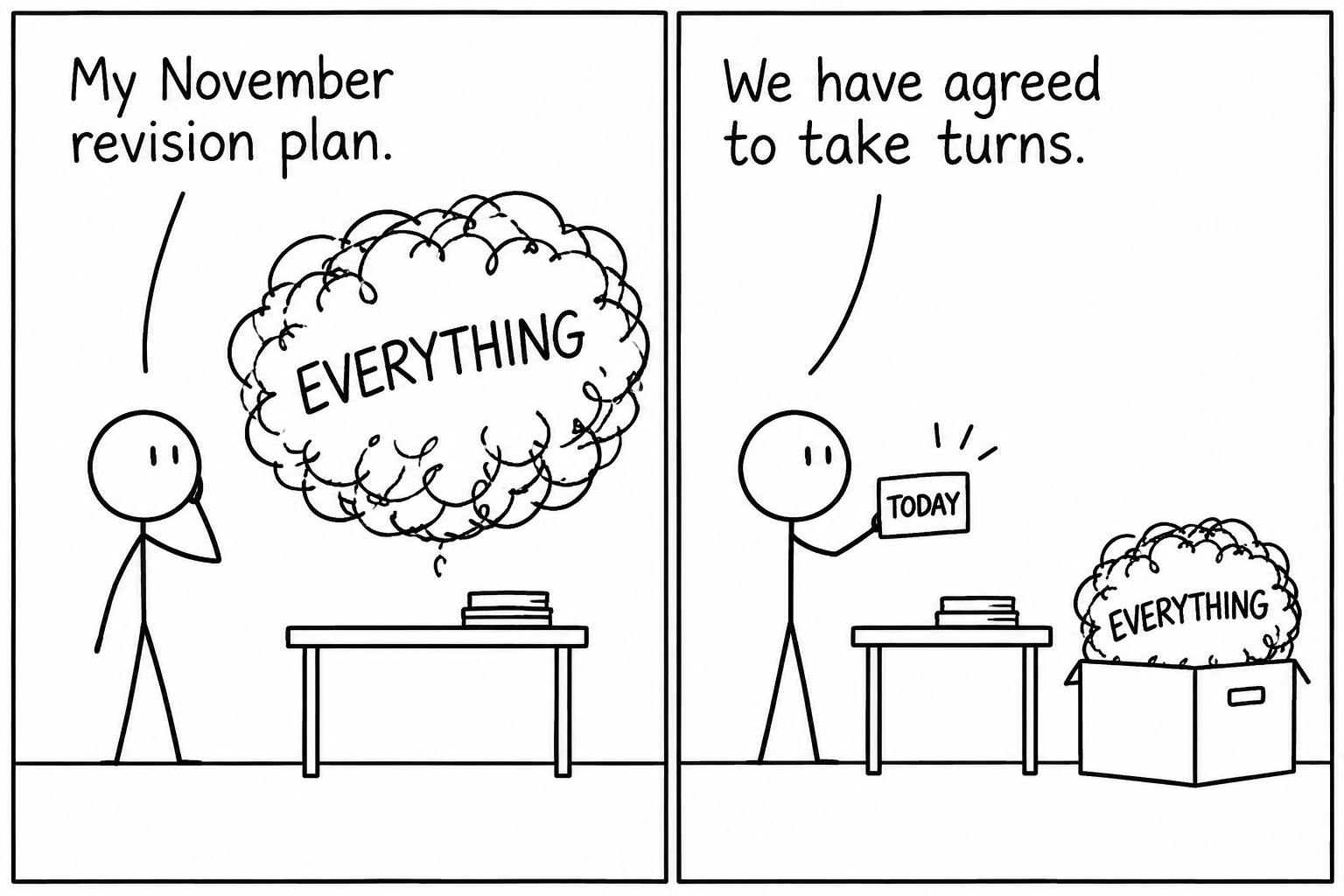 A Year 13 student reducing a huge cloud labelled everything to one manageable card labelled today
Your November priorities
Diagnose before adding more revision
Begin with evidence. Choose a mixed set of questions from topics you have already covered and complete it without notes. This might be a mini test, selected practice questions or part of an appropriate past paper.
Mark it carefully. Then classify each lost mark:
- Knowledge: you could not recall a fact, definition or method.
- Algebra: the main method was correct, but manipulation caused the error.
- Application: you knew the technique but did not recognise where to use it.
- Accuracy: a sign, arithmetic or calculator error changed the answer.
- Communication: the working did not justify the conclusion clearly enough.
This turns a vague feeling such as “I am bad at calculus” into something actionable. Perhaps the real issue is rearranging expressions before differentiating, or forgetting when the chain rule is required.
Secure the Year 12 foundations
Do not restart the whole Year 12 course from page one. Prioritise topics that support much of Year 13:
- algebraic manipulation, indices and surds;
- equations, inequalities and functions;
- coordinate geometry;
- trigonometric identities and equations;
- exponentials and logarithms;
- differentiation and integration;
- vectors;
- core probability and statistical methods;
- kinematics and forces.
For each weak area, use a simple sequence: recall the method, complete focused practice, mark the work and return to one or two similar questions several days later. The delay matters because a method that feels obvious immediately after a lesson may be difficult to retrieve next week.
Consolidate current Year 13 teaching
New content should not wait for a holiday revision block. Within a few days of each lesson, attempt questions without copying the model solution. If you become stuck, identify the exact line where your reasoning failed before checking notes or a video solution.
For example, when working with calculus, ask whether you can:
- identify the appropriate rule;
- perform the required algebra accurately;
- interpret the derivative or integral in context;
- check whether an answer is plausible;
- present enough working for the mark scheme.
The same principle applies to whichever pure, statistics or mechanics topics your class is covering. November revision should follow teaching closely enough to stop uncertainty accumulating.
Keep all strands active
Pure maths can easily occupy every revision session because it contains so many connected techniques. Statistics and mechanics then disappear until a test approaches.
Keep both present each week. In statistics, practise choosing methods and interpreting results, not merely carrying out calculator procedures. In mechanics, draw or describe the model before forming equations. State directions clearly and distinguish between quantities such as velocity and speed.
MathsGenie's A Level past papers can supply mixed exam questions, but use them selectively in November. A few carefully reviewed questions are more useful than rushing through a complete paper and ignoring the mark scheme.
A weekly November revision template
This template is designed to fit around lessons and homework. Adjust the duration to your commitments, but preserve the balance between current work, old knowledge and mixed retrieval.
| Session | Main purpose | Suggested approach |
|---|---|---|
| Monday | Current Year 13 pure topic | Review from memory, then answer focused questions |
| Tuesday | Year 12 foundation | Repair one diagnosed weakness and record errors |
| Wednesday | Statistics or mechanics | Alternate the strand each week and practise interpretation or modelling |
| Thursday | Current class content | Complete questions without notes, then check the method |
| Weekend | Mixed retrieval | Attempt a mini test or selected exam questions under timed conditions |
| Weekend follow-up | Corrections | Use the mark scheme, rewrite weak solutions and schedule a retest |
Sam's plan becomes manageable once each session has one job. Monday is no longer “revise maths”. It is “complete six questions on this week's pure topic, mark them and record two errors”. Specific plans reduce the time spent deciding what to do.
If setting up this weekly structure feels like another task, you can build your November schedule in the MathsGenie Revision Planner instead of repeatedly drawing it out by hand.
A four-week November plan
Week one: find the gaps
Complete a mixed diagnostic and inspect recent class tests. Select no more than three priority weaknesses. Also consolidate the newest Year 13 topic while it is fresh.
Week two: repair and retrieve
Work on the first two weaknesses through focused practice. Reattempt questions you previously answered incorrectly. Include one statistics or mechanics session and one short mixed test.
Week three: connect the topics
Introduce questions that combine skills. A calculus question may require trigonometry or exponentials; a mechanics problem may depend on simultaneous equations. Continue practising current class material.
Week four: test the improvement
Retest the three priorities without notes. Compare your errors with the first diagnostic. Keep unresolved weaknesses on December's plan and remove topics that are now consistently secure.
The goal is not a perfect score. It is reliable evidence that your revision is changing what you can do independently.
How to make each session count
Use active work for most of the session. Reading notes can remind you what a method looks like, but exam success depends on selecting and carrying out that method yourself.
A useful session has four stages:
- Write down what you remember before opening notes.
- Attempt a small set of relevant questions.
- Mark the work using the supplied answers or mark scheme.
- Record one next action and schedule a later retest.
Keep an error log, but make it brief. Record the topic, the cause of the error, the corrected idea and the date you will revisit it. For instance, if you differentiated a composite function incorrectly, the useful note is not simply “chain rule”. Write the structure you missed and include a fresh question for the next review.
When using A Level practice papers, separate completion from review. Mark schemes show the standard expected, while video solutions can help you locate the point where your reasoning diverged. The learning often happens after the first attempt.
Common November revision mistakes
Trying to revise the entire course
A list containing every specification statement is not yet a plan. Choose priorities using test evidence, teacher feedback and the dependency between topics.
Revising only comfortable topics
Familiar questions create reassuring sessions, but improvement usually comes from working just beyond what is currently secure. Keep some confidence-building practice, then address a genuine weakness.
Watching solutions before attempting questions
A clear explanation can create the feeling of understanding without testing recall. Attempt first, even if the attempt is incomplete, and then use the solution diagnostically.
Completing papers too early and too often
Full papers are valuable, but November usually calls for selective use. If substantial Year 13 content remains untaught, topic practice and mixed sections give clearer feedback than repeatedly measuring unfinished knowledge.
Ignoring corrections
A marked question is not automatically a learned question. Redo it without the solution and attempt a related question later. Otherwise, the same error can return in the next assessment.
Build your November schedule
Sam's problem was never a lack of ambition. It was the gap between knowing that revision mattered and deciding what to do on an ordinary Tuesday. Your exams have fixed dates, so each week without a workable routine is revision time you cannot recover later.
You have seen how to balance Year 12 foundations, current Year 13 content and mixed practice. Your turn: build your November schedule in the MathsGenie Revision Planner.