

What to Revise in March of Year 11 Maths
What to revise in March of Year 11 Maths: follow a practical weekly plan, tackle weak topics and prepare for GCSE papers without burning out.
March has an awkward place in Year 11. The GCSE exams are close enough to feel real, but far enough away for revision to remain strangely easy to postpone. A student can spend an evening making a beautiful timetable and still avoid the question that matters: what should I actually do tomorrow?
If you are deciding what to revise in March of Year 11 Maths, focus on three things: diagnose your weak areas, repair important topic gaps and begin regular exam-paper practice. Do not try to revise the entire specification in order. March is the month for turning an indistinct list of worries into a manageable routine.
This guide follows a typical Year 11 student through that process and gives you a weekly template you can adapt for foundation or higher tier. For the wider strategy around it, start with the MathsGenie GCSE revision resources.
Your March revision checklist
By the end of March, aim to have:
- confirmed your exam board and tier;
- completed a short diagnostic paper or mixed set of questions;
- identified roughly five priority topics;
- relearned the methods behind those weaknesses;
- practised those topics without notes;
- completed timed sections from exam papers;
- recorded recurring mistakes and reviewed them each week;
- planned how your routine will continue into Easter.
This is not a demand for perfection. It is a direction of travel. Your school may still be teaching parts of the specification, so coordinate independent revision with lessons, mocks and your teacher's advice.
Where March fits into Year 11 maths revision
Imagine a student called Sam. This is a hypothetical example, but the problem is familiar. Sam reaches March with mock results, a folder of half-finished worksheets and the uneasy belief that everything needs attention at once.
It does not.
Earlier in Year 11, revision is often about building knowledge and preparing for mocks. Nearer the final exams, full papers, timing and exam decisions become more important. March sits between those stages. Sam still needs to repair topic gaps, but must also begin joining topics together under exam conditions.
That makes March a bridge:
| Stage | Main purpose |
|---|---|
| Start of March | Diagnose gaps and choose priorities |
| Middle of March | Relearn methods and complete focused practice |
| End of March | Mix topics, practise timed sections and plan Easter |
A useful balance is to spend more time on targeted topics at the beginning of the month, then gradually introduce more mixed and timed work. A full paper can identify weaknesses, but repeatedly sitting papers without correcting those weaknesses is like checking a leaking roof without repairing it.
What to revise in March of Year 11 Maths first
Sam begins with evidence rather than instinct. Students often revise comfortable topics because successful questions feel productive. Yet revision should reduce future mistakes, not merely confirm what you already know.
Use a mock paper, past paper or mixed assessment to divide topics into three groups:
- Red: you cannot start reliably or misunderstand the method;
- Amber: you know the method but make errors or need prompts;
- Green: you can solve varied questions independently.
Choose a small set of red and amber priorities. Give extra attention to topics that underpin other work, such as fractions, percentages, ratio, algebraic manipulation, solving equations, graphs and basic geometry. Your exact list must come from your own performance and tier, not somebody else's revision timetable.
Check each priority against the requirements for your exam board and ask your teacher if you are unsure. Foundation and higher papers overlap in places, but they are not identical. Revision time is limited, so practise material that belongs to your course.
A weekly March revision plan
Sam now needs a routine that can survive ordinary school life. A plan with four focused sessions is often more useful than one that assumes every evening will be perfect.
Use this template and adjust the session length to suit your workload:
| Session | Activity | Purpose |
|---|---|---|
| Session 1 | Learn or refresh one weak topic | Rebuild understanding |
| Session 2 | Answer focused questions without notes | Develop independent recall |
| Session 3 | Complete mixed or timed exam questions | Practise choosing methods |
| Session 4 | Mark, correct and revisit mistakes | Turn errors into future marks |
A session can follow a simple structure:
- spend a few minutes recalling the method from memory;
- use a revision lesson or video solution if the method is unclear;
- answer practice questions without copying a model answer;
- check the mark scheme;
- redo incorrect questions after a delay.
If setting up four weeks by hand feels like revision before the revision, use the MathsGenie Revision Planner to build your March schedule.
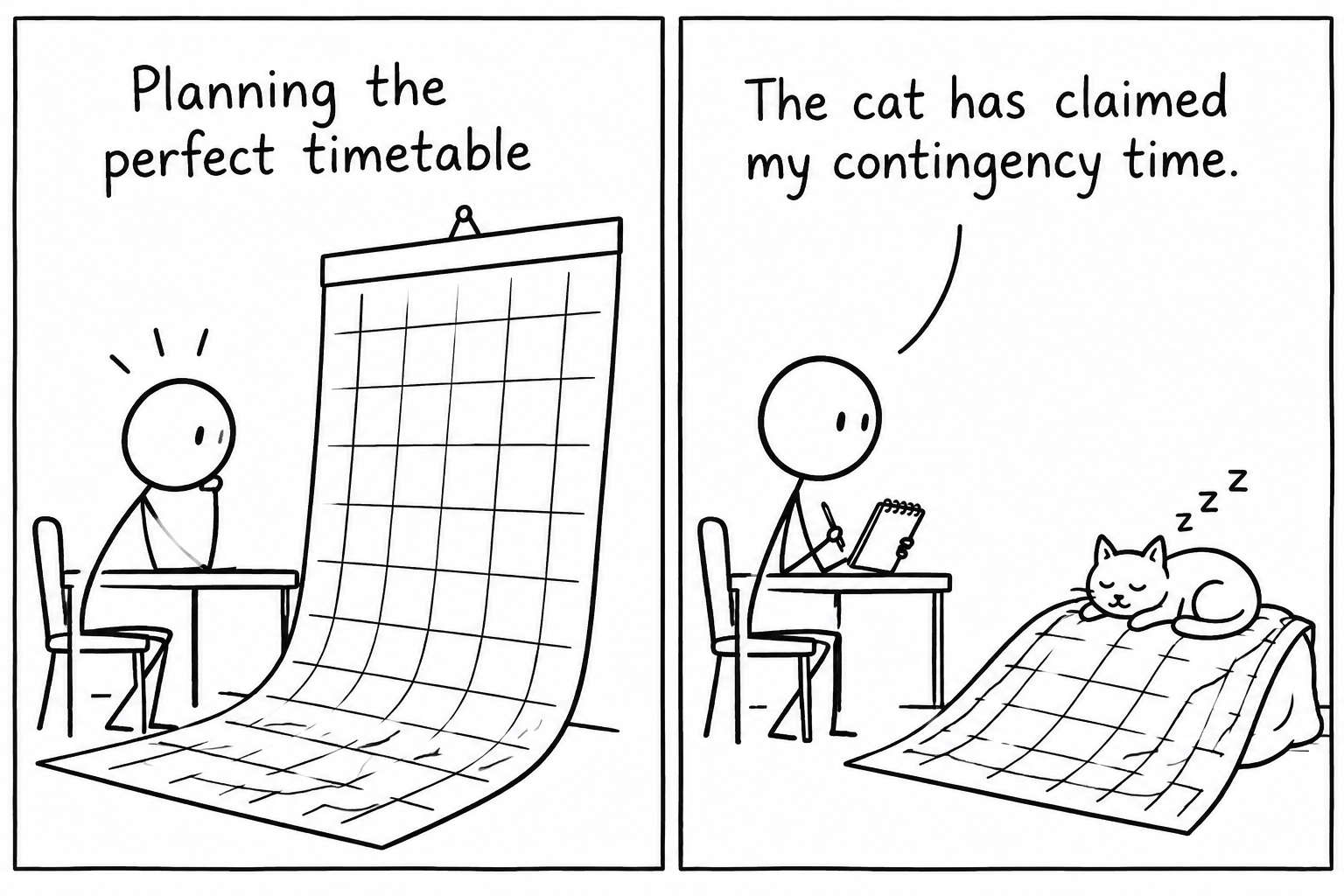 A student discovers that a cat has claimed the contingency time on an enormous revision calendar
Week 1: diagnose and prioritise
Complete a manageable mixed assessment or selected questions from a GCSE maths past paper. Mark it carefully and record the topic behind each lost mark.
Do not write only “careless mistake”. Be specific: substituted a negative value incorrectly, used circumference instead of area, or stopped before giving the requested form. Precision makes the correction useful.
Week 2: repair the largest gaps
Take the two weakest high-priority topics from Week 1. Use MathsGenie GCSE revision lessons to review the method, then answer practice questions independently.
Keep examples close at first, but remove them as soon as possible. Recognition can feel like understanding. The real test is whether you can begin a fresh question alone.
Week 3: mix topics and add time pressure
Continue one weak topic, then complete a timed section containing different areas of maths. Mixed practice matters because an exam does not tell you which technique sits behind each question.
Sam may know how to solve simultaneous equations when a worksheet announces the topic. In a paper, the harder task can be recognising that simultaneous equations are needed. Timed mixed questions train both selection and execution.
Week 4: consolidate and prepare for Easter
Return to questions you previously answered incorrectly. If you can now solve them without help, the revision has changed something. If not, revisit the explanation and try a simpler question before returning to the exam-style version.
Finish the month with a fresh list of red, amber and green topics. This gives your Easter revision a clear starting point and stops April becoming another round of vague planning.
How to use papers without wasting them
Past papers are valuable, but March does not need to become an endless sequence of full papers. Use papers in three ways:
- diagnostic practice: find gaps before revising;
- timed sections: develop pace and method selection;
- full papers: practise sustained concentration and exam strategy.
Always mark your work with the relevant mark scheme. Then classify each error as a knowledge gap, method error, arithmetic slip, misread instruction or timing problem. Watch a video solution where available, but close it before attempting the question again.
Predicted papers can offer additional practice nearer the exams, but they cannot tell you exactly what will appear. Revise the specification broadly and treat every paper as practice, not a forecast.
Common mistakes to avoid in March
Revising only favourite topics
Confidence matters, but comfortable practice has diminishing returns. Keep some green-topic work in the plan, while directing most attention towards fixable red and amber areas.
Watching instead of doing
A clear video can make a method look easy because somebody else is making every decision. Pause, close the solution and complete questions independently. Maths improves through doing.
Completing papers without analysing errors
A score tells you where you are. Corrections help you move. Keep a brief error log and revisit it weekly rather than collecting marked papers that you never open again.
Building an impossible timetable
A plan that ignores homework, other subjects and rest will collapse. Include fewer sessions than your most optimistic self wants, then complete them consistently. Leave space to move a missed session rather than abandoning the week.
Ignoring calculator fluency
Practise with the calculator you expect to use in lessons and assessments. Learn how to enter fractions, powers, roots and brackets correctly, while writing enough working for the method to be clear.
Turn March into a schedule you can follow
By the end of March, Sam has not mastered every GCSE maths topic. The important change is smaller and more believable: weak areas are named, mistakes are being revisited, and each week has a purpose. Knowing the plan is only half the job; following it alongside school and other subjects is the difficult part.
Your turn. Build your four-week March schedule in the MathsGenie Revision Planner.















