

What Percentage Is a Grade 9 in GCSE Maths?
What percentage is a grade 9 in GCSE Maths? Compare 2025 boundaries by exam board, understand higher tier rules and set a realistic target.
A student finishes a GCSE Maths past paper and counts 180180180 marks out of 240240240. That is 75%75\%75%. It feels strong, but one question remains: is it a grade 999?
The direct answer to what percentage is a grade 9 is that there is no fixed percentage. In June 2025, the published grade 999 boundaries ranged from about 82%82\%82% to 91%91\%91% across four major GCSE Maths specifications. The exact mark depended on the exam board and the difficulty of that examination series.
So the student's 75%75\%75% is useful evidence, but it is not a permanent grade. A past paper must be judged against the boundary for its own board, tier and examination series.
Grade 9 at a glance
- A grade 999 is available only on higher tier GCSE Maths.
- There is no universal grade 999 percentage.
- Boundaries are set after the papers have been taken and marked.
- Your total across all papers determines the qualification grade.
- Historical boundaries are useful guides, not promises about a future series.
- A sensible revision target includes a margin above previous boundaries.
What percentage is a grade 9 on recent papers?
The table below compares the published June 2025 higher-tier boundaries. Percentages have been calculated from the total available marks and rounded to one decimal place.
| Exam board and specification | Grade 999 mark | Maximum mark | Percentage |
|---|---|---|---|
| Pearson Edexcel 1MA11\text{MA}11MA1 | 217217217 | 240240240 | 90.4%90.4\%90.4% |
| AQA 830083008300 | 219219219 | 240240240 | 91.3%91.3\%91.3% |
| OCR J560\text{J}560J560 | 258258258 | 300300300 | 86.0%86.0\%86.0% |
| Eduqas C300\text{C}300C300 | 196196196 | 240240240 | 81.7%81.7\%81.7% |
For example, the Edexcel calculation is:
217240×100=90.416…%\frac{217}{240}\times 100=90.416\ldots\%240217×100=90.416…%Rounded to one decimal place, that is 90.4%90.4\%90.4%.
These are clearly dated historical results, not predicted boundaries for the next examinations. They also reveal why advice such as “a grade 999 is always 90%90\%90%” is unreliable. That estimate was close for Edexcel and AQA in June 2025, but it was not the boundary for OCR or Eduqas.
Before comparing a score, check the specification printed on the paper. Different boards may assess broadly similar GCSE content, but their paper structures, total marks and boundaries are not interchangeable.
Why there is no fixed grade 9 percentage
Examination papers cannot be made perfectly equal in difficulty every year. One series may contain an unusually demanding geometry problem; another may make a familiar algebra skill harder to recognise.
Grade boundaries account for those differences. Exam boards use evidence from the completed assessments to set boundaries so that a candidate is not unfairly helped or harmed simply because one series was harder or easier than another.
This means the percentage can move. If a paper is more accessible, students may need more marks for the same grade. If it proves more demanding, the boundary may be lower. The grade standard is intended to remain comparable even when the raw mark changes.
That is why nobody can confirm the next grade 999 boundary before the awarding process. Predicted boundaries can create false certainty. Maths Genie predicted papers are valuable for practising likely styles and content, but they cannot tell you an official future boundary.
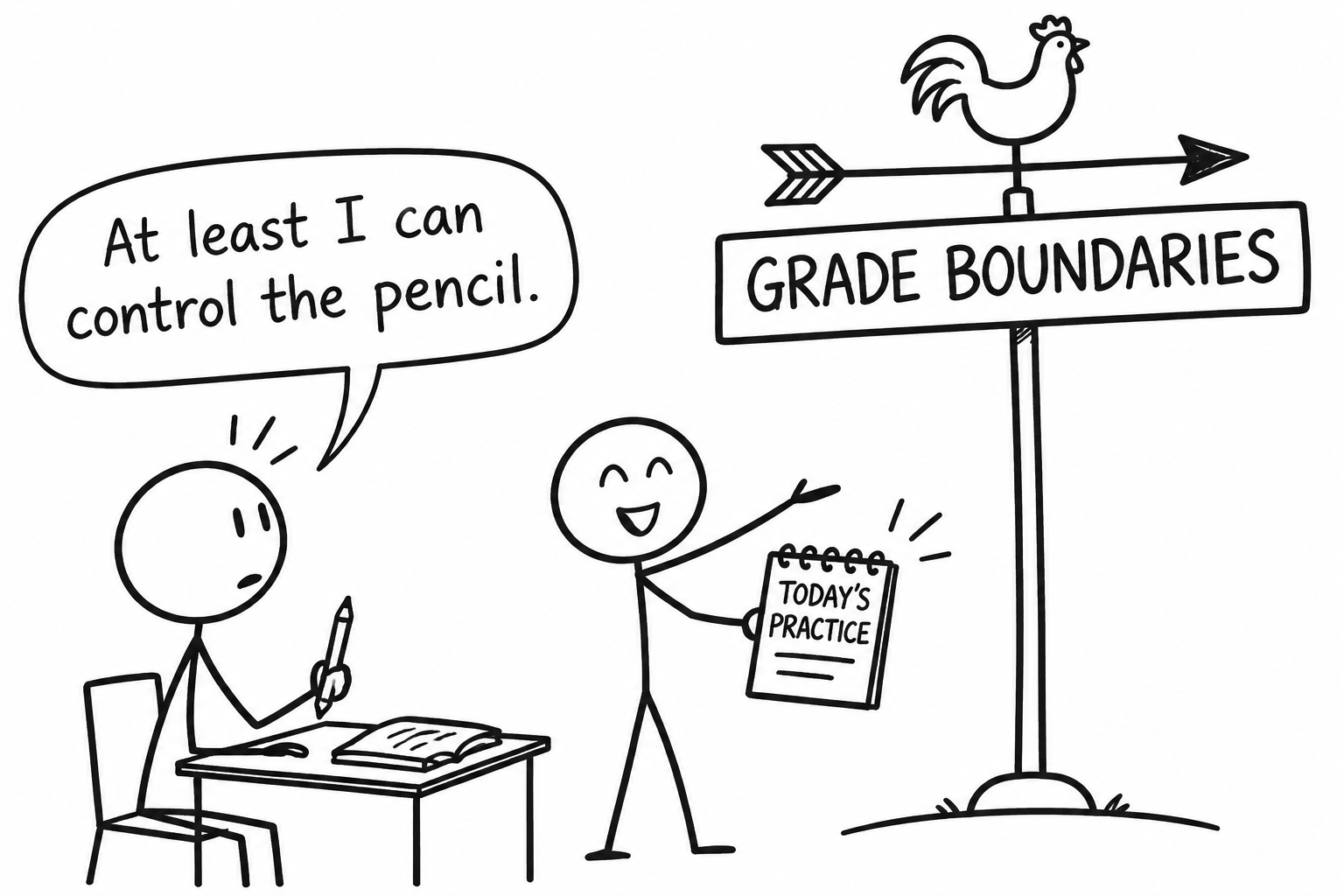 A GCSE student chooses today's practice over worrying about changing grade boundaries
Higher and foundation tier make a crucial difference
A GCSE maths grade 999 is only available on higher tier. Higher-tier candidates can receive grades 999-444, with grade 333 available as an allowed grade in limited circumstances. Foundation tier awards grades 555-111.
Therefore, a student entered for foundation tier cannot achieve a grade 999, regardless of the percentage scored. This is not a judgement on effort. It is part of the qualification's tier structure.
Tier decisions should be discussed with the school. Higher tier offers access to the top grades, but it also includes more demanding content. The right entry is the one that gives the student the most appropriate opportunity to demonstrate what they know.
How to use grade boundaries sensibly
Return to the student with 180180180 marks. Rather than labelling the result immediately, the student should follow a short process:
- identify the exam board and exact series;
- make sure all papers from the series have been completed;
- mark them carefully with the official mark schemes;
- total the marks;
- compare the total with that series's published boundary;
- record which topics lost marks.
The final step matters most. A boundary describes an old result. An error list tells you what to do tomorrow.
Use GCSE Maths past papers under timed conditions, then check the supplied mark schemes and video solutions. For topic-by-topic repair, work through the GCSE Maths revision resources, where lessons and exam questions are organised by grade.
A student near grade 999 should not revise only the hardest-looking questions. Grade 999 totals are built from secure routine marks as well as demanding problem solving. Losing marks through inaccurate arithmetic, incomplete reasoning or missed units can matter just as much as being unable to finish the final question.
Set a target with room for variation
Suppose a historical boundary was 217217217 out of 240240240. Treating exactly 217217217 as the target leaves no protection against an easier paper, an unusually weak topic or a few avoidable slips.
A better aim is consistent performance above the relevant historical boundary. This is not a prediction that the next boundary will rise. It is simply a practical buffer.
Use several complete papers rather than choosing the score you like best. A sequence such as 221221221, 214214214 and 224224224 gives a more honest picture than reporting only 224224224. The lower result also identifies where revision has the greatest value.
Maths Genie's grade-based GCSE revision pages can help prioritise those gaps. Start with topics where marks are repeatedly lost, use the revision lesson, answer the practice questions, and then return to a mixed paper. That loop is more reliable than repeatedly checking boundary tables.
Common mistakes when interpreting grade boundaries
Treating one paper as the whole GCSE
The overall grade normally comes from the combined mark across the full set of papers. A percentage on one paper is only a snapshot, particularly if that paper suited the student's strongest topics.
Using a boundary from another board
AQA, Edexcel, OCR and Eduqas use different specifications and totals. Compare an AQA score with the AQA boundary for that exact series, not with whichever number appears first in a search.
Confusing a target with an official boundary
Teachers may set cautious target percentages for mocks. These help guide progress, but they are not official future grade boundaries.
Ignoring method marks
Students sometimes mark only final answers. Official mark schemes can award marks for valid working, so self-marking must account for method, accuracy and communication. Use the Maths Genie past papers and mark schemes to learn how marks are actually earned.
Chasing difficult questions while dropping routine marks
The final questions feel connected to grade 999, but every mark contributes to the same total. Secure algebra, percentages, graphs, ratio, probability and geometry create the platform from which harder problems become manageable.
Turn the percentage into a revision plan
The useful question is not only, “What grade was this?” It is also, “Where can the next five marks come from?”
Categorise each lost mark as a knowledge gap, an interpretation error, incomplete working or a careless slip. Then choose the Maths Genie GCSE lessons on the topics that can move your marks most. Follow each lesson with practice questions or a mini test, and use another full paper later to check whether the improvement survives under time pressure.
Grade boundaries will always move beyond a student's control. Topic knowledge, written method and exam practice are different. Those can improve, one mark at a time.















