

What Percentage Is a Grade 6 in GCSE Maths?
What percentage is a grade 6 in GCSE Maths? Compare June 2025 grade boundaries by board, understand tiers and plan revision to earn more marks confidently.
Imagine a student opening a marked Higher tier practice paper and seeing that they have earned just over half the available marks. Their first thought is disappointment. Their second is the question that matters: what percentage is a grade 6?
For GCSE Maths, there is no fixed percentage. In the June 2025 Higher tier exams, the grade 6 boundary was approximately 50.4%50.4\%50.4% for Edexcel, 54.2%54.2\%54.2% for AQA and 42%42\%42% for OCR. These are historical thresholds, not guaranteed targets for another exam series. Foundation tier cannot award a grade 6, regardless of the percentage scored.
That changes how our hypothetical student should read their result. Half marks on a demanding Higher paper can represent meaningful progress. The next step is to compare the right papers and boundaries, then identify where more marks are within reach.
The quick checklist
Before turning a percentage into a grade, check:
- Exam board: boundaries differ between Edexcel, AQA, OCR and other boards.
- Tier: a grade 6 requires Higher tier entry.
- Exam series: June and November boundaries must be checked separately.
- Qualification: GCSE and International GCSE boundaries are different.
- Total marks: use the qualification total, rather than treating one paper as a final grade.
The MathsGenie GCSE Maths revision hub lets you start with your exam board, helping you practise with the right resources.
What percentage is a grade 6 in GCSE Maths?
These June 2025 boundaries show why a single percentage would be misleading.
| Exam board and specification | Tier and series | Total available marks | Minimum marks for grade 6 | Percentage, rounded |
|---|---|---|---|---|
| Pearson Edexcel, 1MA1 | Higher, June 2025 | 240240240 | 121121121 | 50.4%50.4\%50.4% |
| AQA, 8300 | Higher, June 2025 | 240240240 | 130130130 | 54.2%54.2\%54.2% |
| OCR, J560 | Higher, June 2025 | 300300300 | 126126126 | 42%42\%42% |
Each percentage is the minimum grade 6 mark divided by the total available marks, multiplied by 100100100. The displayed percentages are rounded; the raw mark boundary is what determines the grade.
These are whole-qualification boundaries across the three papers. They are not marks that must be reached separately on every paper. A stronger performance on one paper can compensate for a weaker performance on another.
Our hypothetical student therefore needs more than a percentage. They need to know which board produced their practice papers and which exam series those papers came from.
For OCR practice, the MathsGenie OCR grade calculator provides a way to compare paper marks with historical boundaries. Any estimate remains a guide until the relevant exam series has been graded.
Why grade boundaries change
Exam boards aim to maintain comparable standards, but papers cannot be made equally difficult in every series. One set might contain a more demanding problem-solving question. Another might present familiar content in a less familiar way.
Grade boundaries are set after exams have been taken, using evidence about performance and standards. As Ofqual explains, harder papers can have lower boundaries, while easier papers can have higher boundaries.
This matters when comparing boards. OCR's lower percentage in June 2025 does not establish that OCR was an easier route to a grade 6. The papers, questions and marking demands differed.
It also explains why last year's boundary is useful for interpreting last year's papers but cannot promise a future result. Revision should build a margin above a historical threshold, rather than depend on it staying unchanged.
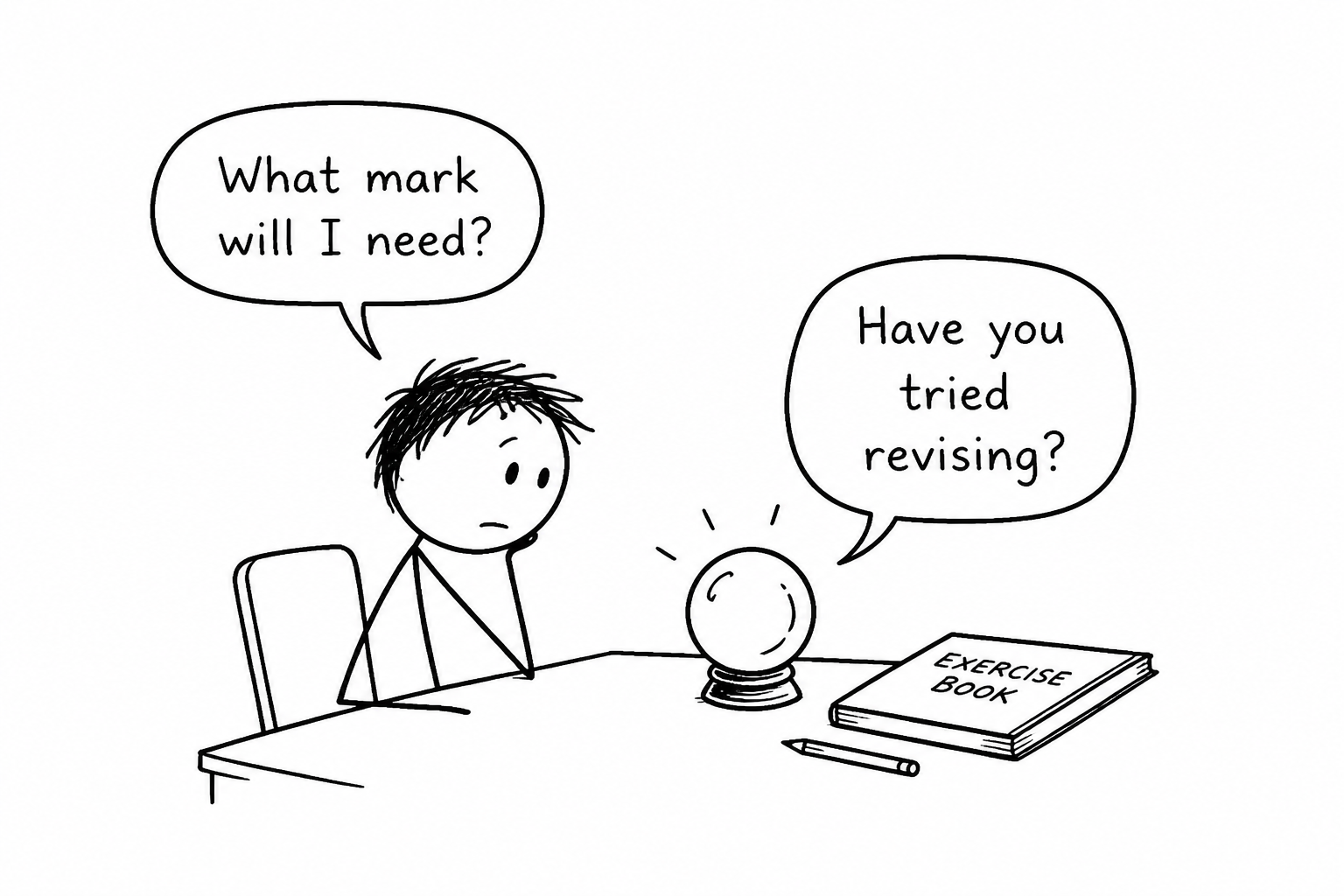 Stick figure student asks a crystal ball to predict the required exam mark, and it suggests revising instead
Foundation and Higher tier: the essential difference
Foundation tier awards grades 1-5. Higher tier is the route to a grade 6 and above.
A high Foundation percentage cannot be converted into a Higher grade because the papers assess different ranges of demand. Even full marks on Foundation would not produce a grade 6.
For parents, this is an important conversation to have with the school. If a student currently takes Foundation papers but needs a grade 6 for their next course, ask the teacher about Higher tier readiness and the content still to cover. Tier decisions should reflect sustained performance across the specification.
Students preparing for Edexcel can use the Edexcel GCSE Maths revision resources to find material appropriate to their tier.
Which topics move marks most?
Once the boundary question is answered, our student's attention can move to something they can influence: the next set of marks.
There is no guaranteed list of topics that delivers a grade 6. The best priorities are topics that appear across the specification and weaknesses that repeatedly cost the individual student marks.
Useful starting areas often include:
- Number and proportion: fractions, percentages, ratio and proportional reasoning support many longer questions.
- Algebra: rearranging formulae, solving equations, expanding and factorising unlock methods used elsewhere.
- Graphs and geometry: interpreting graphs, using angle facts and selecting appropriate formulae require both knowledge and careful reading.
- Probability and statistics: clear methods and accurate interpretation can turn partial understanding into more reliable marks.
Review a marked paper before choosing. If several errors came from percentage multipliers, that is a stronger revision signal than simply selecting the hardest topic available.
Use MathsGenie's topic revision guides to refresh the method, then attempt questions independently. Follow video solutions with another attempt from a blank page so that recognition becomes recall.
Common mistakes when aiming for a grade 6
Treating one paper as the final result
A single paper provides useful feedback, but a full set gives a better picture. Topic balance and individual strengths can make scores fluctuate.
Mixing boundaries and papers
Do not apply an AQA boundary to Edexcel questions, or a June boundary to a November paper set. Keep the board, specification, tier and series matched.
Revising only difficult questions
The final questions can attract most of a student's attention. Yet repeated arithmetic errors, missed units and incomplete methods may reveal more accessible gains. Secure these alongside learning more demanding content.
Reading solutions without trying again
A solution can feel obvious once someone explains it. Test whether you can reproduce the reasoning independently, then revisit it later using GCSE practice worksheets.
Turn the target into a revision plan
The student who began by worrying about half marks now has a more useful question: which marks can I learn to earn consistently?
Start with a complete past-paper set, mark it carefully and record recurring mistakes. Choose a small group of topics, use MathsGenie lessons to rebuild understanding, then test progress with fresh questions and mini tests. Predicted papers can provide extra practice, but cannot guarantee exam content or boundaries.
Use the MathsGenie revision planner to give those priorities a place in the week. Start with MathsGenie lessons on the topics costing you the most marks. A boundary helps explain a result; focused practice helps improve the next one.















