

What Percentage Is a Grade 5 in GCSE Maths?
What percentage is a grade 5 in GCSE Maths? See dated grade boundaries by board and tier, why marks change, and how to set a safer target.
A student finishes a practice paper, counts the marks twice and asks the question that seems as if it should have one simple answer: what percentage is a grade 5 in GCSE Maths?
The honest answer is that there is no fixed percentage. A grade 5 is awarded using grade boundaries set after the papers have been taken and marked. The required mark changes with the exam board, tier and exam series.
As a rough guide from recent papers, a grade 5 has often required around 35%35\%35%-40%40\%40% on higher tier and roughly 70%70\%70%-75%75\%75% on foundation tier. These are not guaranteed boundaries. They are useful reference points, not promises about your next exam.
Grade 5 percentage at a glance
Before planning revision, remember these five points:
- Grade boundaries are based on marks, not a permanent percentage.
- The boundary is set for the whole qualification, usually by adding marks across three papers.
- Higher and foundation tiers have different grade 5 boundaries.
- Boundaries vary between Edexcel, AQA, OCR and Eduqas.
- A sensible practice-paper target should sit above previous boundaries.
The safest approach is to check boundaries for the exact board, tier and year printed on your paper. Maths Genie’s GCSE Maths past papers make it easier to practise with complete papers rather than estimating a grade from isolated questions.
What percentage is a grade 5 on recent papers?
The figures below compare published boundaries from the June 2025 exam series. They show why one percentage cannot describe every GCSE Maths grade 5.
| Exam board and tier | Grade 5 mark | Total mark | Approximate percentage |
|---|---|---|---|
| Edexcel foundation | 175175175 | 240240240 | 72.9%72.9\%72.9% |
| Edexcel higher | 878787 | 240240240 | 36.3%36.3\%36.3% |
| AQA foundation | 188188188 | 240240240 | 78.3%78.3\%78.3% |
| AQA higher | 868686 | 240240240 | 35.8%35.8\%35.8% |
| OCR foundation | 221221221 | 300300300 | 73.7%73.7\%73.7% |
| OCR higher | 111111111 | 300300300 | 37.0%37.0\%37.0% |
Each percentage is calculated using:
percentage=grade boundarytotal available marks×100\text{percentage}=\frac{\text{grade boundary}}{\text{total available marks}}\times 100percentage=total available marksgrade boundary×100For example, the June 2025 Edexcel higher-tier grade 5 boundary was 878787 marks out of 240240240:
87240×100=36.25%\frac{87}{240}\times 100=36.25\%24087×100=36.25%That becomes approximately 36.3%36.3\%36.3%. It does not mean that 36.3%36.3\%36.3% will secure a grade 5 in another year or on another board.
Why there is no fixed GCSE Maths grade 5 percentage
Grade boundaries are not chosen in advance as permanent pass percentages. Awarding organisations set them after reviewing how students performed and how demanding the assessments proved to be.
Imagine that the student from the opening marks two papers. On one, unfamiliar wording makes several questions unusually difficult. On the other, the questions are more accessible. Treating the same raw mark as exactly equivalent on both papers would ignore that difference.
Grade boundaries help maintain comparable standards between exam series. If a paper proves more demanding, the boundary may be lower. If it is more accessible, the boundary may be higher. This is why predictions based on rumours or a single difficult question are unreliable.
There is another important detail: your GCSE grade normally comes from your combined mark across all papers. You do not need to achieve the grade 5 percentage separately on every paper. A stronger performance on one paper can compensate for a weaker performance on another.
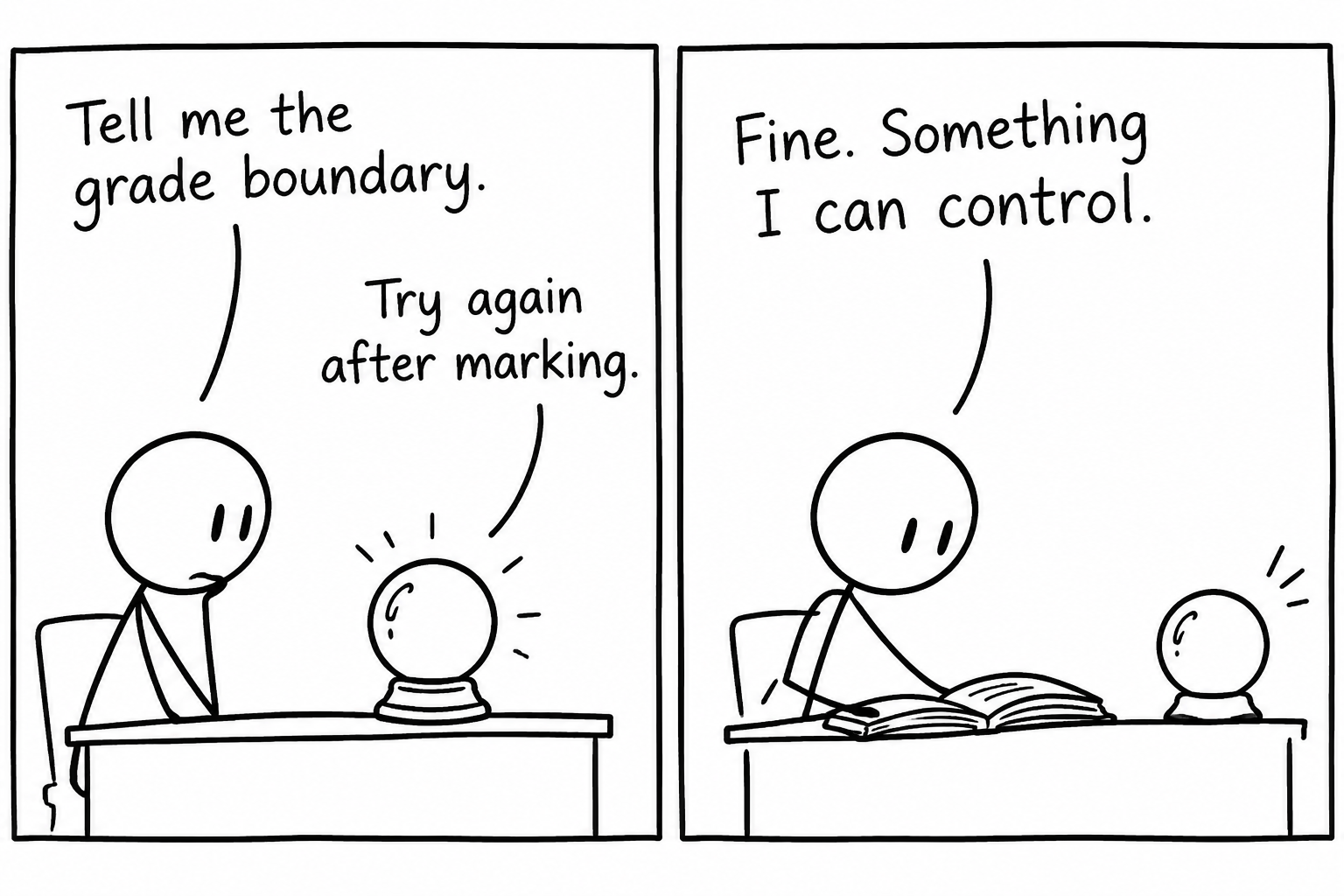 A student gives up asking a crystal ball for the grade boundary and starts revising instead
Foundation and higher tier are not directly comparable
The large difference between foundation and higher percentages can look alarming until you consider what each paper assesses.
Foundation tier covers grades 111-555, so grade 5 is the highest available grade. Students therefore need to collect a substantial proportion of the marks to reach it.
Higher tier covers grades 444-999, with a limited grade 3 safety net available under awarding rules. Its papers contain more demanding content, so a grade 5 can correspond to a lower percentage of the available marks.
A lower higher-tier boundary does not make higher tier an easier route. Its questions are designed for a wider and more advanced grade range. Tier decisions should be made with your teacher, based on current performance, confidence and access to the full specification, rather than boundary percentages alone.
Maths Genie organises its GCSE revision lessons by grade, helping students identify the skills that sit around their current level before moving towards more demanding questions.
What mark should you target?
Do not aim for the historical boundary exactly. A boundary is the lowest mark that achieved a grade in one particular series, not a comfortable revision target.
Suppose a previous higher-tier grade 5 boundary was 878787 out of 240240240. A student repeatedly scoring exactly 878787 has no protection against careless errors, a difficult topic mix or a boundary increase. Aiming above it creates a margin of safety.
A practical process is:
- complete a full paper under timed conditions;
- mark it strictly with the official mark scheme;
- record the total and the topics behind lost marks;
- revise two or three high-impact weaknesses;
- complete another paper and compare the evidence.
Use the boundary from that exact paper to interpret the result, but focus more closely on whether your raw mark is rising. Maths Genie’s GCSE Maths revision resources include videos and exam-style questions, while the GCSE Maths mini tests can reveal whether a topic has genuinely become secure.
Topics that can move a grade 5 score
Students often search for a percentage when the more useful question is: where can I recover the next ten marks?
For many grade 5 candidates, progress comes from making common skills dependable. These may include fractions and percentages, ratio, solving equations, sequences, area and volume, probability, transformations and interpreting graphs. The exact priorities depend on the errors in your own papers.
Begin with the Maths Genie GCSE Maths lessons. Watch the video for a weak topic, complete its practice questions, check the solutions, and return to a mixed paper later. That final step matters because recognising a method in a lesson is easier than selecting it independently in an exam.
Once the core skills are secure, use GCSE predicted papers for additional exam-style practice. Predicted papers cannot forecast exact questions or future grade boundaries, but they can help you practise choosing methods under time pressure.
Common mistakes when estimating a grade
Treating an old boundary as a guarantee
A past boundary describes one exam series. It can guide a target, but it cannot tell you the boundary for a future paper.
Comparing marks without checking the total
A mark of 909090 means something different on a qualification worth 240240240 marks from one worth 300300300. Convert marks carefully when making comparisons.
Mixing up foundation and higher boundaries
Always check the tier code on the paper. Foundation and higher grade 5 percentages differ substantially because the assessments target different grade ranges.
Grading one paper as if it were the whole GCSE
Qualification boundaries usually apply to the combined total. If you attempt only one paper, use it diagnostically rather than claiming a final GCSE grade.
Counting method marks too generously
Mark schemes may award marks for specific working, but self-marking needs discipline. If your method does not meet the stated requirement, do not assume the mark. Use available worked or video solutions to understand what examiners expect.
Turn the percentage into a revision plan
The student who began by asking for one magic number eventually needs a more useful set of numbers: the marks lost to algebra, the marks lost to ratio, and the marks lost because working was not shown.
Grade boundaries matter, but they are outside your control. The next topic you practise is not.
Start with Maths Genie’s GCSE Maths lessons on the topics that can move your marks most. Then test that progress with past papers, mark schemes, mini tests and video solutions. The goal is not to predict the boundary perfectly. It is to build enough knowledge that a small change in the boundary no longer decides the result.















