

What Percentage Is a Grade 4 in GCSE Maths?
What percentage is a grade 4 in GCSE Maths? Compare June 2025 boundaries by board and tier, then learn how to set a safer revision target.
A student finishes a practice paper, checks the mark scheme and gets 58%58\%58%. The first question is not about algebra or geometry. It is: “Have I passed?”
The honest answer is that what percentage is a grade 4 depends on the exam board, tier and exam series. There is no permanent pass percentage for GCSE Maths. As a rough guide from the June 2025 boundaries, a grade 4 ranged from about 16%16\%16% to 26%26\%26% on higher tier and from about 45%45\%45% to 67%67\%67% on foundation tier.
That difference looks surprising, but it does not mean one paper was automatically easier. The tiers test different ranges of difficulty, while grade boundaries are set for each exam series after the papers have been taken.
The short answer
Before interpreting a practice-paper result, check four details:
- your exam board: Edexcel, AQA, OCR or Eduqas
- whether the paper is foundation or higher tier
- the year and exam series shown on the paper
- the total mark available across all papers
A grade boundary is a mark threshold, not a fixed percentage written into the specification. Your final GCSE Maths grade is normally based on your total mark across the full set of papers, rather than the percentage from one paper in isolation.
What percentage was a grade 4 in June 2025?
The following table converts the published June 2025 grade 4 boundaries into percentages. Percentages are rounded to one decimal place.
| Exam board | Tier | Grade 4 boundary | Percentage |
|---|---|---|---|
| Edexcel | Foundation | 144144144 out of 240240240 | 60.0%60.0\%60.0% |
| Edexcel | Higher | 535353 out of 240240240 | 22.1%22.1\%22.1% |
| AQA | Foundation | 160160160 out of 240240240 | 66.7%66.7\%66.7% |
| AQA | Higher | 636363 out of 240240240 | 26.3%26.3\%26.3% |
| OCR | Foundation | 134134134 out of 300300300 | 44.7%44.7\%44.7% |
| OCR | Higher | 474747 out of 300300300 | 15.7%15.7\%15.7% |
| Eduqas | Foundation | 111111111 out of 240240240 | 46.3%46.3\%46.3% |
| Eduqas | Higher | 272727 out of 240240240 | 11.3%11.3\%11.3% |
These are historical boundaries, not predictions for a future examination. For example, the official Pearson Edexcel June 2025 boundary was 144144144 marks on foundation and 535353 marks on higher. A student calculating the Edexcel foundation percentage would use:
144240×100=60%\frac{144}{240}\times 100=60\%240144×100=60%Someone taking Edexcel higher in the same series would calculate:
53240×100≈22.1%\frac{53}{240}\times 100\approx22.1\%24053×100≈22.1%The same grade had a very different percentage because the two tiers contained different questions and covered different grade ranges.
Why there is no fixed GCSE Maths grade 4 percentage
Imagine that our student’s 58%58\%58% came from an Edexcel June 2025 foundation paper set. That result would sit below the historical grade 4 boundary of 60%60\%60%, although using an individual paper rather than the complete set makes the comparison less reliable.
Now imagine the same percentage came from a higher-tier set. It would be comfortably above the historical grade 4 threshold. Context changes the meaning of the mark.
Grade boundaries can move because examination papers are not identical from one series to another. One set may prove more demanding than another. Awarding processes use evidence to maintain the standard of a grade, so students are not expected to achieve exactly the same raw percentage every year.
This is why statements such as “a pass is always 50%50\%50%” are misleading. Grade 444 is described as a standard pass, but that description is not a promise that 50%50\%50% of the marks will always be enough.
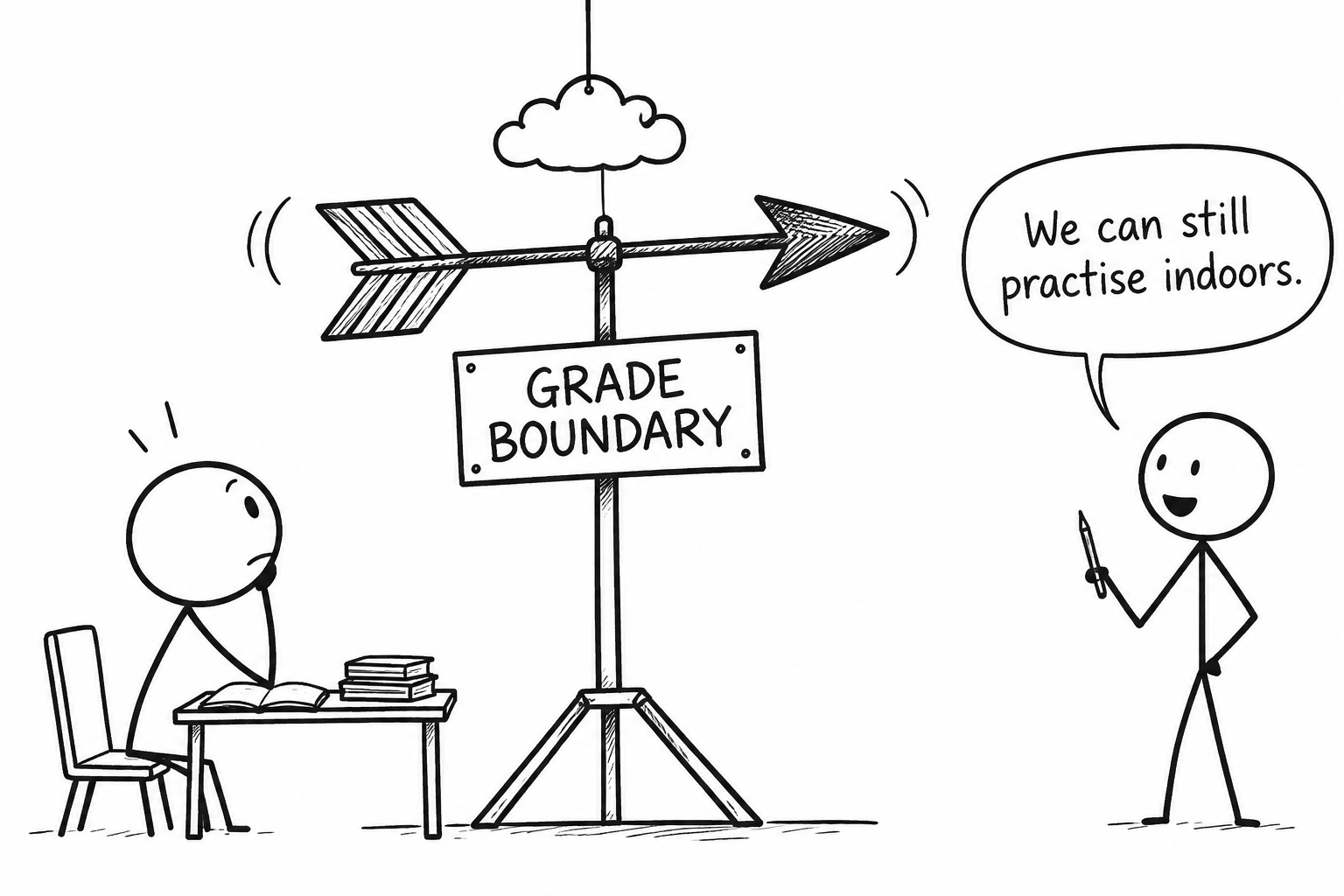 A student faces an indoor grade-boundary weather vane while another calmly continues revising
Foundation and higher tier are not directly comparable
Foundation tier awards grades 111 to 555. Higher tier awards grades 444 to 999, with a limited safety-net grade 333 available when the required standard is met.
The lower grade 4 percentage on higher tier does not offer an easy shortcut. Higher papers contain substantially more demanding material, and marks can be harder to collect. Foundation papers provide more accessible questions, but the grade 4 boundary is usually a larger proportion of the total.
Tier entry should therefore be discussed with the school rather than chosen by looking for the smallest percentage. A sensible decision considers current attainment, confidence across the specification and the grade the student is aiming to achieve.
How to use grade boundaries sensibly
Past boundaries are useful for interpreting completed papers, but they should not become a prediction machine. If a historical boundary was 144144144 marks, aiming for exactly 144144144 leaves no room for a difficult question, a calculator slip or normal variation between exam series.
A better plan is to build a margin above recent boundaries. The exact margin should reflect the student’s board, tier and remaining revision time. More importantly, compare several complete papers rather than trusting one unusually strong or weak result.
A practical routine is:
- complete a full paper under timed conditions
- mark it carefully using the correct mark scheme
- record lost marks by topic, not only the total
- revise the weakest high-frequency skills
- answer fresh practice questions on those skills
- repeat with another paper and look for a trend
Maths Genie’s GCSE Maths revision resources organise topics by grade, helping students identify skills that can move their total. The GCSE Maths past papers are useful for realistic timed practice, while the GCSE revision planner turns weak topics into a manageable schedule.
Topics that can move a grade 4 result
The best next topic is not necessarily the hardest chapter in the textbook. It is often the skill that appears in several forms and currently costs marks repeatedly.
For a student near grade 4, that may include fractions, percentages, ratio, solving equations, averages, area, probability and interpreting graphs. Secure methods on accessible questions can matter more than occasionally solving one very difficult problem.
Maths Genie provides free revision lessons with videos, practice questions and answers. Start with the fractions revision lesson, strengthen proportional thinking through the percentage revision lesson, and practise unknown values with the solving equations revision lesson. Students can then use past papers, predicted papers, mini tests, mark schemes and video solutions to check whether those skills hold up under exam pressure.
This changes the student’s question from “What is the lowest percentage I need?” to “Which lost marks can I make more reliable?” The second question is usually far more useful.
Common mistakes when judging a grade 4
Treating 50%50\%50% as an automatic pass
No universal 50%50\%50% pass rule exists. Use the boundary for the correct board, tier and series.
Comparing one paper with a subject boundary
A published subject boundary generally applies to the combined mark across the assessment. Add the marks from the full paper set before making a direct comparison.
Using foundation boundaries for a higher paper
The two tiers have different levels of demand. Their percentages cannot be swapped.
Revising to the exact boundary
Boundaries change, and performance changes too. Build a cushion rather than treating a previous threshold as a target.
Counting only fully correct answers
Method marks can make a significant difference. Write clear working, even when you are unsure of the final answer, and use mark schemes to learn how marks are awarded.
Turn the percentage into a plan
A grade boundary tells you what happened in a particular exam series. It cannot tell you which topic to revise tonight.
That is where progress begins. Mark a complete paper, find the recurring gaps and choose the skills most likely to recover marks. Then revisit them until the method feels ordinary rather than lucky.
Start with Maths Genie’s free GCSE Maths lessons on the topics that move marks most. Combine the videos and practice questions with timed papers, mark schemes and the revision planner. You cannot control the next grade boundary, but you can become less dependent on it.















