

What Percentage Is a Grade 3 in GCSE Maths?
What percentage is a grade 3 in GCSE Maths? See dated boundaries by exam board and tier, why marks change, and how to work towards grade 4.
A student opens a marked GCSE Maths paper and sees 44%44\%44% at the top. It feels like the obvious next question should have an obvious answer: what percentage is a grade 3?
The direct answer is that there is no fixed percentage. In recent GCSE Maths exams, the minimum percentage for a grade 3 has often been around 40%−50%40\%-50\%40%−50% on foundation tier and around 15%−22%15\%-22\%15%−22% on higher tier. However, the exact boundary changes with the exam board, tier and exam series.
That difference can look startling. It does not mean that higher tier is an easier route to a grade 3. Higher papers contain substantially more demanding questions, and grade boundaries reflect the difficulty of the assessment.
Grade 3 percentage at a glance
Before interpreting any mark, check four things:
- your exam board, such as Edexcel, AQA, OCR or Eduqas
- whether the paper is foundation or higher tier
- the exam series and year
- your total mark across all papers, not simply one paper percentage
A percentage from a mock or past paper is only meaningful when compared with the boundary for that particular set of papers.
What percentage was a grade 3 in 2025?
The following examples use published June 2025 qualification boundaries. They show the minimum total mark needed for grade 3, followed by that mark as a percentage. Boundaries apply across the whole qualification.
| Exam board and tier | Grade 3 mark | Maximum mark | Percentage |
|---|---|---|---|
| AQA foundation | 119119119 | 240240240 | 49.6%49.6\%49.6% |
| AQA higher | 464646 | 240240240 | 19.2%19.2\%19.2% |
| Edexcel foundation | 105105105 | 240240240 | 43.8%43.8\%43.8% |
| Edexcel higher | 363636 | 240240240 | 15.0%15.0\%15.0% |
| OCR foundation | 959595 | 300300300 | 31.7%31.7\%31.7% |
| Eduqas foundation | 818181 | 240240240 | 33.8%33.8\%33.8% |
The calculation is:
Percentage=grade boundarymaximum mark×100\text{Percentage}=\frac{\text{grade boundary}}{\text{maximum mark}}\times 100Percentage=maximum markgrade boundary×100For example, the June 2025 Edexcel foundation boundary was 105105105 out of 240240240:
105240×100=43.75%\frac{105}{240}\times 100=43.75\%240105×100=43.75%So the minimum was approximately 43.8%43.8\%43.8%. A student gaining 44%44\%44% on those exact papers would have been just above the grade 3 boundary. On a different board, tier or year's paper, the conclusion could change.
These figures are useful historical reference points, not predictions of future boundaries. You can compare your Edexcel total with the Maths Genie Edexcel predicted grade calculator, which includes dated boundaries.
Why there is no fixed GCSE Maths grade 3 percentage
Grade boundaries are set after papers have been taken and marked. Exam boards consider how demanding an assessment proved to be, using evidence to maintain standards between exam series.
If one year's papers are more demanding, students may need fewer raw marks to demonstrate the standard associated with a grade. If the papers are more accessible, the boundary may be higher. This is why a school cannot know the final boundary for a live exam in advance.
It also explains why statements such as “a grade 3 is always 40%40\%40%” are unreliable. A percentage may be a sensible working estimate for a particular board and tier, but it is not a national rule.
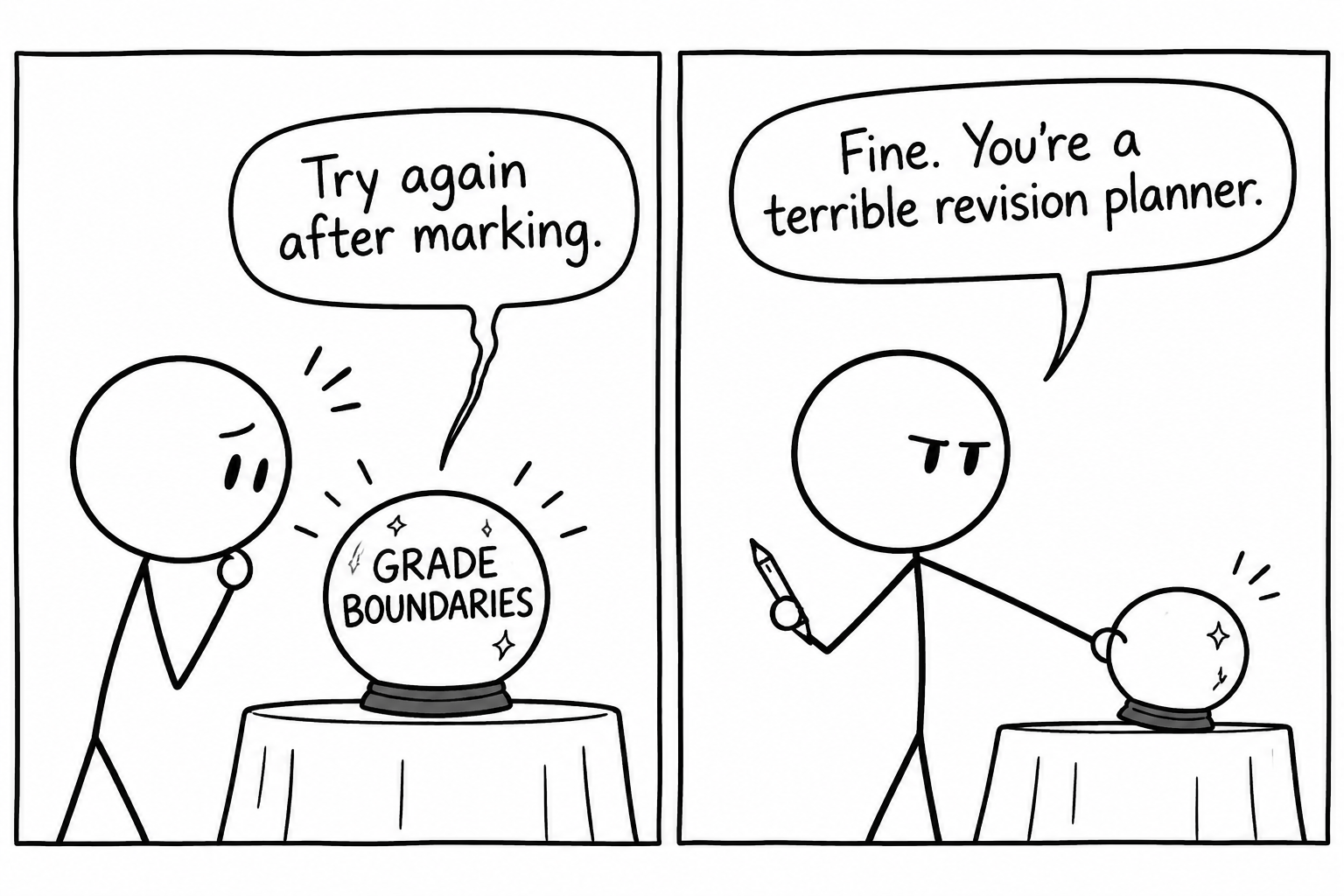 A student abandons a grade-boundary crystal ball and returns to useful revision
The practical lesson is simple. Use old boundaries to interpret old papers, but build a margin above them rather than aiming for the narrowest possible pass.
Foundation and higher tier are not directly comparable
Foundation tier awards grades 1−51-51−5. Higher tier principally targets grades 4−94-94−9, although a grade 3 may be awarded to candidates who fall a limited distance below the grade 4 boundary.
This creates the apparently strange percentages in the table. A higher-tier student can receive a grade 3 with a much lower percentage because a large part of the paper tests content aimed at higher grades. The questions and percentages are therefore not like-for-like.
Imagine two hypothetical students. Sam earns 105105105 marks on Edexcel foundation in June 2025, while Alex earns 363636 marks on Edexcel higher. Both totals meet that series' grade 3 boundary, but they come from different papers with different levels of demand.
Tier decisions should not be made by looking for the lowest percentage. Schools consider a student's current attainment, target grade and ability to access the questions. Parents and students should discuss the choice with the maths teacher, who has evidence from lessons and mocks.
Turning a grade 3 into a grade 4
A grade boundary tells you where the line was. It does not tell you which next step will move you across it.
Start by marking a complete paper carefully. Sort lost marks into three groups:
- topics you had not learnt securely
- methods you knew but could not apply
- avoidable errors, including arithmetic, units and misreading
Then focus first on frequently tested fundamentals. Fractions, percentages, ratio, basic algebra, equations, graphs, area, probability and interpreting data connect to many other questions. Maths Genie organises free GCSE Maths revision lessons by grade, with videos and exam-style questions, so students can work at an appropriate level rather than revising randomly.
After reviewing a topic, complete questions without the video beside you. Mark them, correct every error and return to the same skill a few days later. The ability to recognise a method independently matters more than recognising it while someone else explains it.
Finally, move into GCSE Maths past papers. Complete full papers under timed conditions and use the correct mark scheme and boundary for that exam series. Predicted papers and mini tests can add variety, but completed past papers give the clearest evidence of whether your marks are becoming stable.
Common mistakes when estimating a grade
Treating every percentage as equivalent
A result of 44%44\%44% on foundation does not represent the same performance as 44%44\%44% on higher. Check the tier before drawing conclusions.
Using the wrong year's boundary
Applying a June 2025 boundary to a paper from another series gives only a rough estimate. Match the paper, mark scheme and grade boundary wherever possible.
Judging a grade from one paper
GCSE Maths grades are based on the total qualification mark. One unusually strong or weak paper can distort an estimate. Complete all papers from the series and add the marks.
Aiming exactly at the old boundary
Boundaries move, and performance can vary on exam day. A student repeatedly landing on an old grade 3 threshold has little protection against a difficult topic or avoidable mistake. Aim comfortably above the boundary.
Counting marks too generously
Mark schemes award marks for particular methods and answers. Do not award yourself a method mark because an attempt “was nearly there”. Accurate marking produces a more useful revision plan.
The percentage is a clue, not a verdict
A GCSE Maths grade 3 is not tied to one universal percentage. Recent boundaries show why the board, tier and year matter, but they also point towards something more useful: the marks still available.
If a student is near grade 3, progress rarely requires mastering every difficult question. It often begins with recovering marks from core number, proportion, algebra and geometry skills, then practising until those methods remain reliable under time pressure.
Use the free Maths Genie GCSE lessons to target the topics that move marks most. Follow each lesson with practice questions, mark the work honestly, and then test the improvement on a complete past paper. Boundaries cannot be controlled. The next mark can.















