

What Percentage Is a Grade 1 in GCSE Maths?
What percentage is a grade 1 in GCSE Maths? Compare 2025 boundaries by board, understand tier rules and plan revision to improve your marks.
A student opens a marked GCSE Maths paper and sees 323232 out of 240240240. The first thought is often immediate: “What grade is that?” The second is more anxious: “Is it enough?”
So, what percentage is a grade 1 in GCSE Maths? There is no fixed percentage. In the June 2025 Foundation papers, the grade 1 boundary ranged from approximately 5.7%5.7\%5.7% to 16.3%16.3\%16.3% across four major exam boards. For Edexcel, it was 292929 marks out of 240240240, which is about 12.1%12.1\%12.1%.
Those figures are useful reference points, but they are not targets or promises. Grade boundaries change each exam series because papers vary in difficulty.
Grade 1 percentage at a glance
Here are the published June 2025 Foundation tier boundaries. The percentages have been calculated from the total available marks.
| Exam board | Grade 1 boundary | Total marks | Approximate percentage |
|---|---|---|---|
| AQA | 393939 | 240240240 | 16.3%16.3\%16.3% |
| Edexcel | 292929 | 240240240 | 12.1%12.1\%12.1% |
| OCR | 171717 | 300300300 | 5.7%5.7\%5.7% |
| Eduqas | 212121 | 240240240 | 8.8%8.8\%8.8% |
For example, the Edexcel percentage is:
29240×100=12.083…%\frac{29}{240}\times 100=12.083\ldots\%24029×100=12.083…%Rounded to one decimal place, this is 12.1%12.1\%12.1%.
The simple checklist is:
- A GCSE Maths grade 1 does not have one permanent percentage.
- The boundary depends on the exam board, tier and exam series.
- A grade 1 is available on Foundation tier, not Higher tier.
- Use past boundaries to interpret practice papers, not to predict an exact future result.
- Aim above the previous boundary to allow for normal variation between papers.
Why no fixed grade 1 percentage exists
Return to the student with 323232 marks. On the June 2025 Edexcel Foundation boundaries, that result would have been above the grade 1 threshold. On the June 2025 AQA Foundation boundaries, it would have been below it.
The student’s percentage has not changed:
32240×100=13.3% to one decimal place\frac{32}{240}\times 100=13.3\% \text{ to one decimal place}24032×100=13.3% to one decimal placeWhat changed was the paper and the boundary used to interpret it.
Exam boards design papers to a specification and try to maintain a consistent level of demand. Yet students may find one year’s questions harder than another year’s. Grade boundaries are therefore set after the papers have been taken and marked.
Ofqual explains that a harder paper will generally have lower boundaries, while an easier paper will generally have higher boundaries. The purpose is to keep the standard required for a grade comparable from year to year. A lower boundary does not automatically mean that an exam board is easier.
This is why nobody can confirm the percentage needed for a grade 1 before the relevant boundaries are published.
How boards and tiers affect GCSE Maths grade 1
Foundation tier
Foundation tier covers grades 111 to 555. If you are looking specifically for a GCSE Maths grade 1 boundary, Foundation is the relevant tier.
The total number of marks also matters. AQA, Edexcel and Eduqas each had 240240240 available marks in June 2025, while OCR had 300300300. Comparing raw marks without comparing totals can therefore be misleading.
A percentage creates a common scale, but even percentages cannot tell the whole story. The OCR grade 1 boundary was much lower as a percentage in this series because it reflected the demand of those particular papers and the evidence considered during awarding.
Higher tier
Higher tier principally covers grades 444 to 999, with an allowed grade 333 for students who narrowly miss grade 444. A performance below that range is ungraded rather than awarded grades 111 or 222.
That distinction matters for parents interpreting mock results. A low mark on a Higher paper should not be converted using a Foundation grade 1 boundary. The papers contain different questions and have different grade ranges.
For a clearer picture, use a complete paper from the correct board and tier, mark it carefully, then apply the boundary from that paper’s exam series. Maths Genie’s Edexcel predicted grade calculator and AQA predicted grade calculator make that comparison easier.
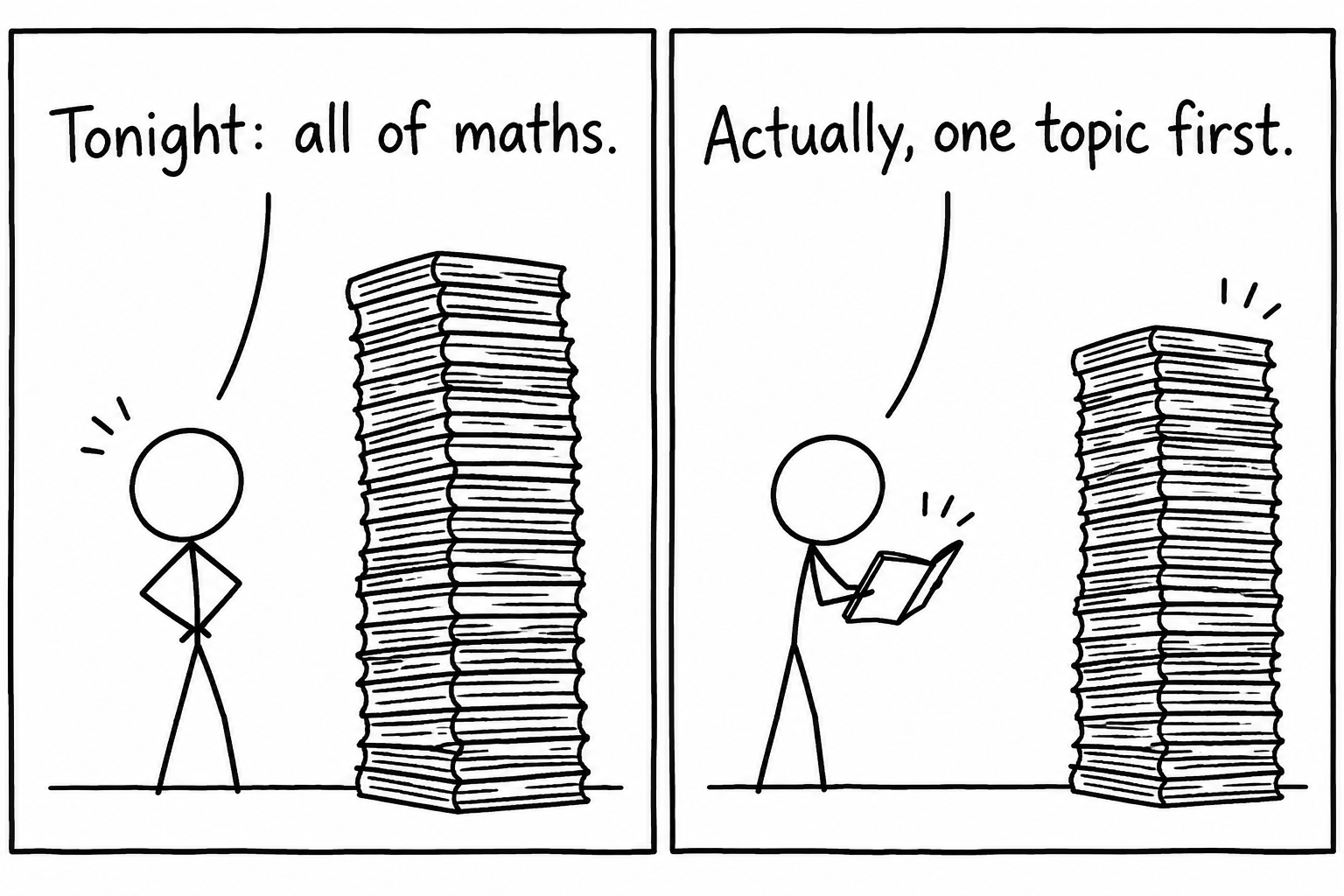 A student replaces an enormous revision plan with one manageable topic
A grade boundary is a snapshot, not a revision plan
The student with 323232 marks could spend the evening repeatedly calculating that it is 13.3%13.3\%13.3%. The number would become more familiar, but the mark would not move.
A better question is: where can the next ten marks come from?
At this stage, improvement often begins with reliable marks from core number skills and accessible data questions. On Maths Genie’s Edexcel GCSE Maths revision page, topics are arranged by grade so students can start at an appropriate level rather than jumping randomly between difficult questions.
Useful priorities include:
- addition and subtraction;
- multiplication and division;
- place value and ordering;
- fractions of an amount;
- fractions, decimals and percentages;
- interpreting charts and tables;
- metric conversions;
- basic perimeter and area.
The Grade 1 multiplication and division lesson is one practical starting point. Students can then use the GCSE Maths question bank to practise individual skills and check whether mistakes are disappearing.
This approach is less dramatic than trying to revise the whole specification at once. It is also more useful. A grade boundary describes an old set of results; practice changes the next one.
How to use past boundaries sensibly
Complete a full paper under suitable timed conditions, ideally without checking notes between questions. Then use the official mark scheme and record marks by topic.
A productive routine looks like this:
- mark the entire paper consistently;
- calculate the total across all papers in the set;
- compare the total with boundaries from the same board, tier and series;
- identify questions where the method was known but executed incorrectly;
- revise two or three weak topics;
- complete another paper and compare the evidence.
Maths Genie provides free GCSE Maths exam booklets by topic, along with answers and worked resources. The fractions exam booklet, for example, can help when a paper reveals that fraction questions are repeatedly being left blank.
Past papers, predicted papers, mini tests, mark schemes and video solutions serve different purposes. Past papers measure broad performance. Topic questions repair a specific weakness. Mini tests check whether the repair has lasted. Predicted papers can provide fresh exam-style practice, but they cannot predict future grade boundaries with certainty.
Common mistakes when interpreting grade boundaries
Treating one percentage as permanent
Saying that a grade 1 “is 12%12\%12%” turns one historical result into a universal rule. A more accurate statement is that the June 2025 Edexcel Foundation boundary was about 12.1%12.1\%12.1%.
Comparing different exam series
A mark from a 2025 paper should first be compared with the 2025 boundary for that specification. Using a boundary from another year gives only a rough indication.
Mixing boards or tiers
An AQA mark should not be judged against an Edexcel boundary. Likewise, Foundation boundaries should not be applied to Higher papers.
Using one paper as the final grade
GCSE Maths grades are based on the total mark across the qualification, not an isolated paper interpreted on its own. Notional paper boundaries may be published for guidance, but the subject-level total determines the final grade.
Aiming exactly at the old boundary
If a previous grade 1 boundary was 292929 marks, aiming for exactly 292929 leaves no room for a harder personal experience, an arithmetic slip or a future change in boundaries. A safer revision goal is steady improvement beyond the old threshold.
Turn the percentage into a next step
A grade 1 boundary can answer an important question about where a past performance sits. It cannot define a student’s ceiling.
The student who began with 323232 marks does not need every topic at once. They need the next secure method, the next completed question and the next honest check of their working. Ten extra marks can be built one mark at a time.
Start with the Maths Genie GCSE and A Level revision resources, then choose the lessons on the topics that move marks most. Use the videos to learn the method, practice questions to apply it, mark schemes and video solutions to understand errors, and mini tests or past papers to measure progress. The goal is not to memorise last year’s boundary. It is to move well beyond it.















