

What If You Fail the November Resit? GCSE Maths
What if you fail the November resit? Understand your GCSE maths options, college requirements and next steps, then build a targeted practice plan that works.
You check your November result between college lessons, or before a shift, and it is still below the grade you need. The immediate question is practical: what if you fail the November resit? You can take GCSE maths again, usually in the next summer series. If you are on a funded post-16 programme in England, you will generally continue maths alongside your main course, with your college confirming the qualification and next exam entry.
A disappointing result means revisiting your plan. It does not automatically mean leaving college or abandoning your intended career. Your next steps depend on your existing qualifications, course requirements and what your exam papers reveal.
Your next steps at a glance
Before deciding that you need to revise everything again:
- Ask your maths teacher for your marks and the relevant grade boundary.
- Discuss whether accessing your marked scripts or requesting a review of marking would help.
- Confirm your next exam opportunity, entry arrangements and any costs.
- Check how the result affects your current course and future progression.
- Identify specific weaknesses and build a manageable practice routine.
You do not need to solve the whole situation on results day. You need enough information to make the next decision.
What if you fail the November resit: do you have to continue?
The position in England
Department for Education guidance makes continued maths study a condition of funding for relevant post-16 programmes. This is a requirement placed on providers to support eligible students who have not achieved GCSE grade 4 or above, subject to the guidance’s exemptions and individual circumstances.
For full-time students who hold GCSE grade 3, the usual requirement is to study towards GCSE maths. Other approved routes may be available for students with lower prior attainment. Ask your college which rule applies to you, especially if you already hold another maths qualification.
The important distinction is that continued study does not mean compulsory entry into every available exam series. Your provider should consider readiness when deciding when to enter you.
These funding rules apply to England. If you study in Wales, Northern Ireland or elsewhere, ask your provider about the arrangements that apply locally.
Will you lose your college place?
A below-target November result does not create a universal rule requiring you to leave your main course. Your college’s entry, continuation and progression requirements matter.
Ask your tutor a direct question: “Can I continue my current course while working towards maths, and what must I achieve before progressing?” That separates an immediate concern about your timetable from a future requirement for a particular qualification, apprenticeship or job.
When can you take GCSE maths again?
The next usual opportunity after a November resit is the following summer GCSE series. Agree the entry with your college rather than assuming it happens automatically. Confirm your exam board, tier, paper dates and the college’s internal deadline.
Use your board’s final timetable and your personal exam timetable for exact dates. AQA, Edexcel and OCR publish their own arrangements, and calculator-paper order can differ between boards.
Ask about fees as well. Funding and entry arrangements depend on your circumstances and provider; private exam-centre bookings can involve charges. Get a clear answer before making a separate booking.
You can start with MathsGenie’s GCSE maths resources, choosing your actual exam board so that practice matches your specification.
Should you request a review of marking?
If you narrowly missed the grade you need, speak to your teacher or exams officer promptly. Ask whether they can obtain your marked scripts and check whether the marking appears to have been applied correctly.
A review of marking checks the original marking. It does not award extra marks because you worked hard or were close to a boundary. Marks and grades can go down, stay the same or go up, so your informed consent matters.
Your exams officer can explain the deadline, possible fee and school or college process. Being close to a boundary is a reason to investigate carefully, rather than a guarantee that a review will change the result.
Keep attending lessons while this is considered. Preparation for another sitting remains useful whatever the review outcome.
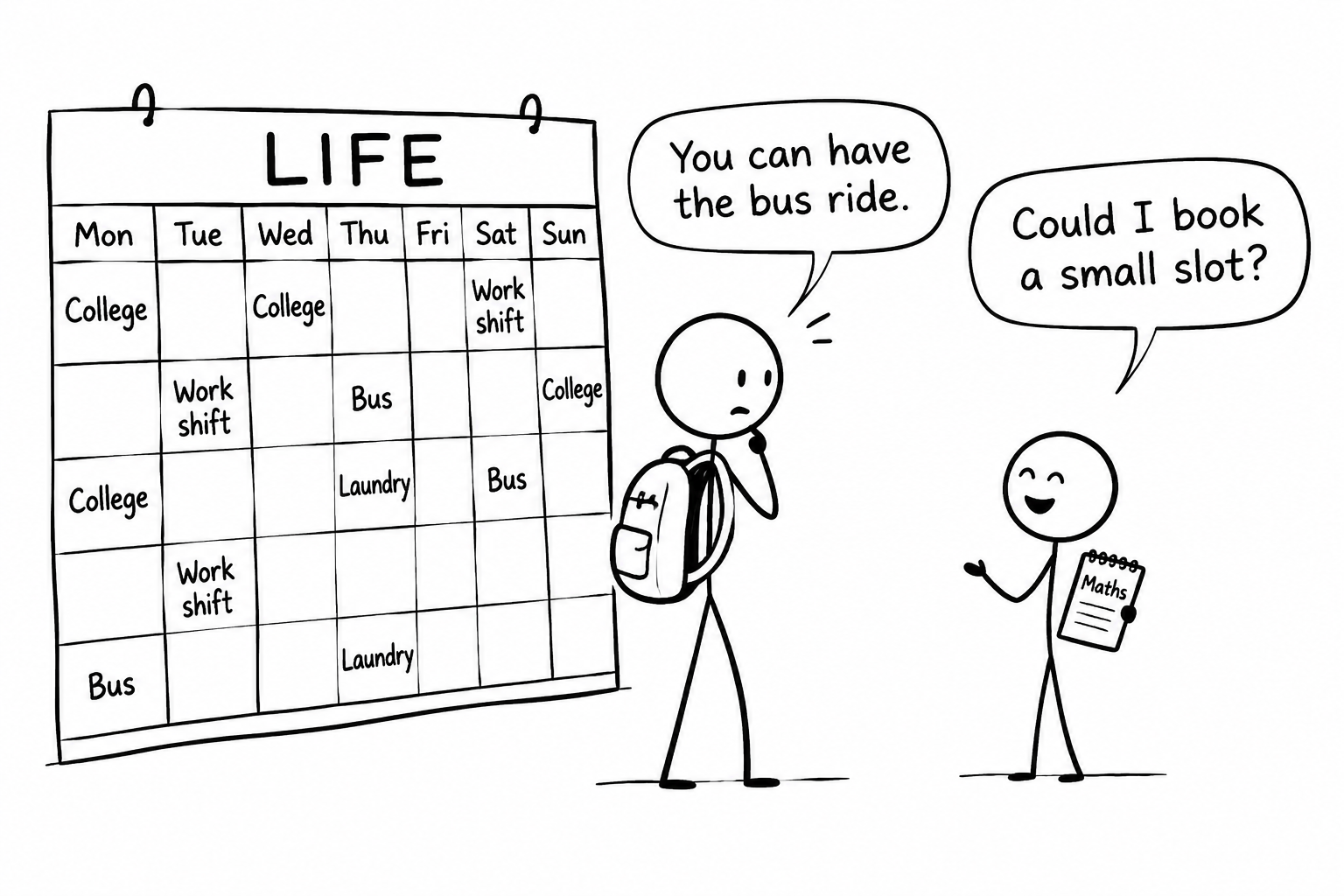 A college student negotiates space for maths revision in a calendar crowded with college, work and everyday responsibilities.
Turn the result into a more precise revision plan
Imagine a college student balancing a vocational course, travel and weekend work. After another disappointing result, “do more maths” is difficult advice to act on. “Practise percentage change and interpreting graphs this week” gives them somewhere to begin.
Find out where marks disappeared
Use your scripts if available, or a recent assessed paper, to distinguish between:
- Knowledge gaps: you did not know the method.
- Application difficulties: you knew the skill but did not recognise when to use it.
- Execution errors: arithmetic, copying, units or calculator input went wrong.
- Unfinished questions: pacing or getting stuck prevented an attempt.
Each problem needs a different response. Watching another explanation may help a knowledge gap. It will do less for pacing unless you also practise under time.
Choose a small set of priorities from the evidence. MathsGenie’s revision lessons and practice questions let you revisit those skills without restarting the entire course.
Build a routine around your actual week
Start with short sessions you can repeat around college, work and other responsibilities. One session might involve a revision lesson and related questions; another might revisit earlier mistakes without notes.
Use mini tests to check specific skills if you study Edexcel. Mark your answers, identify the first incorrect step and attempt a similar question later. Reading a solution is useful, but independent practice tells you whether the method has stuck.
The revision planner can help turn your available time into a realistic schedule. Leave room to adjust it when assignments or shifts change.
Move towards mixed exam practice
Once individual methods feel more secure, combine topics. Mixed questions test whether you can choose a method without a topic heading giving it away.
Use GCSE past papers and mark schemes for your board. Where available, video solutions can help explain an unfamiliar approach after you have attempted the question.
Predicted papers can provide extra practice, but they cannot guarantee which topics will appear. Keep revision broad enough to cover your specification.
Common mistakes after an unsuccessful November resit
Repeating the same revision unchanged. If your previous routine involved mostly watching videos, add written questions, marking and delayed retries. Let the result change the method.
Setting a fixed percentage target for a pass. Grade boundaries vary between exam series and tiers. Use the boundary belonging to the paper you completed, while aiming to improve your underlying accuracy.
Changing tier without discussing it. Foundation and higher tier offer different grade ranges and question demands. Review the choice with your teacher using recent assessment evidence and your progression goal.
Avoiding support until the next exam approaches. Tell your tutor early if anxiety, attendance, travel or an unmet learning need is affecting lessons. This gives your college time to discuss appropriate support and any exam arrangements.
Make your next practice paper count
A November result can leave you feeling that you are repeating the same year. Your next preparation can be more specific: fewer guesses about what went wrong, clearer priorities and practice that checks whether you have improved.
Once you have identified your weak topics, build a targeted practice paper in MathsGenie’s Mock Exam Builder. Choose your subject and board, use the available options to focus your practice, then review the errors before attempting another paper.
Start with the questions your result tells you to work on. That gives your next revision session a purpose you can act on today.















