What Grade Is 65% in GCSE Maths?
GCSE: what grade is 65% in GCSE Maths? Learn how grade boundaries work, estimate your grade from marks, and plan revision with Maths Genie.
A percentage feels like an answer until GCSE grade boundaries arrive
You’ve just finished a mock, opened the results email, and there it is: 65%65\%65%. For a moment, it feels solid. Measurable. Like a number you can hold.
Then the doubt kicks in: What grade is 65%65\%65% in GCSE Maths?
Here’s the uncomfortable truth (and the oddly reassuring one): in GCSE Maths, a percentage is not a grade. It’s a clue. The grade depends on tier (foundation/higher), exam board (Edexcel, AQA, OCR, Eduqas), paper difficulty, and the year’s grade boundaries. Once you understand that system, 65%65\%65% stops feeling mysterious and starts feeling like a plan.
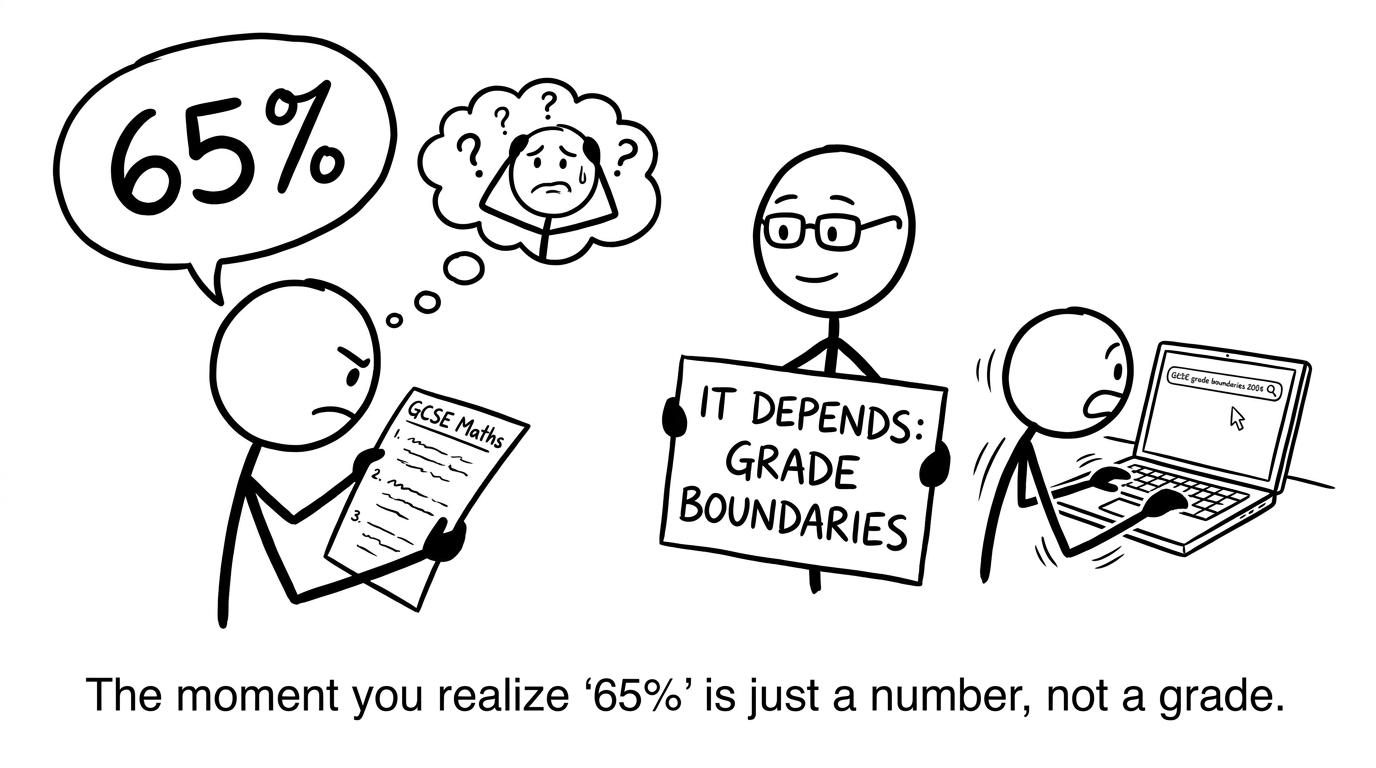 Student staring at 65% and a teacher saying it depends
Quick answer: what grade is 65%65\%65% in GCSE Maths?
For most current UK GCSE Maths specifications, the full set of papers totals 300300300 marks (three papers worth 80,80,8080, 80, 8080,80,80 for Edexcel, for example). If your score is 65%65\%65% overall, that’s:
0.65×300=195 marks 0.65 \times 300 = 195\text{ marks} 0.65×300=195 marksOn many recent series, around 195/300195/300195/300 often sits roughly in the grade 777 to grade 888 region on higher tier (depending on the board and year). On foundation tier, 65%65\%65% can be closer to the top end of the available grades (because foundation caps at grade 555).
But you should treat that as an estimate, not a promise.
To see how boundaries move across years, use the board-specific tables on Maths Genie, such as:
A simple checklist to turn 65%65\%65% into a sensible grade estimate
Before you translate 65%65\%65% into a GCSE grade, run this checklist:
- Are you higher or foundation tier?
- Is your paper Edexcel, AQA, OCR, or Eduqas?
- Is 65%65\%65% from a full set of papers or just one paper?
- Do you know the total marks? (Often 300300300 across three papers.)
- Are you using the correct grade boundaries for that exam series?
If you can answer those, you can estimate your grade with surprising accuracy.
Why 65%65\%65% isn’t a fixed GCSE grade
A lot of revision stress comes from wanting certainty. But GCSE grades are awarded using grade boundaries, not percentages. Grade boundaries shift because each year’s papers are slightly different in difficulty.
That means:
- 65%65\%65% in one year might be comfortably grade 888.
- 65%65\%65% in another year might sit nearer grade 777.
This isn’t unfair; it’s the system trying to keep standards comparable across years.
If you want to anchor your expectations, your best move is to practise with real exam papers and compare your marks to real boundaries.
Good places to do that on Maths Genie include:
Worked example: converting 65%65\%65% into marks (and then into an estimated grade)
Let’s make the process clear and repeatable.
Step 1: Convert your percentage to marks
Assume your GCSE Maths total is 300300300 marks.
Marks=0.65×300=195 \text{Marks} = 0.65 \times 300 = 195 Marks=0.65×300=195So 65%65\%65% corresponds to 195/300195/300195/300.
Step 2: Compare to grade boundaries (example approach)
Suppose (hypothetically) a given series has these higher-tier boundaries:
- Grade 777: 190190190
- Grade 888: 220220220
Then 195195195 is above 190190190 but below 220220220, so it would be an estimated grade 777.
Now imagine a different year:
- Grade 777: 180180180
- Grade 888: 210210210
Then 195195195 would land more securely in the grade 777 range and closer to grade 888.
The big idea: your percentage becomes meaningful only when attached to marks and boundaries.
What 65%65\%65% usually means on higher tier vs foundation tier
Higher tier: 65%65\%65% often signals “strong grade 7 territory”
On higher tier, 65%65\%65% overall usually means you’re doing a lot right: the basics are stable, and you’re picking up marks on middle-to-hard topics. In many recent contexts, it’s commonly around grade 777 and sometimes pushes toward grade 888.
If you’re aiming for grade 888 or 999, the difference is rarely “learn everything again”. It’s often:
- fewer unforced errors
- better method marks
- confidence with multi-step problems
That’s where targeted practice helps. Maths Genie’s topic-by-grade structure is designed for exactly this kind of jump.
Foundation tier: 65%65\%65% can be close to the top
On foundation tier, grades are capped (usually up to grade 555). So 65%65\%65% can put you in a position where the most valuable revision isn’t “more topics” but “more accuracy”: hitting the grade 555 questions consistently and not leaking marks on grade 333 and $4 skills.
Mini tests can be a calm way to build that consistency:
How to estimate your GCSE grade from one paper (not the whole set)
A common situation: you get 65%65\%65% on just Paper 1, and you want to know what grade that is.
Be careful. In GCSE Maths, grade boundaries are usually set on the total across all papers. One strong paper can be balanced by a weaker one (and vice versa).
Still, you can do a sensible estimate:
Worked example
Suppose each paper is out of 808080, and you scored 65%65\%65% on Paper 1.
0.65×80=52 marks 0.65 \times 80 = 52\text{ marks} 0.65×80=52 marksIf you repeated that across three papers, you’d expect:
3×52=156 marks out of 300 3 \times 52 = 156\text{ marks out of }300 3×52=156 marks out of 300Now you compare 156156156 to the total boundaries for that board and series.
This is why practising full papers matters: the exam is a marathon, not a single sprint.
To build stamina without burning out, you can use:
The quiet power move: stop chasing a grade, start chasing marks
A grade is a label. Marks are leverage.
If 65%65\%65% is your current reality, your next improvement is usually not dramatic. It’s boring in the best way: a few marks per paper.
For example, across three papers out of 300300300, moving from 65%65\%65% to 70%70\%70% is:
0.70×300−0.65×300=210−195=15 marks 0.70 \times 300 - 0.65 \times 300 = 210 - 195 = 15\text{ marks} 0.70×300−0.65×300=210−195=15 marksThat’s 151515 marks total. Often 555 marks per paper.
Five marks can be:
- one correct histogram or cumulative frequency interpretation
- one rearranging formula question done cleanly
- one probability tree where you don’t miss the final multiply
This is why structured revision works. Maths Genie is built around small, repeatable wins: revision lessons, practice questions, mark schemes, and video solutions.
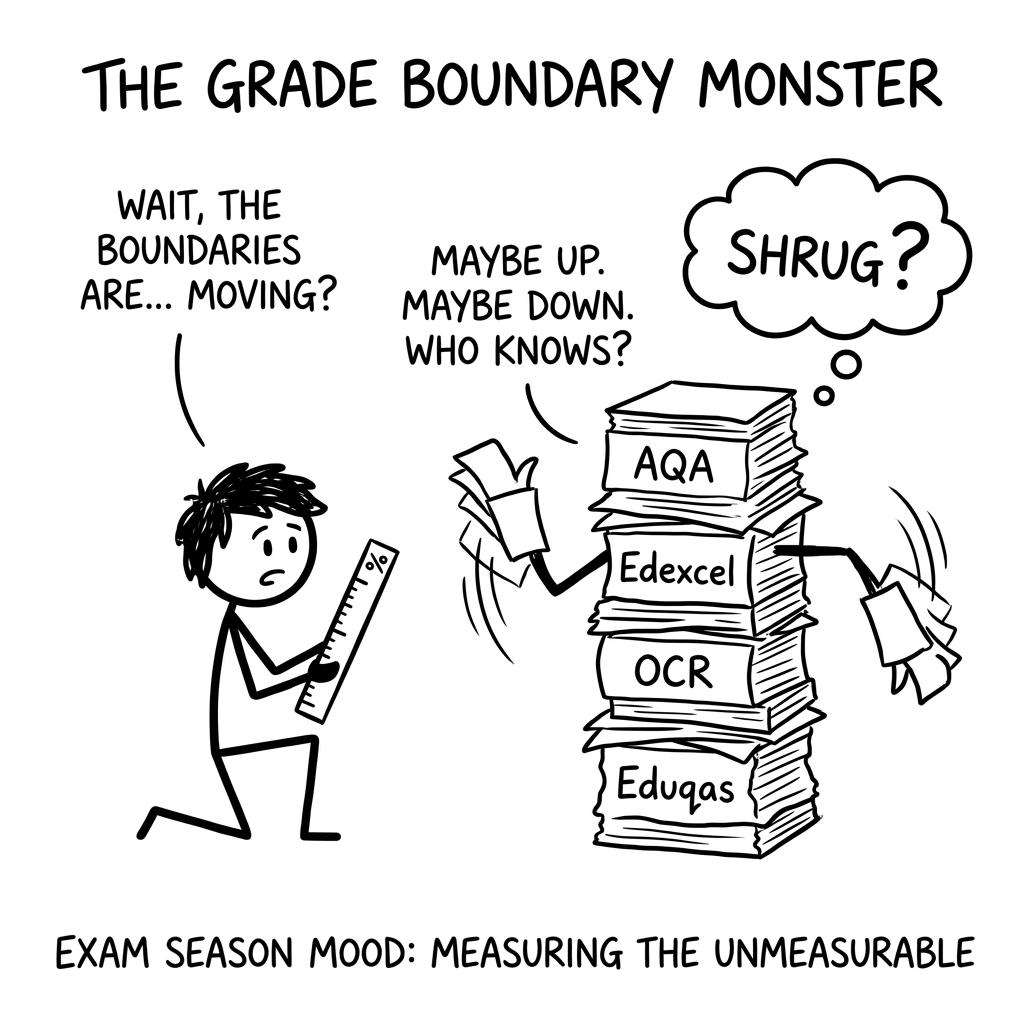 Grade boundary monster shifting around
Common mistakes students make when asking “what grade is 65%65\%65% in GCSE Maths?”
Mixing up percentage and total marks
Students often say “I got 65%65\%65%” without knowing whether the test was out of 404040, 808080, or 300300300. In GCSE Maths, those are completely different situations. Always convert to marks first using marks=percentage×total\text{marks} = \text{percentage} \times \text{total}marks=percentage×total. If you don’t know the total, you don’t really know what the 65%65\%65% means. Ask for the raw mark.
Comparing across exam boards without checking boundaries
An Edexcel paper and an AQA paper can feel different even in the same year. Grade boundaries are board-specific. If you’re estimating, use the boundaries relevant to your course. Otherwise you’ll either panic unnecessarily or relax too early.
Treating one paper as the whole GCSE
A strong Paper 1 doesn’t guarantee a strong overall outcome, especially if your calculator skills are weaker or you rush the non-calculator paper. GCSE grades are usually based on total marks across the set. Train as a set: Paper 1, Paper 2, Paper 3. The habit of finishing one paper properly is what lifts the full score.
Ignoring method marks
At 65%65\%65%, you’re often losing marks in the same way repeatedly: missing a step, forgetting units, or not showing working. Mark schemes reward method, not just final answers. When you practise, use mark schemes actively. Maths Genie past papers and resources are designed so you can check method marks quickly.
A realistic way to use 65%65\%65% in your revision plan
If you’re sitting at 65%65\%65%, you’re not “stuck”. You’re actually in the most improvable zone of GCSE Maths: where a small change in habits can produce a noticeable change in marks.
Try this approach for two weeks:
- Do one full paper (or a 45-minute half-paper) under timed conditions.
- Mark it using the mark scheme and write down why each mark was lost.
- Pick two weak topics and revisit them using targeted revision.
- Repeat with a second paper and check whether the same mistakes show up.
To support that, here are strong Maths Genie resources to build into your routine:
- GCSE Predicted Papers and Revision Resources
- AQA GCSE Maths Past Papers (Foundation and Higher)
- OCR GCSE Grade Boundaries
- 45 Minute Edexcel GCSE Maths Tests
- GCSE Mini Tests
- GCSE Statistics Revision (extra support for data skills)
- GCSE Summer Revision Guide (seasonal focus)
Conclusion: so, what grade is 65%65\%65% in GCSE Maths?
In GCSE Maths, 65%65\%65% is best understood as a mark level that often corresponds to a strong higher-tier outcome (frequently around grade 777, sometimes pushing toward grade 888), but it is never a guaranteed grade without the right boundaries.
Convert your 65%65\%65% to marks, compare to the correct board and series grade boundaries, then use that information to win back a handful of marks per paper. That’s where grades move.
If you want the simplest route from “I got 65%65\%65%” to “I know what to do next”, use Maths Genie as your base camp: revision lessons to relearn topics cleanly, practice questions to build accuracy, past papers to build stamina, and predicted papers to sharpen focus close to exam day. Your next grade isn’t hidden in a percentage. It’s waiting in the marks you’re about to earn.