

Volume GCSE Maths Resit: Secure Grade 4 Marks
Volume GCSE maths resit guide for grade 4: learn prism and cylinder methods, avoid common mistakes, and practise exam questions with clear worked examples.
A volume question can look complicated: a three-dimensional diagram, several measurements and units that are easy to overlook. For a post-16 student, it can bring back the feeling that this topic never quite made sense.
But volume GCSE maths resit questions involving prisms and cylinders rest on one dependable idea: find the area of a constant cross-section, then multiply by the solid's length. Recognising that cross-section makes the method repeatable.
This is useful grade 4 revision, although no topic guarantees a grade. Your aim is to collect accessible marks across the paper.
Your volume grade 4 checklist
Before attempting exam questions, check that you can:
- identify a constant cross-section;
- calculate the area of a rectangle, triangle or circle;
- use V=A×lV = A \times lV=A×l;
- distinguish radius from diameter;
- convert measurements into compatible units;
- use cubic units and show working;
- follow the requested rounding instructions.
If anything feels uncertain, start with the Volume of a Prism revision lesson.
Read the question before reaching for your calculator. Underline what you need to find and label the measurements you will use. This pause helps separate relevant information from distracting detail, especially when a diagram is drawn at an unfamiliar angle or includes a sloping edge you do not need.
The volume method for a GCSE maths resit
A prism has the same polygonal cross-section throughout its length. Imagine slicing a loaf: each slice has the same shape.
The formula is:
V=A×lV = A \times lV=A×lHere, AAA is the cross-sectional area and lll is the prism's length. Identify the cross-section, calculate its area, then multiply by the length.
For a triangular cross-section, use the triangle area formula. A cylinder has a circular cross-section, so the same area-times-length principle applies, using the area of a circle.
Cuboids, other right prisms and cylinders are covered at GCSE foundation tier and remain relevant on higher tier. Secure these methods before tackling less familiar solids.
The length in this formula measures the distance between the matching end faces. It is different from the height used to calculate a triangular cross-section. Giving those measurements separate labels can prevent a common confusion: using the same height twice while leaving the actual length out of the calculation.
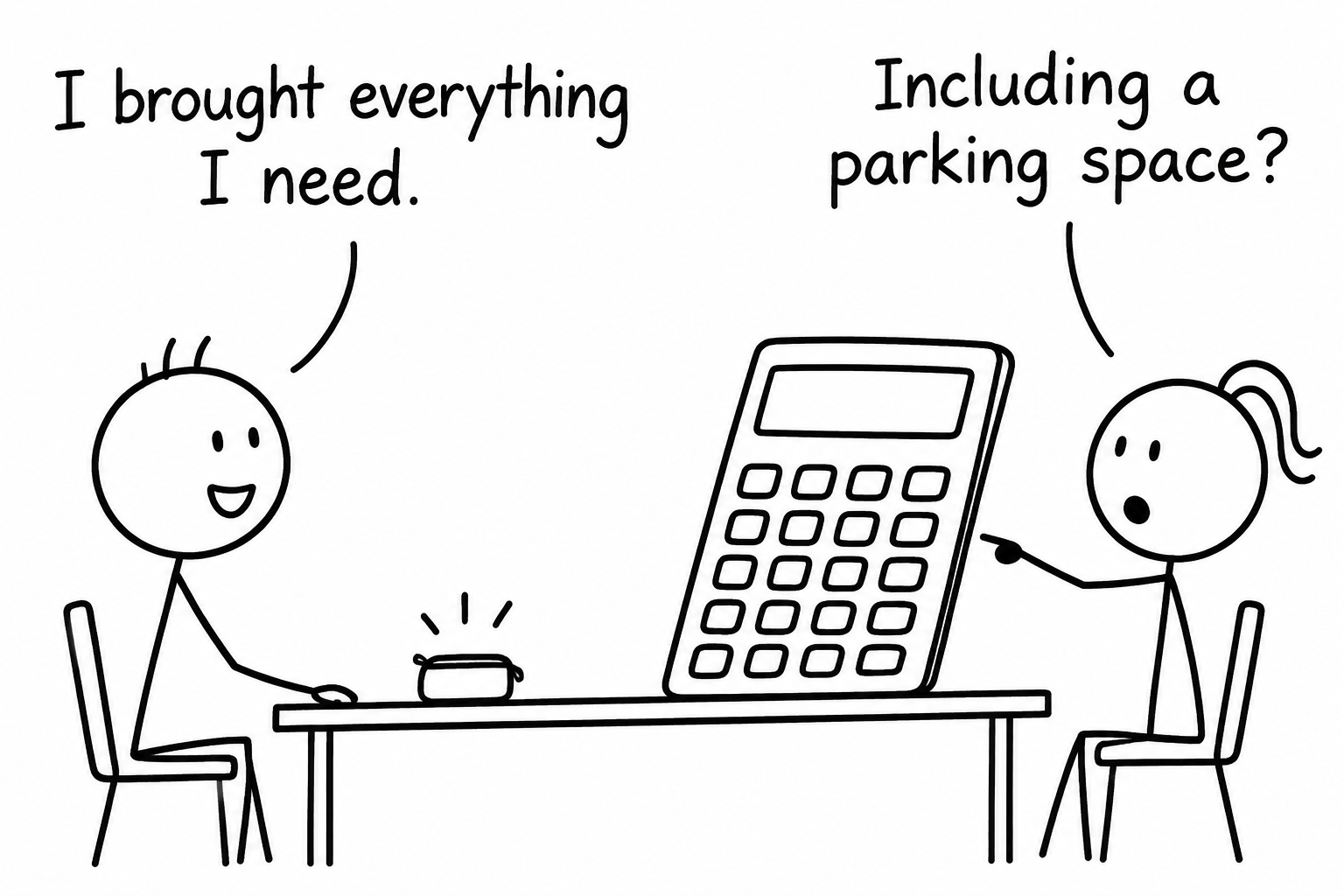 A post-16 student arrives for revision with an enormous calculator
Worked example: a triangular prism
A triangular prism has a cross-section with base 8 cm8\text{ cm}8 cm and perpendicular height 5 cm5\text{ cm}5 cm. Its length is 12 cm12\text{ cm}12 cm. Find its volume.
First calculate the triangular area:
A=12×8×5=20 cm2A = \frac{1}{2} \times 8 \times 5 = 20\text{ cm}^2A=21×8×5=20 cm2Then multiply by the prism's length:
V=20×12=240 cm3V = 20 \times 12 = 240\text{ cm}^3V=20×12=240 cm3The factor of 12\frac{1}{2}21 matters because the cross-section is triangular. Multiplying every measurement together without it would double the answer.
Writing both stages can help secure method marks even if a later arithmetic slip occurs, depending on the mark scheme.
Reinforce the process with the interactive Volume of a Prism lesson, then try the GCSE Maths question bank.
Worked example: the volume of a cylinder
A cylinder has diameter 10 cm10\text{ cm}10 cm and height 7 cm7\text{ cm}7 cm. Calculate its volume to 333 significant figures.
Halve the diameter to find the radius:
r=10÷2=5 cmr = 10 \div 2 = 5\text{ cm}r=10÷2=5 cmCalculate the circular cross-sectional area:
A=πr2=π×52=25π cm2A = \pi r^2 = \pi \times 5^2 = 25\pi\text{ cm}^2A=πr2=π×52=25π cm2Multiply by the height:
V=25π×7=175π cm3V = 25\pi \times 7 = 175\pi\text{ cm}^3V=25π×7=175π cm3Using a calculator gives:
V=549.778… cm3V = 549.778\ldots\text{ cm}^3V=549.778… cm3To 333 significant figures:
V=550 cm3V = 550\text{ cm}^3V=550 cm3Keep π\piπ in the calculator until the final line. Using the diameter as the radius would make the answer four times too large because the radius is squared.
Use the MathsGenie cylinders lesson for further practice.
Why cubic units matter
Area uses square units because two dimensions are multiplied. Volume uses three dimensions:
cm×cm×cm=cm3\text{cm} \times \text{cm} \times \text{cm} = \text{cm}^3cm×cm×cm=cm3Writing cm2\text{cm}^2cm2 for a volume confuses area with volume and may lose a mark. Check that your final answer uses cubic units.
If measurements mix metres and centimetres, convert them before calculating. Converting volume units afterwards requires cubing the length conversion factor, so starting with compatible lengths is usually simpler.
A useful final check is to read your working as a sentence: cross-sectional area multiplied by length gives volume. If you have only calculated an area, the question is unfinished. If the answer seems unexpectedly large or small, revisit the units and the radius before repeating the calculator entry.
Common mistakes that cost volume marks
Choosing the wrong cross-section
Find the face whose shape and size remain constant through the prism's length. It is not necessarily the largest face. Label its dimensions before calculating.
Forgetting part of an area formula
For triangles, include 12\frac{1}{2}21 and use the perpendicular height. A sloping edge is not automatically the height. Write the complete formula before substituting values.
Using diameter instead of radius
The circle area formula is A=πr2A = \pi r^2A=πr2. Halve a given diameter first, then label the radius clearly to prevent substituting the wrong measurement.
Confusing volume with surface area
Volume measures space inside a solid; surface area measures its outside covering. Review surface area questions separately to keep the methods distinct.
Rounding early or hiding working
Keep full calculator values until the final answer. Show the area calculation and multiplication by length separately so the examiner can follow your reasoning.
A focused resit revision routine
Start with a lesson, answer a small group of questions without notes, then mark them. Classify each error: cross-section, formula, calculator, units or rounding.
This diagnosis directs your next attempt. Correcting a diameter misunderstanding is more useful than repeating questions with the same mistake.
After checking a solution, close it and redo the question on a blank page. Explain why each measurement belongs in your calculation. Return to a similar question in a later revision session; remembering the method after a gap is a more useful check than immediately copying a solution accurately.
The Edexcel GCSE Maths exam booklets provide topic practice. Students following AQA can use the AQA GCSE revision guides to organise revision around their course.
Once the method feels secure, mix volume with other topics. In an exam, recognising which method to use is part of the challenge.
Turn the method into exam marks
A resit gives you another opportunity to make your approach deliberate: identify the cross-section, find its area, multiply by the length and check the units.
Use MathsGenie's lessons, practice questions, worked solutions and mark schemes to address specific gaps. Then build a targeted practice paper in Mock Exam Builder. Complete it under timed conditions and use each correction to choose what to practise next.















