

Using Past Papers for the November Resit
Using past papers for the November resit? Learn how to diagnose gaps, practise by topic and turn each GCSE maths paper into a focused revision plan.
A November resit can feel oddly compressed. You leave school in summer, begin college or training, and suddenly the next GCSE maths exam is close enough to shape every week.
The best approach to using past papers for the November resit is not to complete as many papers as possible. It is to use each paper as a diagnostic tool: sit it under realistic conditions, mark it carefully, identify the reasons behind lost marks, practise those specific skills, then test them again.
That creates a useful cycle:
Attempt, mark, diagnose, repair, retest.
This guide follows the kind of routine a post-16 resit student can fit around a new timetable, rather than treating autumn as a repeat of Year 11.
Your past-paper checklist
A productive November resit plan should include:
- one initial paper to establish your current position
- the correct exam board and tier
- timed practice without notes or interruptions
- marking with the official mark scheme
- an error log organised by topic and cause
- focused revision between full papers
- another paper to measure whether the work helped
Past papers reveal what you can do under exam conditions. They are less effective at teaching a skill from the beginning, so combine them with MathsGenie GCSE revision resources, practice questions and video solutions.
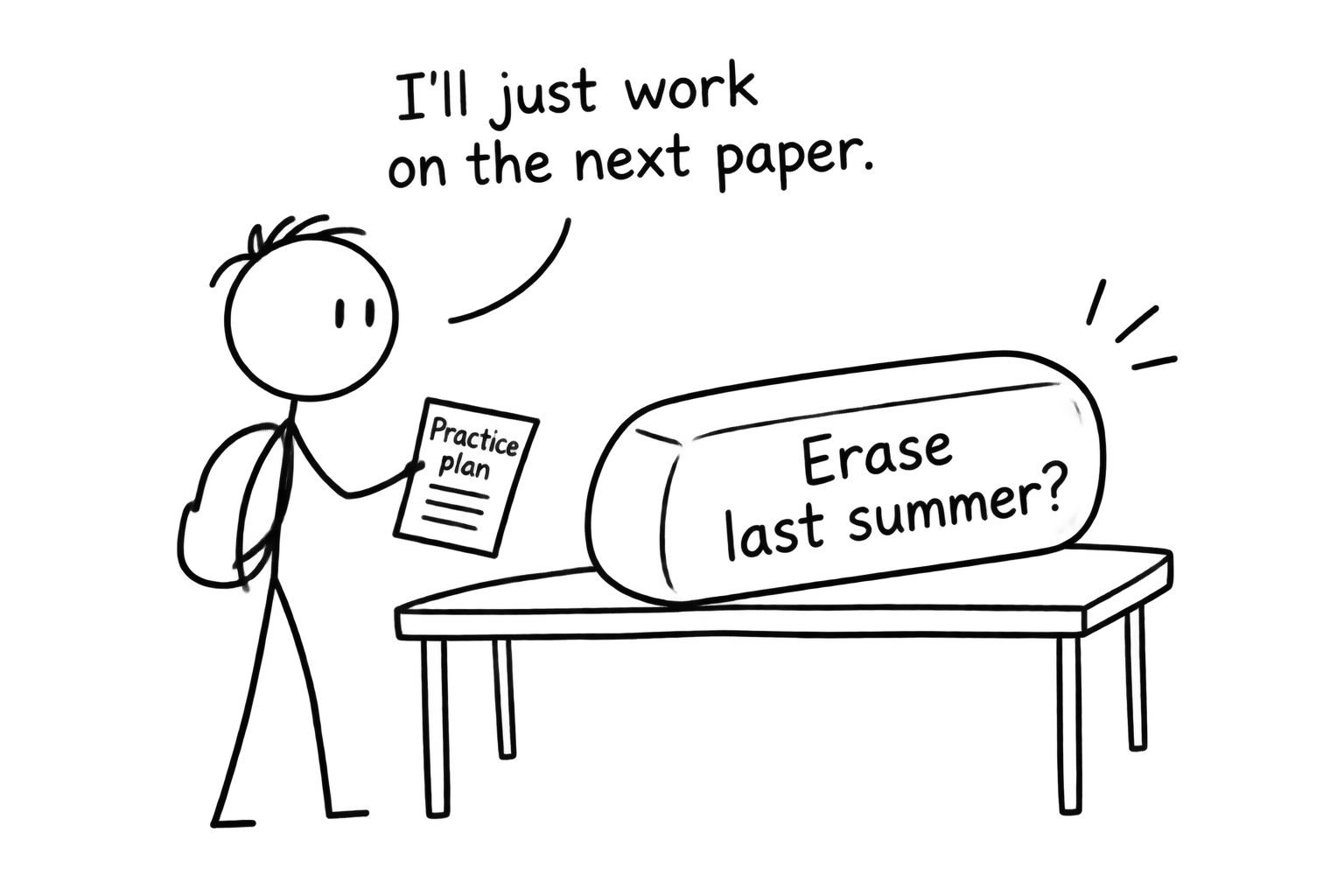 A post-16 resit student chooses the next practice paper rather than trying to erase last summer
Begin with one honest GCSE maths resit paper
Imagine a student starting college in September. Their timetable is unfamiliar, travel takes longer than expected, and maths now competes with a course they chose. Giving that student a pile of ten papers is not a plan. It is a source of guilt.
One paper is enough to begin.
Choose a paper from your exam board and the tier for which you have been entered. MathsGenie's GCSE maths past papers provide papers alongside mark schemes and worked solutions. Check your entry details with your school, college or exam centre if you are unsure about the board or tier.
Before relying on any published date, confirm the current November timetable with your centre and exam board. Exam arrangements can change between series, and your centre controls practical details such as arrival times and rooming.
Sit the first paper somewhere quiet. Use only the equipment allowed in the relevant exam and follow its stated time limit. If it is a calculator paper, use the calculator you expect to take into the exam. If it is non-calculator, put the calculator away completely.
This first mark is not a prediction. It is evidence.
Mark the reason, not only the answer
A mark scheme tells you where marks were available. It cannot automatically tell you why you missed them.
For every lost mark, assign a cause:
| Cause | What it might mean | Next action |
|---|---|---|
| Knowledge gap | You did not know the method | Relearn the topic and complete practice questions |
| Method error | You knew the topic but chose an unsuitable approach | Compare your work with a video solution |
| Accuracy error | Your method was sound but arithmetic or algebra failed | Practise shorter questions with written checks |
| Misread question | You answered something different from what was requested | Underline command words and required units |
| Time pressure | You left reachable marks untouched | Practise decisions about when to move on |
Be strict but fair when marking. Award marks according to the scheme, including method marks where your working earns them. Then watch the relevant video solution rather than merely copying the final answer.
A paper marked out of 808080, for example, can be converted into a percentage using
marks achieved80×100.\frac{\text{marks achieved}}{80}\times 100.80marks achieved×100.However, do not turn that percentage directly into a promised grade. Grade boundaries differ between exam series and papers. Use the mark to track progress, while treating official boundaries for the relevant series as historical context rather than a guarantee.
Turn the paper into a targeted revision plan
The paper becomes valuable after it has been marked.
Suppose your error log shows repeated difficulty with fractions, rearranging formulae and probability trees. Spending the next session on an entire new paper would expose the same gaps again. It would feel busy without changing much.
Instead, choose the two or three topics costing the most accessible marks. Use the MathsGenie GCSE topic list to find revision lessons, exam-style questions and solutions at an appropriate level.
A practical weekly rhythm might look like this:
- Session one: complete and mark a section of a paper
- Session two: revise the weakest topic and answer focused questions
- Session three: revise a second weak topic
- Session four: redo selected missed questions without notes
Short, specific sessions often fit post-16 life better than vague instructions to revise maths all evening. Use the MathsGenie revision planner to organise work around college, employment or training commitments.
Use full papers and targeted practice differently
Full papers and topic practice solve different problems.
A full paper tests endurance, timing, topic recognition and the transition between unfamiliar questions. Targeted practice builds fluency in one area. You need both.
Early in the revision period, place more emphasis on repairing weaknesses. As the November resit approaches, increase the number of timed sections and complete papers. This avoids using up every recent paper before you have improved the skills those papers test.
MathsGenie's practice papers and predicted papers can provide further exam-style material. A predicted paper is useful practice, but it cannot guarantee which topics will appear. Revise the specification broadly and treat predictions as rehearsal, not inside information.
Retest without memorising solutions
After revising a weak area, return to selected questions from the first paper. Leave enough time that you must reconstruct the method rather than reproduce a remembered answer.
Ask three questions:
- Can I identify the topic without being told?
- Can I complete the method independently?
- Can I explain why each step is valid?
Then test the same skill through unfamiliar questions. This matters because genuine improvement is transferable. Remembering that one particular answer was 242424 is not the same as understanding the method that produced it.
The next full paper should show whether your changes survived time pressure. Compare causes as well as totals. A small increase in marks alongside fewer blank answers or fewer misread questions can be meaningful progress.
Common mistakes when using past papers
Completing papers without reviewing them
A stack of finished papers can create the appearance of revision. Improvement usually happens during the review: locating the gap, learning the method and trying again.
Looking at answers too quickly
Struggle is informative. Give yourself a genuine attempt before consulting a mark scheme or video solution. During a timed paper, mark the question and move on instead of checking the answer.
Practising only comfortable topics
Correct answers feel reassuring, but your error log should decide the next task. Give priority to recurring weaknesses and questions where a modest improvement could recover marks.
Ignoring working and units
GCSE maths mark schemes can reward valid method even when the final answer is wrong. Show substitutions, algebraic steps and calculations clearly. Include required units and check whether the question asks for an exact value, an estimate or a stated degree of accuracy.
Treating one paper as a verdict
Performance changes with topic mix, timing and concentration. Look for a pattern across several carefully reviewed attempts rather than allowing one difficult paper to define your expectations.
Build the next paper around what you need
The November resit is not about recreating Year 11. You now know more about how you work, what disrupts your concentration and which methods disappear under pressure. Past papers let you turn that knowledge into decisions.
Start with evidence. Repair what the evidence reveals. Then retest it.
When a complete paper is too broad, use MathsGenie's Mock Exam Builder to build a targeted practice paper around the topics in your error log. Complete it under timed conditions, mark it honestly and let the results choose your next revision session. That is how past papers stop being a record of old mistakes and become a route towards a better November resit.















