

Typing vs Handwriting Notes GCSE Geography
Typing vs handwriting notes GCSE Geography: discover which improves recall, when each method works, and how active revision makes knowledge stick.
Which note-taking method actually helps you remember?
A page can look productive without producing much learning. Typed notes become neat documents. Handwritten notes fill exercise books. Yet, when the book closes and an exam question appears, neither format guarantees that the information will be there.
For students comparing typing vs handwriting notes GCSE Geography, the most useful answer is not that one method always wins. Handwriting may encourage you to select, organise and rephrase information, while typing is often better for speed, storage and editing. But recall depends far more on what you do with your notes afterwards.
If you merely reread them, either method can fail. If you use them for retrieval practice, spaced revision and exam questions, either can become effective.
That matters beyond Geography. The same memory principles can strengthen your GCSE maths revision, although maths also requires repeated problem-solving rather than notes alone.
The short answer: choose thinking over transcription
A sensible note-taking system should help you:
- identify the important information;
- explain it in your own words;
- connect ideas rather than list isolated facts;
- retrieve knowledge without looking;
- correct misunderstandings quickly;
- revisit material after increasingly long intervals; and
- apply what you know to exam questions.
Handwriting often supports the first three because writing is relatively slow. You cannot comfortably capture every sentence, so you are pushed to make decisions. Typing can support the same thinking, but only if you resist copying material word for word.
Typing has practical advantages too. Digital notes are searchable, easy to reorganise and convenient when you are combining information from several lessons. They may also be more accessible for students with particular physical, visual or learning needs.
The winning method is therefore the one that leads to active thought and later retrieval, not the one that creates the prettiest page.
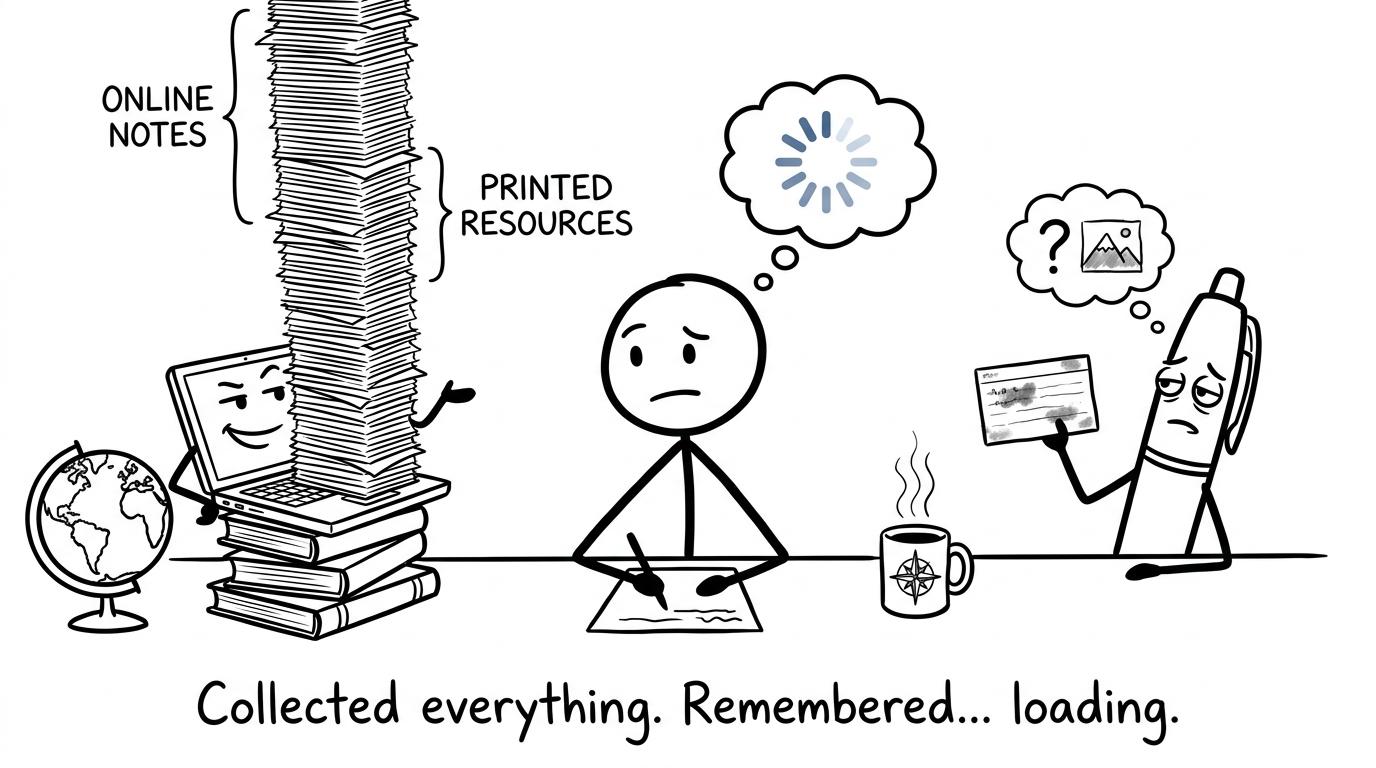 A laptop celebrates collecting everything while a thoughtful pen keeps one useful revision card
How memory actually turns notes into knowledge
Memory is not a filing cabinet into which information is deposited permanently. Learning requires information to be encoded meaningfully, retrieved later and strengthened through use.
Encoding requires decisions
When you decide whether a Geography detail is evidence, a process, a cause or a consequence, you give it structure. That structure provides more routes back to the information later.
Handwriting can encourage this because its slower pace makes complete transcription difficult. A student might reduce a long explanation to a short causal chain, sketch a labelled process or place evidence beneath a clear heading. The benefit comes from selecting and organising, not from the movement of the pen alone.
Typing can produce equally thoughtful encoding when you pause to summarise, compare or ask questions. It becomes less useful when speed allows you to record sentences without processing their meaning.
Retrieval changes what notes are for
Notes should eventually become prompts, not scripts. Close the page and try to reproduce a process, case-study outline or sequence of causes. Then check what was missing.
This is retrieval practice: attempting to bring knowledge to mind instead of repeatedly exposing yourself to it. The attempt reveals weak areas and makes later recall easier. A blank page, verbal explanation or short self-quiz can all work.
The principle transfers directly to maths. Reading a method can make it feel familiar, but familiarity is not the same as being able to start an unfamiliar question. After reviewing a topic through the GCSE maths revision lessons, close the explanation and attempt practice questions independently.
Spacing makes retrieval more demanding
Revisiting material across separate sessions is usually more valuable than repeating it several times in one sitting. Some forgetting between sessions makes retrieval harder, but that effort is part of the learning.
A revision plan can schedule brief returns to topics rather than leaving everything until the final week. MathsGenie's GCSE revision planner can help you organise this process across maths topics while you apply the same idea to Geography units.
When handwriting is likely to work better
Handwriting is particularly useful when the task benefits from compression or spatial organisation. This includes:
- condensing a case study to essential evidence;
- drawing connections between physical and human processes;
- creating a rough mind map from memory;
- annotating maps, diagrams or fieldwork methods;
- planning an extended response; and
- writing a summary without copying the source.
A handwritten page can make relationships visible. Arrows, grouped ideas and quick annotations may be easier to place freely than in a conventional document.
However, handwriting is not automatically active. Copying a textbook neatly remains copying. Colour-coded headings can help organisation, but decoration that requires no decisions about meaning contributes little to recall.
The useful question is: did writing this page make you retrieve, select or connect anything?
When typing is likely to work better
Typing is valuable when efficiency and organisation genuinely serve learning. It may be the better choice when you need to:
- combine class material into one searchable resource;
- reorganise notes after identifying a clearer structure;
- update case-study facts supplied by your school;
- create question-and-answer prompts;
- record feedback from several exam questions; or
- use accessibility tools that make digital work more comfortable.
The danger is frictionless transcription. A keyboard can make it easy to collect more information than you can meaningfully process. Notifications, open tabs and rapid switching between tasks can also interrupt attention, although this is a device-management problem rather than proof that typing itself prevents learning.
Use a focused document, hide the source after reading a section and type a summary from memory. Add questions in the margin instead of merely bolding sentences. These small constraints turn a digital document into a revision tool.
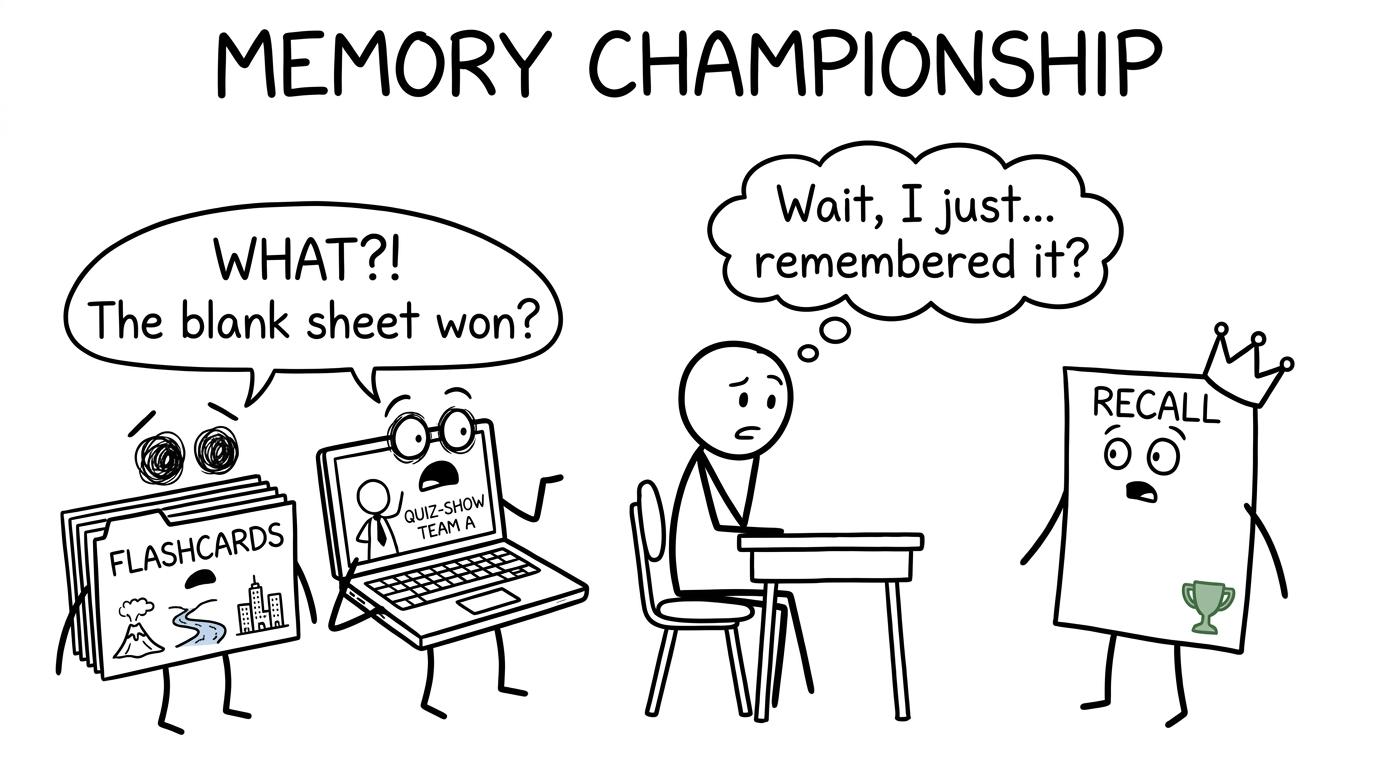 Handwritten cards and a laptop discover that active recall has won the revision trophy
A hybrid system for GCSE Geography and maths
You do not need to make a permanent choice between pen and keyboard. Each format can handle the job it does best.
Capture and organise digitally
Use a digital document to store lesson summaries, teacher feedback, specification headings and links to resources. Keep the structure simple enough that you can find a topic quickly.
Do not treat this master document as the revision itself. It is the source from which you create prompts and identify gaps.
Compress important ideas by hand
Without looking, handwrite a short summary, causal chain, comparison or diagram. Check it against your source and correct omissions in another colour. The change of format is useful because it prevents passive copying.
Turn notes into questions
Convert every major heading into something you could answer without support. Geography prompts might ask for a process, comparison, judgement or piece of case-study evidence.
In maths, prompts should lead rapidly to doing questions. MathsGenie's grade-based GCSE revision resources combine topic guidance with practice, while the higher-grade revision topics help students target more demanding content when appropriate.
Test under exam conditions
Notes are preparation for performance, not the performance itself. Geography students need to interpret command words, select evidence and construct responses. Maths students need to recognise methods, carry out accurate working and communicate reasoning.
Use GCSE maths past papers to test whether knowledge transfers beyond familiar exercises. Check the relevant mark scheme, then use MathsGenie mini tests or topic questions to address specific weaknesses.
Keep an error log, either typed or handwritten. Record what went wrong, why it happened and what you will do next time. That document is often more valuable than a large folder of general notes because it is built from evidence about your own performance.
Why the answer is slightly different for maths
Geography revision involves processes, examples, data, concepts and extended arguments. Notes can organise much of this knowledge before you practise applying it.
Maths is more procedural. You may need a brief record of a formula, definition or method, but improvement comes primarily from attempting questions and responding to feedback. Copying worked solutions, by hand or keyboard, can create confidence without independence.
A stronger sequence is to review a concise explanation, attempt questions without support, mark them and revisit errors. MathsGenie predicted papers can provide additional exam-style practice, while video solutions help you diagnose a method only after you have made a genuine attempt.
This distinction prevents a common revision trap: using a technique that feels successful in one subject without adapting it to the demands of another.
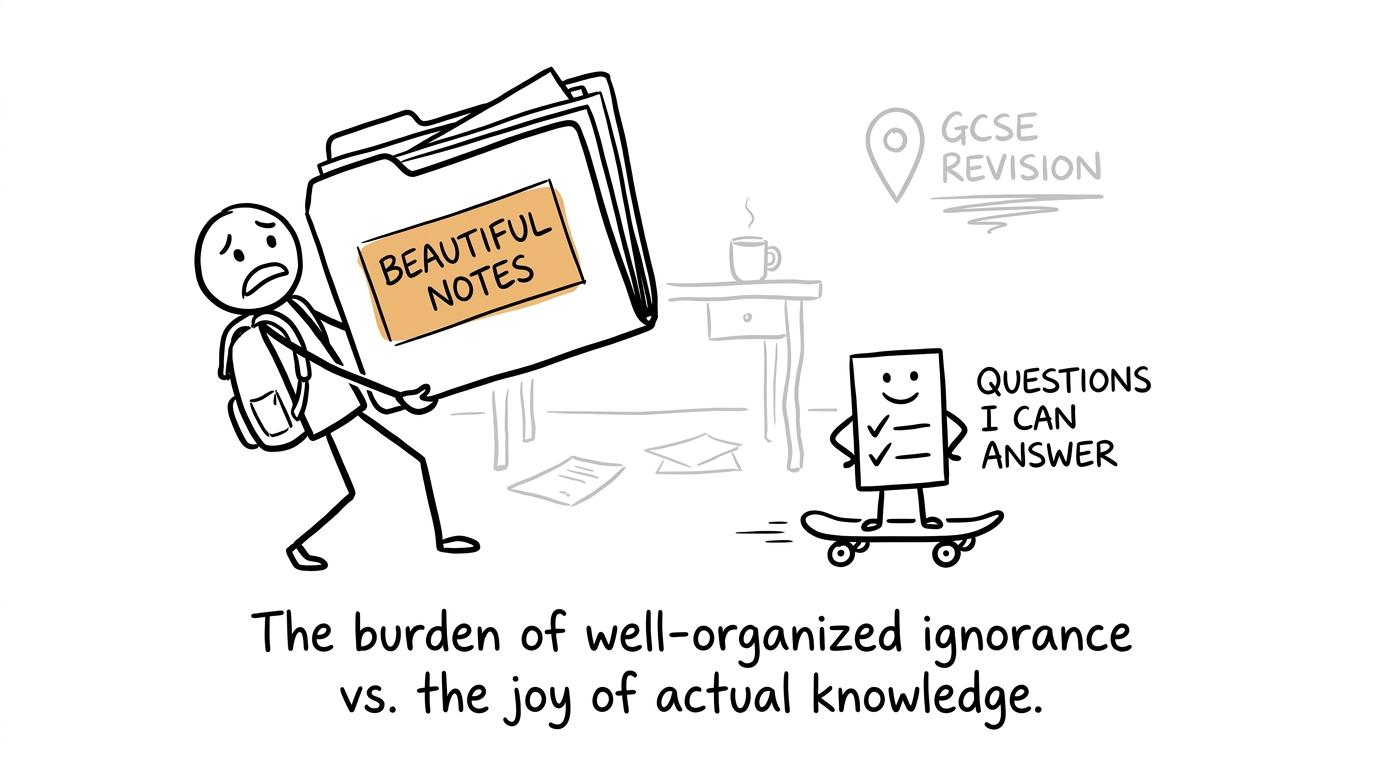 A giant folder of beautiful notes watches a small checklist of answerable questions roll past
Common mistakes with typed and handwritten notes
Mistaking neatness for memory
A polished page may be easy to read, but its appearance does not show whether you can retrieve the content. Test yourself before spending time redesigning it.
Copying complete sentences
Verbatim copying reduces the decisions that make note-taking useful. Read a manageable section, hide it and express the meaning concisely.
Rereading without a question
Rereading can support a first review, but repeated reading often creates familiarity rather than dependable recall. Give each session a prompt: explain, compare, draw, justify or solve.
Revising only in your preferred format
Preference and effectiveness are not identical. You might enjoy typing yet remember more after drawing a process from memory. Judge a method by delayed recall and exam performance, not comfort alone.
Making notes instead of answering questions
There is a point at which another summary offers less value than practice. For maths especially, move promptly from the foundation GCSE revision topics or higher-tier lessons to independent questions and mark-scheme feedback.
Using two systems without connecting them
A hybrid method fails if handwritten sheets and digital files become separate archives. Give both the same topic headings and use one clear list to track what has been reviewed, tested and corrected.
The method matters less than the learning it produces
The typing versus handwriting debate is attractive because it appears to offer a simple choice. Memory is less tidy. Handwriting can slow you down enough to think; typing can make revision organised and accessible. Neither rescues passive learning.
For GCSE Geography, use handwriting when compression, diagrams and planning help you see relationships. Use typing when search, editing and organisation save useful time. Then close both and retrieve the knowledge.
For GCSE maths, take the same principle one step further: move from explanation to independent problem-solving as quickly as you reasonably can. Start with MathsGenie's free revision lessons, practise by topic, use mini tests, and build towards past papers and predicted papers with mark schemes and video solutions. Your notes are not the destination. They are the route to what you can do unaided.










