Typing vs Handwriting Notes for GCSE Astronomy
Typing vs handwriting notes GCSE Astronomy: discover what memory research suggests and build a practical routine for more reliable exam recall at GCSE.
A blank page can create an oddly difficult decision. Do you open a document and type quickly, or take out a pen and accept that your notes will be slower and less tidy?
For typing vs handwriting notes GCSE Astronomy, the useful answer is not that one method always wins. Handwriting can encourage you to select, organise and rephrase information, which may strengthen understanding. Typing is better for speed, editing and building searchable resources. But neither reliably produces long-term recall unless you later close the notes and retrieve the knowledge from memory.
That is the central idea: the method that sticks better is usually the one that makes you think, test yourself and revisit material over time.
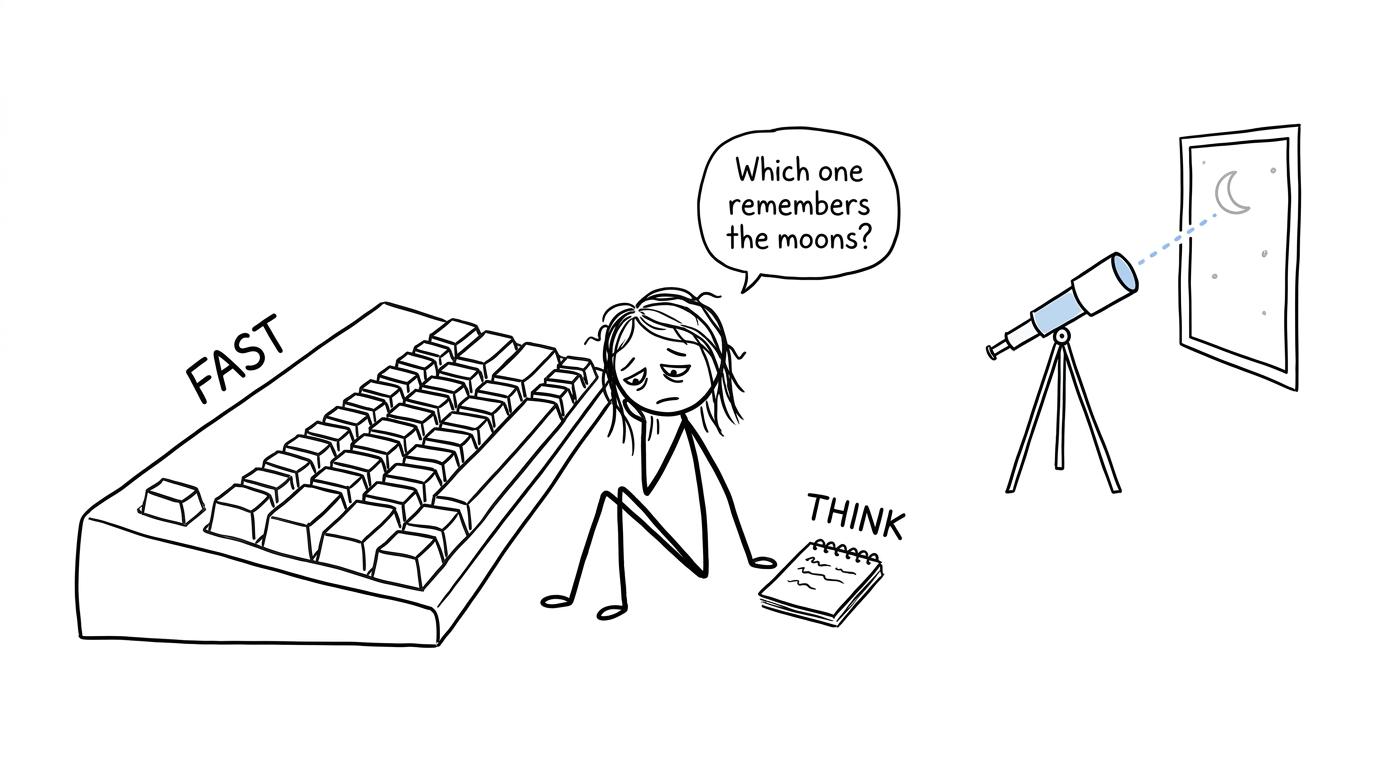 A GCSE student choosing between a fast keyboard and a thoughtful notebook
The short answer: choose thinking over transcription
Use this checklist when choosing how to make GCSE Astronomy notes:
- Handwrite when you need to process a difficult explanation, sketch a diagram or connect several ideas.
- Type when you need an organised summary, searchable definitions or a resource that will be updated.
- Use either method for an initial set of notes, but convert those notes into questions.
- Practise retrieval without looking at the page.
- Space your revision across several sessions rather than repeatedly reading everything in one evening.
- Complete exam questions because remembering information and applying it for marks are different skills.
If you are also preparing for GCSE Maths, the free MathsGenie GCSE revision hub provides structured lessons, videos and questions organised by grade and topic.
What memory research actually tells us
It is tempting to ask whether a pen or keyboard has a special effect on memory. The more important question is what you do mentally while using it.
Memory involves at least three relevant stages:
- Encoding: noticing and making sense of new information.
- Storage: retaining it over time.
- Retrieval: bringing it back when it is no longer in front of you.
Handwriting can support encoding because it is relatively slow. You cannot usually record every sentence, so you must decide what matters and express it more concisely. That selection can create meaningful processing.
Typing can become shallow if it turns into word-for-word transcription. However, this is a behaviour associated with typing, not an unavoidable property of keyboards. A student who types a concise explanation from memory may process the material more deeply than someone who copies a textbook neatly by hand.
Research comparing handwritten and typed notes has produced results that depend on the task, the students, the delay before testing and whether notes can be reviewed. It does not support a universal rule that handwriting always leads to better examination performance. The safer conclusion is that generative note-taking, summarising, questioning and connecting ideas, matters more than the tool alone.
There is stronger practical support for retrieval practice and spaced revision. Looking away from your notes and attempting to recall an idea exposes what you genuinely know. Returning to it after some forgetting has occurred makes retrieval more demanding, and that effort can strengthen later access.
Notes are therefore not the finished product. They are raw material for practice.
When handwriting is likely to help
GCSE Astronomy combines terminology, explanations, observations, diagrams and calculations. Handwriting is particularly useful when the physical layout of a page helps you represent relationships.
Diagrams and connected processes
A handwritten page makes it easy to add arrows, labels, annotations and corrections. This can help when mapping cycles, comparing models or representing how an observation relates to an explanation.
The benefit does not come from producing an attractive diagram. It comes from deciding what each part means and how the parts connect. Redrawing a diagram from memory is more valuable than repeatedly tracing one while looking at the answer.
Concise explanations
Because handwriting is slower, it can force useful compression. After reading a section, close the source and write the explanation in two or three sentences. Then compare it with the specification or lesson and correct what is missing.
That final comparison matters. Memory can feel fluent while remaining incomplete, and examination mark schemes reward precise scientific statements.
Formula organisation
Handwriting can also help you arrange formulae with definitions and units. Astronomy may require relationships such as
v=dtv = \frac{d}{t}v=tdor quantities written in standard form, such as
1.5×10¹¹ m.1.5 \times 10^{11}\,\mathrm{m}.1.5×1011m.The aim is not to copy a formula repeatedly. Cover it, reconstruct it and explain what every symbol represents. For related mathematical practice, MathsGenie's grade-based GCSE topics can help strengthen the underlying skills.
When typing is the better tool
Typing earns its place when organisation reduces friction. A well-structured digital document can become a useful revision index rather than an enormous block of copied text.
Searchable definitions and comparisons
Astronomy contains specialist vocabulary that must be distinguished carefully. A searchable table can organise each term with a concise definition, a related idea and a question that tests the difference.
Typing also makes it easier to move material into sections, remove repetition and update misunderstandings. This is particularly helpful when your teacher corrects an explanation or when an exam question reveals a missing detail.
Faster capture with deliberate limits
Typing is useful during a fast lesson, but speed can disguise passivity. Give yourself a rule: record one short idea per bullet and add at least one question beneath each section.
After the lesson, reduce the document rather than expanding it. If a page cannot be used to test you, it may be storing information without supporting revision.
Accessibility and individual needs
For some students, typing is more comfortable, legible or accessible. Fatigue, coordination difficulties and specific learning needs can make handwriting an unnecessary barrier. The right method should support genuine engagement rather than satisfy a simplistic rule about what revision ought to look like.
Typing can also support A Level students managing larger collections of definitions and linked concepts. MathsGenie's free A Level Maths revision resources offer a similarly structured route through lessons and practice.
The hybrid method that is most likely to stick
The strongest practical system is often not typing or handwriting. It is a short cycle in which each format has a clear job.
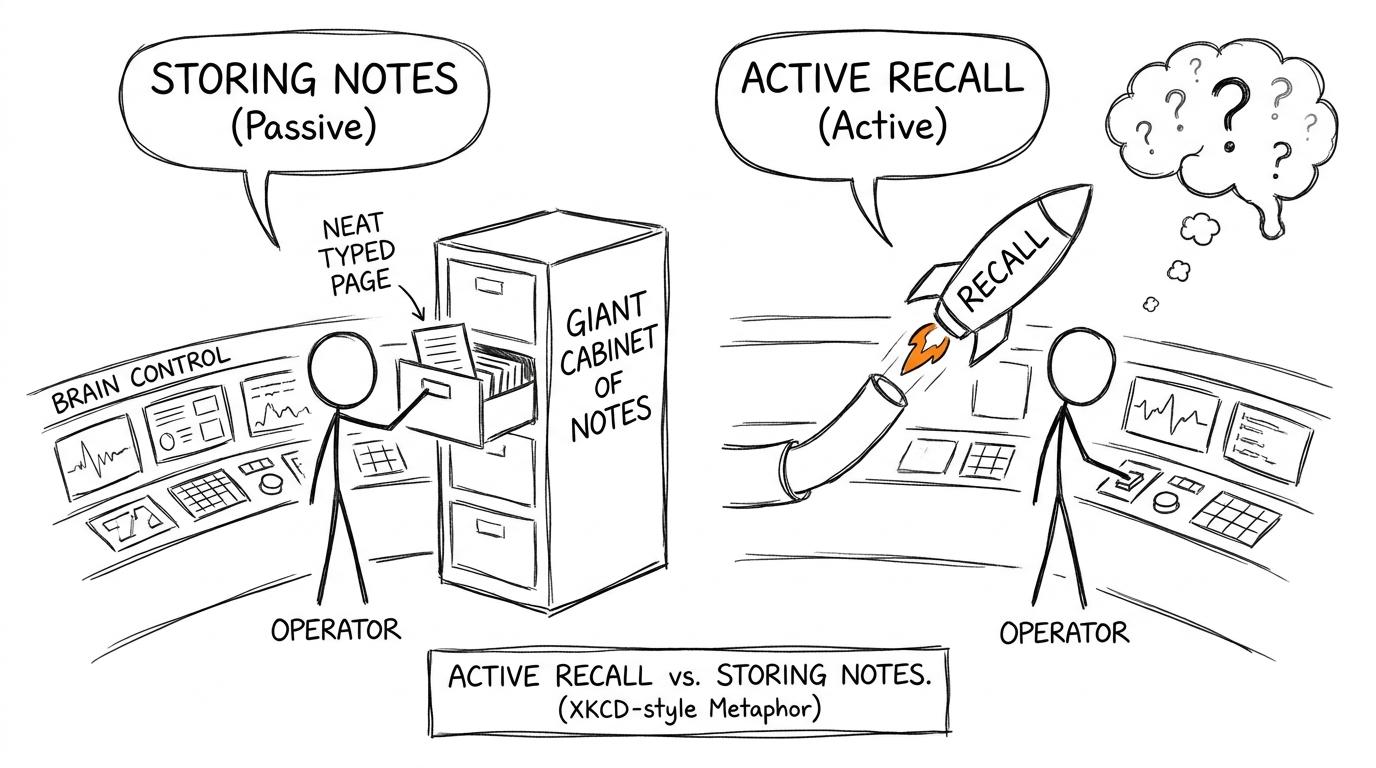 A brain mission control launching a recall card instead of simply filing notes
Capture the essential information
Make brief notes during the lesson using whichever method lets you follow the explanation. Do not try to create a final revision resource while encountering the material for the first time.
Reconstruct it without looking
Later, put the original away. On paper, recreate the key diagram, list the essential facts or explain the concept. This handwritten reconstruction is a retrieval task, not another copying session.
If you prefer typing, open a blank document rather than editing the original. The blank space matters because it prevents recognition from being mistaken for recall.
Check and correct
Compare your reconstruction with a reliable source. Add missing points in a different colour, but do not rewrite the whole page. A visible correction tells you exactly what to retrieve next time.
Turn gaps into questions
Create short prompts that demand an answer. Useful forms include:
- What is the difference between two related terms?
- What observation supports this conclusion?
- What are the stages of this process?
- Which equation is required, and what units should be used?
- Why would this measurement be uncertain?
Questions are more useful than headings because they specify what your brain must produce.
Return after a delay
Test the questions again across several days and weeks. Spend more time on weak items, but occasionally mix them with older topics. This prevents familiarity with one chapter from creating false confidence.
Finally, move from isolated recall to full examination questions. The GCSE Maths past papers and mark schemes are useful for practising the same transition in maths: remembering a method, recognising when it applies and presenting enough reasoning to earn marks.
Applying the method to mathematical astronomy
Astronomy notes should not separate scientific knowledge from calculation skills. A typed definition may tell you what a quantity means, but a written question can test whether you can select and rearrange the relevant relationship.
Build revision prompts around four demands:
- recalling the relationship;
- identifying the known and unknown quantities;
- converting units where necessary;
- reporting a sensible answer with appropriate units.
For example, a proportional relationship such as
B∝1d2B \propto \frac{1}{d^2}B∝d21should be stored with its meaning, not as an isolated pattern. Your notes should prompt you to explain what happens when distance changes and then direct you towards practice questions.
This approach transfers directly to foundation and higher tier GCSE Maths across Edexcel, AQA, OCR and Eduqas. Topic knowledge matters, but marks come from selecting and executing methods under exam conditions. MathsGenie's higher-grade GCSE revision topics provide targeted practice when standard form, graphs, ratio or algebra needs attention.
Common mistakes with typed and handwritten notes
Copying instead of processing
A complete page can feel productive because it is visible. Yet copying mainly practises copying. Pause after each section and state the idea without looking.
Making notes too beautiful to use
Colour and layout can support organisation, but decorating every heading consumes time that could be spent retrieving knowledge. A useful page may contain crossings-out because it records where understanding changed.
Highlighting almost everything
Highlighting can identify key language, but it does not show whether you can recall or apply it.
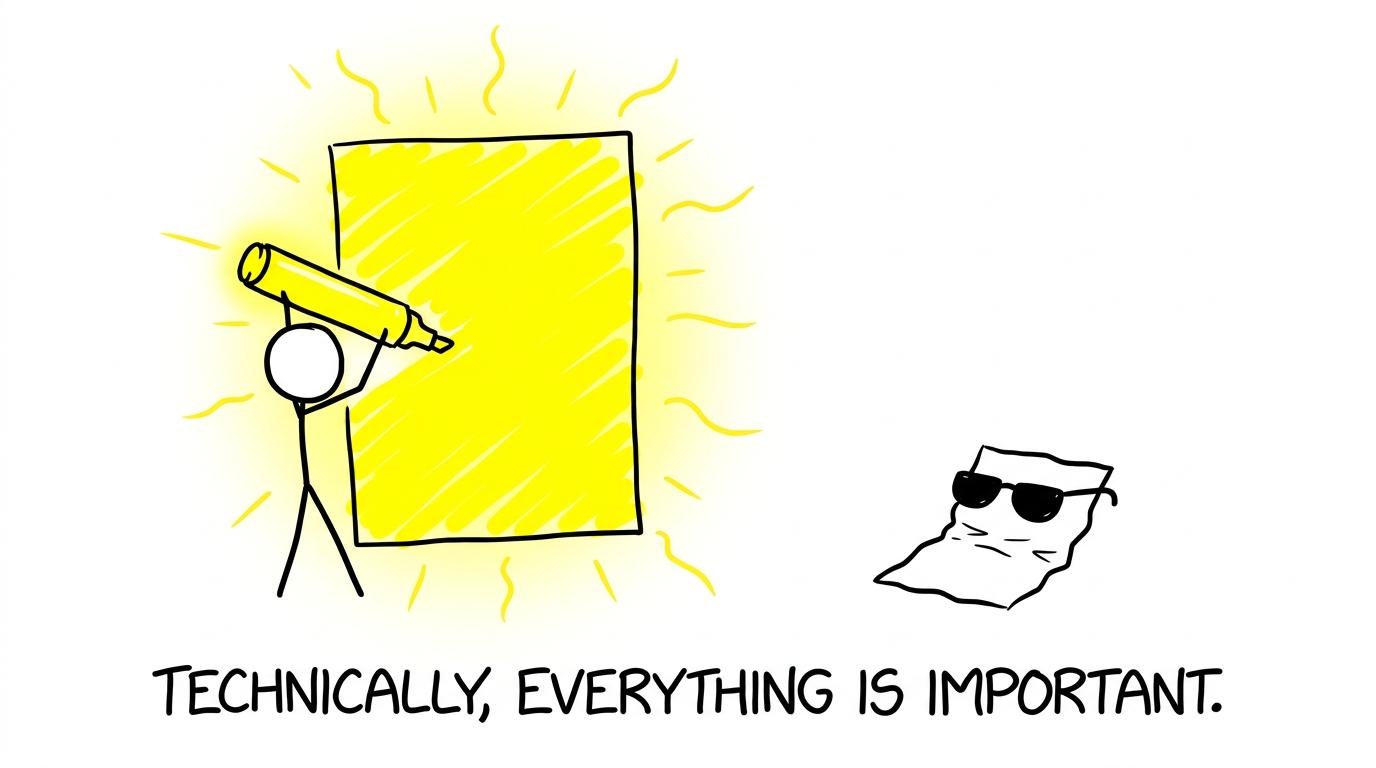 A student highlights everything while a practice paper waits in sunglasses
Testing immediately and stopping
Recalling an idea seconds after reading it is easier than retrieving it days later. Use a revision planner to schedule repeated contact rather than treating one successful attempt as completion.
Ignoring the mark scheme
An answer can be scientifically sensible but too vague for the available marks. Use mark schemes to identify required precision, then rewrite the idea as a question for future retrieval.
Replacing exam practice with note-making
No note-taking method can fully reproduce the demands of an examination. Timed papers reveal whether you can interpret wording, select methods and manage limited time. As the exam approaches, MathsGenie predicted papers can complement past-paper practice for GCSE Maths, but they should never replace learning the full specification.
Build a revision system, not a note collection
In the typing vs handwriting debate, the pen and keyboard receive more credit than they deserve. Handwriting is useful when its slower pace makes you select and connect ideas. Typing is useful when speed, accessibility and organisation help you build a resource you will actually revisit. Either can fail when it becomes passive transcription.
Choose one topic today. Capture it briefly, close the source, reconstruct what you know, correct the gaps and test it again later. Then apply the knowledge through exam questions.
For maths preparation alongside GCSE Astronomy, start with MathsGenie's free revision resources. Use the revision lessons and video solutions to understand a topic, mini tests and practice questions to retrieve it, and past papers, predicted papers and mark schemes to turn that understanding into exam marks.