

Two-Way Tables GCSE Maths Resit Guide
Two-way tables GCSE maths resit guide for grade 4 students. Learn the method, follow worked examples and avoid errors that cost marks.
A GCSE Maths resit can make familiar topics feel heavier than they are. You may remember seeing two-way tables before, yet still pause when several boxes are empty or a probability question appears underneath one.
Here is the useful truth: two-way tables GCSE maths resit questions usually depend on a small number of reliable operations. You add along rows, add down columns, subtract known frequencies from totals and use the correct group as the denominator in probability questions.
For a student working towards grade 444, this is a topic worth securing. The method is manageable, the working can be checked, and one completed table may support several marks.
Your two-way tables checklist
Before attempting exam questions, make sure you can:
- identify what the rows and columns represent;
- recognise frequency as the number of people or items;
- add across a row and down a column;
- use subtraction to find a missing frequency;
- check that the row totals and column totals agree;
- write a probability as a fraction;
- choose the correct denominator when the question refers to a particular group.
Start with the free Two Way Tables revision lesson, then use the Two Way Tables exam booklet to practise the same ideas in exam-style questions.
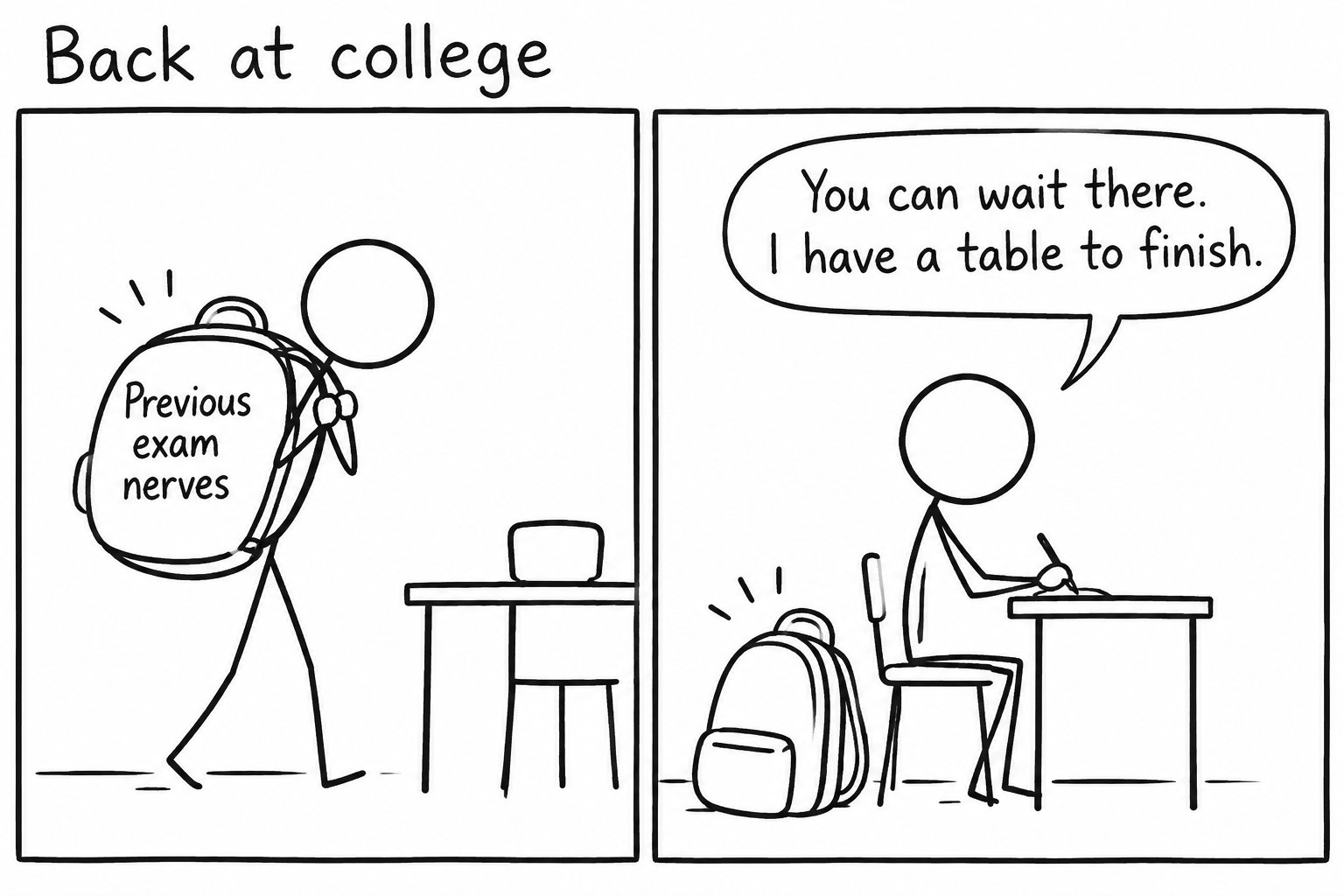 A resit student puts previous exam nerves aside before finishing a table
What is a two-way table?
A two-way table organises frequencies using two categories. For example, a table might classify students by their course and by whether they travel to college by bus or train.
| Travel method | Engineering | Health and Social Care | Total |
|---|---|---|---|
| Bus | 181818 | 222222 | 404040 |
| Train | 121212 | 888 | 202020 |
| Total | 303030 | 303030 | 606060 |
The number 181818 belongs to both the Bus row and the Engineering column. This is why the table is described as two-way: each internal frequency is classified in two ways.
The totals provide a built-in checking system. Across the first row,
18+22=40. 18+22=40. 18+22=40.Down the Engineering column,
18+12=30. 18+12=30. 18+12=30.The bottom-right grand total must agree whether you add the row totals or the column totals:
40+20=60 40+20=60 40+20=60and
30+30=60. 30+30=60. 30+30=60.This check matters. It can reveal a small arithmetic error before it affects the rest of your answer.
The method for completing two-way tables
There is no need to fill the boxes in reading order. Begin wherever two known values allow you to calculate a third.
Use this process:
- Read both category headings carefully.
- Find a row or column with only one missing value.
- Subtract the known frequencies from its total.
- Write the result in the correct box.
- Repeat until the table is complete.
- Check the grand total in two directions.
If a row has a total of 525252 and contains 191919 in one category, the missing frequency is
52−19=33. 52-19=33. 52−19=33.That subtraction is the heart of most grade 444 two-way table questions. The challenge is usually organisation rather than difficult arithmetic.
Worked example: completing a two-way table
A college asks 808080 students whether they prefer morning or afternoon lessons. There are 464646 students aged 161616-181818. Of these, 282828 prefer morning lessons. In total, 494949 students prefer morning lessons.
Complete the table.
| Lesson preference | Aged 161616-181818 | Aged 19+19+19+ | Total |
|---|---|---|---|
| Morning | 282828 | 494949 | |
| Afternoon | |||
| Total | 464646 | 808080 |
First find the number of students aged 19+19+19+ by using the bottom row:
80−46=34. 80-46=34. 80−46=34.Next complete the Morning row:
49−28=21. 49-28=21. 49−28=21.Now find the number aged 161616-181818 who prefer afternoon lessons:
46−28=18. 46-28=18. 46−28=18.Finally, complete the aged 19+19+19+ column:
34−21=13. 34-21=13. 34−21=13.The completed table is:
| Lesson preference | Aged 161616-181818 | Aged 19+19+19+ | Total |
|---|---|---|---|
| Morning | 282828 | 212121 | 494949 |
| Afternoon | 181818 | 131313 | 313131 |
| Total | 464646 | 343434 | 808080 |
Check the Afternoon row:
18+13=31. 18+13=31. 18+13=31.Then check the totals:
49+31=80. 49+31=80. 49+31=80.Each total agrees, so the completed table is internally consistent.
Worked example: finding probability from a table
The completed table now supports probability questions.
One student is chosen at random from all 808080 students. Find the probability that the student is aged 19+19+19+ and prefers afternoon lessons.
The word and directs you to one internal box. There are 131313 students who meet both conditions, and there are 808080 students altogether. Therefore,
P(aged 19+ and afternoon)=1380. P(\text{aged }19+\text{ and afternoon})=\frac{13}{80}. P(aged 19+ and afternoon)=8013.Now consider a different question:
One student is chosen at random from those aged 19+19+19+. Find the probability that this student prefers morning lessons.
The selected group has changed. The denominator is no longer 808080 because the choice is made only from the 343434 students aged 19+19+19+. Of those, 212121 prefer morning lessons. Therefore,
P(morning∣aged 19+)=2134. P(\text{morning}\mid\text{aged }19+)=\frac{21}{34}. P(morning∣aged 19+)=3421.The vertical bar means “given that”. You do not need that notation to answer a typical foundation question, but the idea is essential: restrict the denominator to the group named in the question.
For broader question practice, use the Edexcel GCSE Maths question bank. You can also browse the GCSE Maths exam booklets to revisit connected probability and statistics skills.
Mistakes that cost marks
Using the grand total every time
When a student is chosen from a stated subgroup, that subgroup provides the denominator. In the second worked example, the choice was from the 343434 students aged 19+19+19+, not all 808080 students.
Underline phrases such as “from the students aged 19+19+19+” before calculating.
Adding when subtraction is needed
If you know a total and one part, subtract to find the other part. For example,
49−28=21. 49-28=21. 49−28=21.Adding 494949 and 282828 would combine a total with a number already included in that total.
Mixing up rows and columns
A value can satisfy two descriptions at once. Trace from the row heading and the column heading until they meet. This takes seconds and prevents avoidable errors.
Filling several boxes mentally
Write each subtraction beside the table. Clear working may help you recover method marks if a later arithmetic slip occurs, although exact marking depends on the exam board and question.
Failing to check the final table
Every row total and column total should work. If the two routes to the grand total disagree, at least one entry is wrong.
Turning this into grade 4 progress
Two-way tables grade 444 revision should be short and deliberate. Watch or read the lesson, answer a small set without notes, mark it honestly, then repeat only the questions that exposed a weakness.
A resit student does not need to pretend the previous result never happened. It is more useful to treat it as information. Perhaps the issue was not understanding what a table represented. Perhaps it was selecting the denominator. Those are specific problems, and specific problems can be practised.
Once the method feels secure, move beyond isolated exercises. Build a targeted GCSE practice paper in Mock Exam Builder, selecting questions that test two-way tables and related probability skills. Sit it under timed conditions, mark it and return to the precise step that caused difficulty.
MathsGenie brings the revision lesson, practice questions, booklets, mark schemes and custom mock practice into one free revision route. A grade 444 is rarely built through one dramatic breakthrough. More often, it comes from collecting dependable methods, then applying them calmly when the paper puts them in a slightly unfamiliar setting.















