

Too Late to Revise GCSE Business? A Realistic Plan
Too late to revise GCSE Business? Use a realistic late-start plan to prioritise content, practise exam technique and make every revision session count.
The uncomfortable part of starting revision late is rarely the lack of time. It is the time lost wondering whether beginning is still worthwhile.
If you are asking whether it is too late to revise GCSE Business, the honest answer is usually no. You may not have time to relearn every page of the course perfectly, but you can still improve your knowledge, calculation skills and exam technique. Even close to the exam, focused revision is more valuable than trying to cover everything equally.
The aim is not to pretend that time does not matter. It does. The aim is to use the time that remains on the parts of the course most likely to produce marks.
Your late revision checklist
Start with these actions:
- Confirm your exam board: Edexcel, AQA, OCR or Eduqas.
- Download the correct specification or topic list.
- Identify your weakest topics rather than revising in textbook order.
- Test yourself before making more notes.
- Practise calculations without relying on a calculator to choose the method.
- Answer questions using the command words and business context.
- Mark your work and record why marks were lost.
- Protect sleep, particularly on the night before an exam.
If GCSE Maths is competing for your revision time, use the free GCSE Maths revision lessons on MathsGenie to target specific gaps instead of reviewing the entire course.
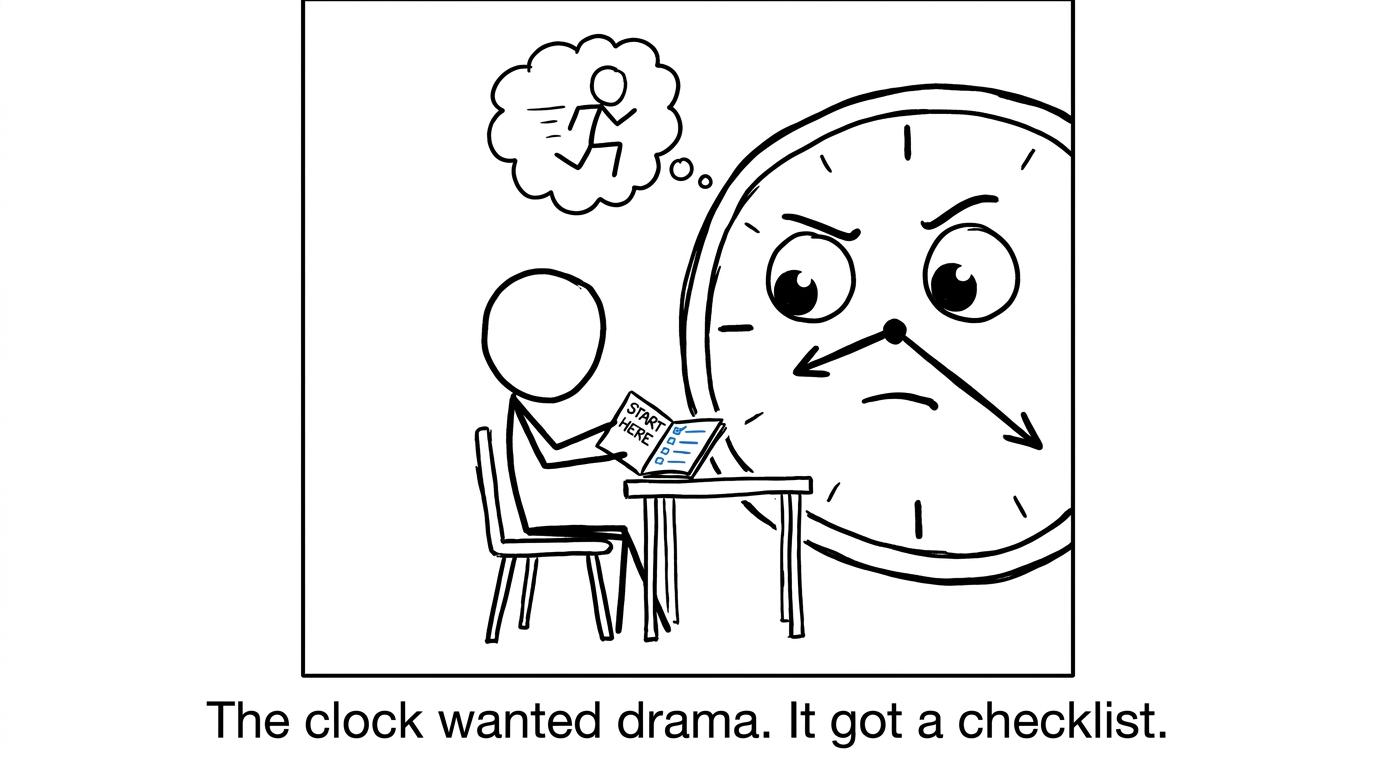 A calm student begins revision while a dramatic clock looks disappointed
How much difference can late revision make?
Late revision cannot guarantee a particular grade. Your starting knowledge, the time available, the papers you sit and the quality of your answers all matter. However, a late start does not mean that your result is fixed.
GCSE Business rewards more than memorising definitions. Across the main exam boards, students are expected to apply business knowledge to a context, interpret information, perform relevant calculations and build justified arguments. That creates several routes to improvement.
You might gain marks by:
- learning precise definitions for commonly examined terms;
- recognising what a command word requires;
- using figures and details from the case study;
- showing calculation stages clearly;
- developing both sides of an argument;
- writing conclusions that respond to the circumstances of the business.
These are trainable skills. A student who already knows part of the content may make a noticeable difference by improving how that knowledge is expressed under exam conditions. A student with larger gaps should prioritise core concepts and accessible questions rather than attempting complete mastery overnight.
What to do when several weeks remain
With several weeks available, you still have time for a compact revision cycle: diagnose, relearn, retrieve and practise.
Begin with a topic audit based on your own exam board's current specification. Typical areas include business activity, marketing, operations, finance and human resources, although names and organisation vary between specifications.
Mark each area as:
- secure;
- partly secure;
- weak;
- not yet understood.
Then spend most of your time on the middle two categories. Secure topics need brief retrieval. Completely unfamiliar topics may require a lesson before questions become useful. Partly secure topics often provide the quickest gains because some knowledge is already in place.
Use short, repeated sessions rather than one enormous session followed by silence. Close your notes and retrieve definitions, advantages, disadvantages and chains of reasoning from memory. After checking, correct what you missed. The act of trying to remember is part of the revision.
The same principle works in maths. A lesson should lead to questions, and questions should lead to corrections. MathsGenie's GCSE revision resources combine videos, practice questions and solutions so that revision becomes active rather than merely familiar.
What to do when only a few days remain
When the exam is close, selectivity matters more than completeness. Do not divide your remaining hours equally across every chapter. Use evidence from a past paper, mini test or topic quiz to locate the gaps that are actually costing you marks.
A sensible daily structure is:
- one short retrieval session for key terms;
- one focused content session on a weak area;
- one set of exam questions;
- one marking and correction session;
- one brief return to previously revised material.
Past papers are useful only when you learn from them. Compare your response with the mark scheme, but do not reduce the process to hunting for identical wording. Ask why the answer earns marks. Look for knowledge, application to the context, analysis and evaluation.
If you also have maths papers approaching, MathsGenie's GCSE Maths past papers provide exam-board practice with mark schemes and video solutions. Alternate full papers with targeted topic work so that you address weaknesses rather than repeatedly proving what you already know.
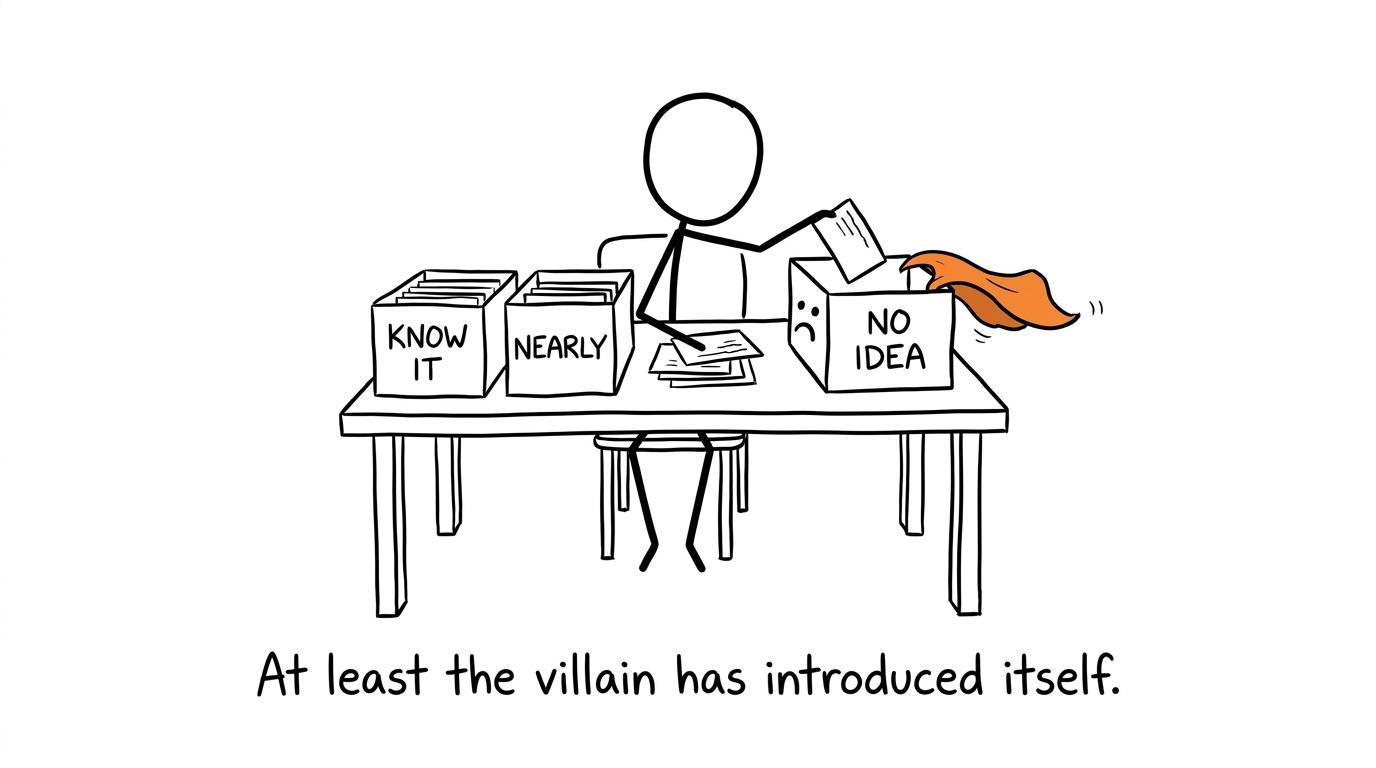 A revision card labelled no idea wears a tiny villain cape
What can you do the night before?
The night before is too late for comprehensive revision, but not too late for useful preparation.
Concentrate on a limited set of tasks:
- recall essential terms and formulas;
- review errors from questions you have already attempted;
- plan how you will approach different command words;
- organise your equipment and exam details;
- stop at a sensible time and sleep.
Avoid beginning an entirely new revision system. Recopying a whole folder or decorating flashcards may feel controlled, but it gives you little evidence that you can retrieve or apply the content.
If panic is rising, shrink the task. Choose one topic, test yourself for a short period, check the answers and make one correction list. Progress becomes easier when the next action is visible.
Prioritise the quantitative skills in GCSE Business
Business calculations can offer relatively direct marks, but only if you know which values to use and what the result means. Requirements differ by exam board, so check your specification and any instructions about formulas.
Common relationships may include:
Revenue=selling price×quantity sold\text{Revenue} = \text{selling price} \times \text{quantity sold}Revenue=selling price×quantity sold Profit=revenue−total costs\text{Profit} = \text{revenue} - \text{total costs}Profit=revenue−total costs Total costs=fixed costs+variable costs\text{Total costs} = \text{fixed costs} + \text{variable costs}Total costs=fixed costs+variable costs Percentage change=changeoriginal amount×100\text{Percentage change} = \frac{\text{change}}{\text{original amount}} \times 100Percentage change=original amountchange×100Do not merely memorise the arrangement of symbols. Check whether you can identify the correct information in a case study, include relevant units and interpret the answer in business terms.
For example, knowing that profit has risen is not the same as explaining why that change matters. The figure might affect investment, cash availability or the owner's decisions, depending on the context supplied.
If percentages, ratio or rearranging formulas are slowing you down, revisit the relevant GCSE Maths topic lessons and practice questions. Improving these skills supports both Business and Maths revision.
Turn exam technique into marks
A Business answer should respond to the question that was asked, not the question you hoped would appear.
Read the command word first
Commands such as identify, explain, analyse, discuss and evaluate demand different depths of response. The marks available and the wording of the question should guide how much you write. Use guidance from your teacher and your exam board because precise expectations can vary.
Use the case study
Generic knowledge is a starting point. Application shows why the idea matters to the particular business in the question. Use its product, customers, objectives, ownership, size, location or financial information where relevant.
Build connected reasoning
A strong analytical paragraph follows consequences. Ask what happens next, why it matters and how it affects the business objective in the question. Avoid listing several undeveloped ideas when one well-connected chain would be clearer.
Make conclusions conditional
Evaluation is not simply adding the phrase “it depends”. State what it depends on and explain why that factor changes the decision. A justified conclusion should follow from the evidence and context already discussed.
Use predicted papers carefully
Predicted papers can help you practise unfamiliar combinations of topics and work under time pressure. They cannot tell you exactly what will appear, so they should complement rather than replace specification coverage and official past papers.
MathsGenie's GCSE Maths predicted papers are designed as extra exam practice. For both Maths and Business, the productive sequence is the same: attempt independently, mark honestly, investigate errors and revisit the underlying topic.
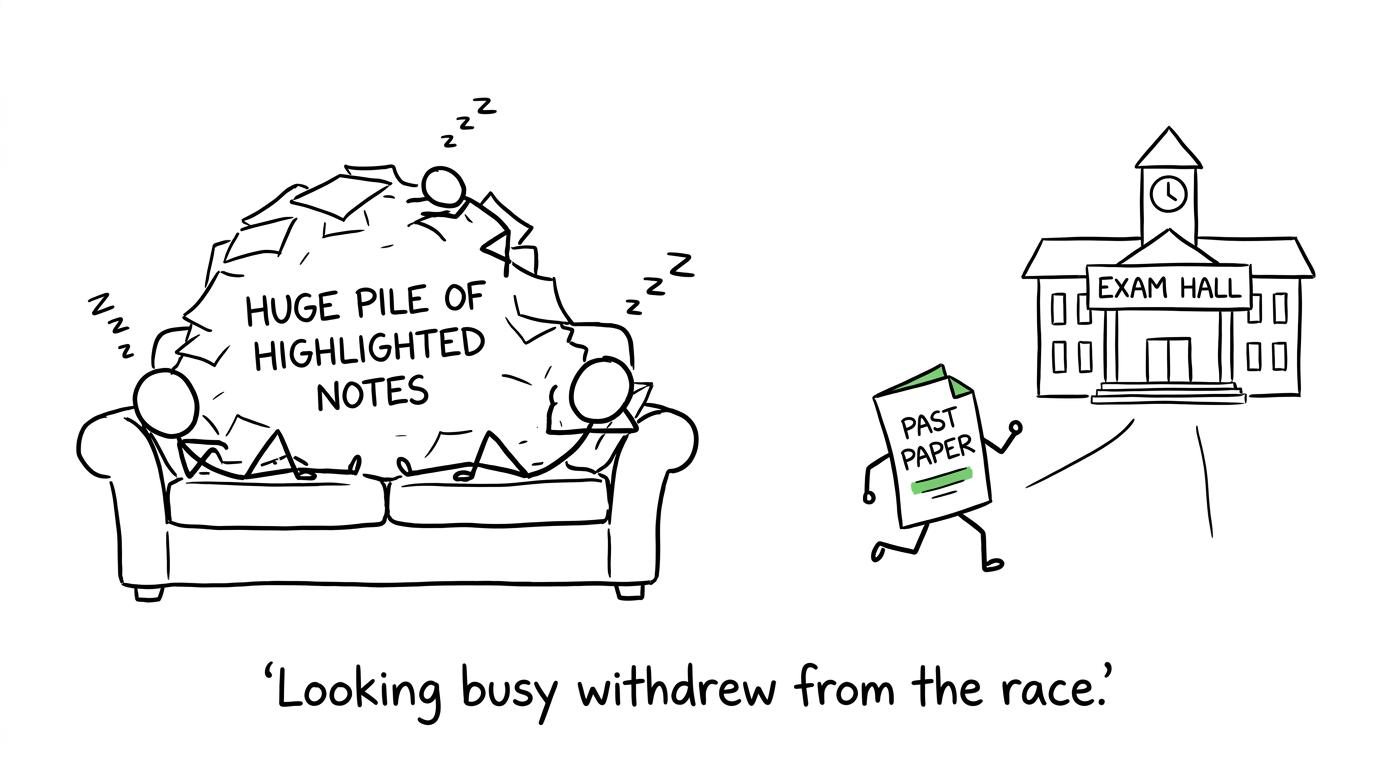 A small past paper runs towards an exam hall while highlighted notes nap
Common mistakes when revision starts late
Trying to cover everything equally
Equal time does not create equal value. Use topic checks and marked questions to decide where your next session belongs.
Reading instead of retrieving
Recognition can feel like knowledge. Close the book and produce the definition, argument or formula from memory before checking it.
Completing papers without reviewing them
A paper identifies weaknesses; the review fixes them. Record whether each error came from missing knowledge, weak application, faulty reasoning, a calculation mistake or time pressure.
Ignoring the business context
Memorised advantages and disadvantages rarely form a complete response. Connect each relevant idea to the business described.
Spending too long on a single difficult area
Do not allow one stubborn topic to consume the whole evening. Set a limit, seek an explanation, practise a small set of questions and then move on.
Sacrificing sleep for low-quality revision
An exhausted extra hour may be less useful than arriving able to read carefully, recall information and make decisions. Late revision needs discipline, not punishment.
Start with the next useful action
So, is it too late to revise GCSE Business? It may be too late to do everything, but it is probably not too late to do something valuable. Diagnose what you know, prioritise the gaps that can still be improved, practise questions and use every mistake as information.
The same calm approach can protect your maths grade during a crowded exam timetable. Start with MathsGenie's free GCSE Maths revision lessons, then use past papers and video solutions to expose weaknesses. Add predicted papers for further practice, review the mark schemes and return to targeted questions.
You do not need to feel ready before you begin. Beginning is what makes you more ready.











