

Switching Maths Tier After Mocks: Grade Impact
Switching maths tier after mocks can change the grades available. Understand Foundation and Higher tiers, boundaries and your best next steps.
A parent sees the mock result first. The mark is lower than expected, the school mentions Foundation tier, and suddenly one paper seems to have decided everything.
It has not.
Switching maths tier after mocks changes the range and difficulty of grades available in the final GCSE, but it does not change a grade already awarded or automatically predict the summer result. Foundation tier offers grades 111-555. Higher tier principally offers grades 444-999, with a possible grade 333 for a candidate who falls narrowly below the grade 444 boundary. The school or exam centre makes the final entry decision.
For students, the important question is not whether Higher sounds better. It is which tier gives you the strongest realistic chance of earning the grade you need.
What to check after a proposed tier change
Before treating the decision as final, ask the maths teacher:
- Which tier is being recommended, and why?
- Was the recommendation based on one mock or evidence across the year?
- Which topics cost the most marks?
- What grade does the student need for sixth form, college or an apprenticeship?
- Can the decision be reviewed after further assessment?
- When will the school confirm its final examination entry?
Then use the free Maths Genie GCSE revision resources to turn the answers into a focused revision plan.
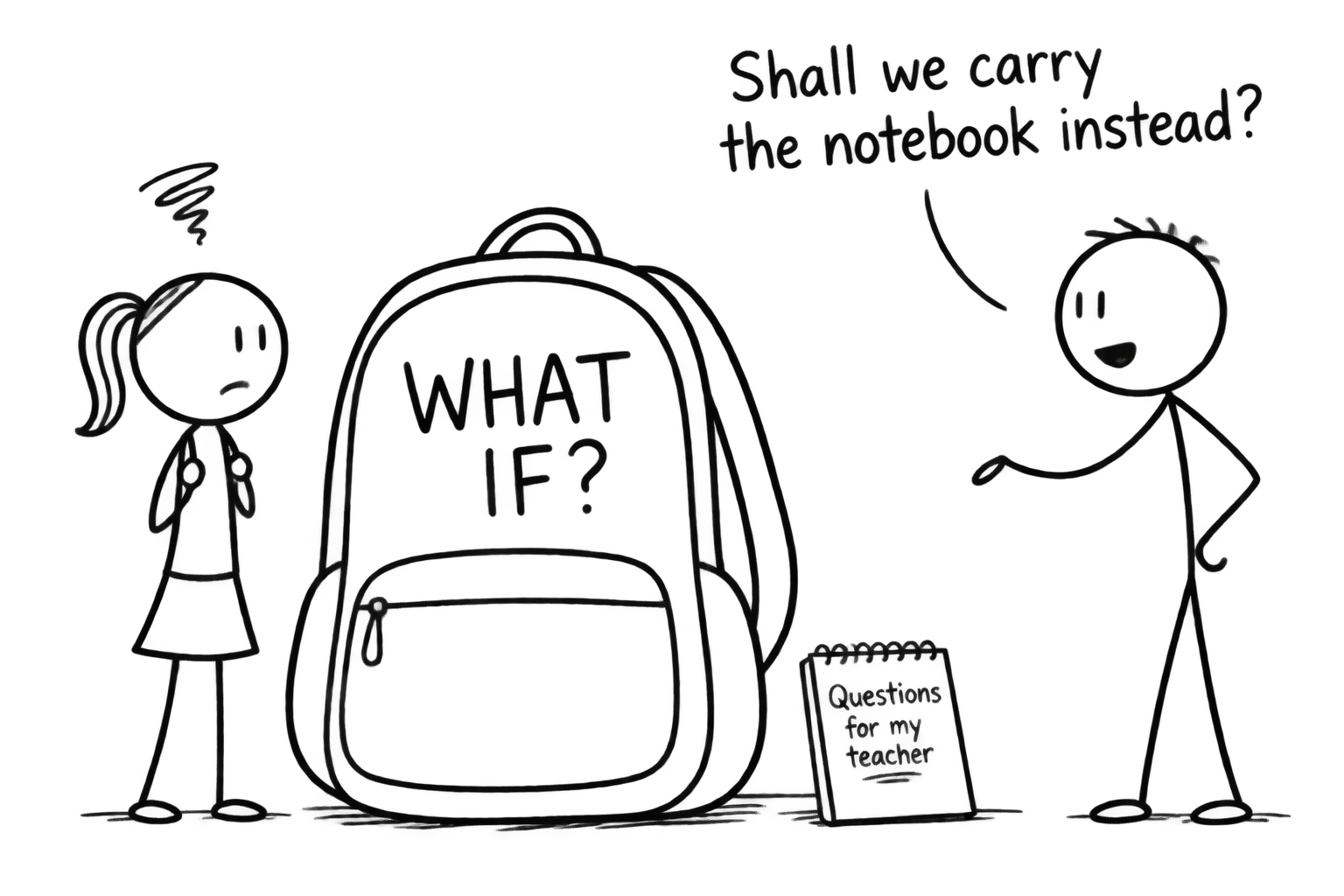 A pupil and parent replace a huge bag of worries with a small notebook of useful questions
What switching maths tier actually changes
GCSE Maths has overlapping tiers because neither paper is intended for every student.
| Entry | Grades available | Practical meaning |
|---|---|---|
| Foundation tier | 111-555 | A grade 555 is the highest possible result |
| Higher tier | Mainly 444-999 | A grade 333 may be awarded just below the grade 444 boundary |
These grade ranges apply to the reformed GCSE in England. Schools following different qualifications should check the relevant specification.
A move from Higher to Foundation removes access to grades 666-999. That matters if a student is securely working towards those grades or needs one for a future course. But Foundation may give a student currently struggling on Higher a more suitable route towards grades 444 or 555.
Moving from Foundation to Higher has the opposite trade-off. It opens the possibility of grades 666-999, while introducing more demanding content and a greater risk if the student is not yet secure at the overlap grades.
The word tier can sound like a judgement about ability. It is better understood as an assessment route. It determines the questions placed in front of you, not the limit of what you might learn later.
Why schools reconsider tiers after mocks
Mocks provide evidence under timed conditions. They can reveal whether knowledge survives the pressure of an unfamiliar paper, whether earlier topics have been retained and whether the student can collect method marks when a complete solution is out of reach.
However, one total mark does not tell the whole story. A sensible review also considers classwork, topic tests, attendance, improvement and the kinds of errors made.
Imagine a student whose Higher mock contains many blank final questions but avoidable losses on fractions, percentages, ratio and solving equations. The issue may not simply be that Higher is too difficult. Secure core skills could move the result substantially. Another student may know those skills but remain far from the marks needed on repeated Higher assessments. Foundation might then be the more credible path to a secure grade 444 or 555.
That is why the conversation should move from “Which paper sounds more ambitious?” to “Where can marks realistically be gained?”
GCSE maths grade boundaries are not fixed percentages
Students often hear claims such as “you always need a certain percentage for a grade 555”. GCSE maths grade boundaries do not work like that.
Awarding organisations set boundaries after papers have been taken and marked. Boundaries can vary by exam board, examination series and tier because paper difficulty varies. A raw mock percentage therefore cannot be converted into a guaranteed summer grade using an old boundary from a different paper.
For a clearly dated example, Ofqual explained in November 2017 that Foundation and Higher have overlapping grades, but candidates do not necessarily need the same number of marks for the same grade on each tier. That principle remains more useful than memorising an isolated historical figure.
When reviewing a mock, check that the school used boundaries appropriate to that particular paper. Better still, look beyond the reported grade:
marks available from fixable errors=method marks missed+accuracy marks missed\text{marks available from fixable errors} = \text{method marks missed} + \text{accuracy marks missed}marks available from fixable errors=method marks missed+accuracy marks missedThis is not an official grading formula. It is a practical revision lens. It shifts attention towards marks that can be recovered.
How the switch can affect GCSE maths grades
A tier decision changes both the ceiling and the nature of the risk.
Moving from Higher to Foundation
This may be sensible when the required outcome is a grade 444 or 555 and repeated evidence suggests that the Higher paper is preventing the student from demonstrating secure knowledge. More accessible questions can create a steadier start and reduce the number of topics demanding the deepest Higher-tier reasoning.
The cost is clear: even an exceptional Foundation performance cannot produce a grade above 555.
Staying on or moving to Higher
Higher is necessary for grades 666-999. It can be appropriate when a student is close to the overlap boundaries, improving consistently and prepared to address specific weaknesses.
Yet Higher should not be chosen only because its raw grade boundaries sometimes appear lower. The questions are designed differently. Comparing percentages without comparing paper demand can create false confidence.
Students can test their position using full Maths Genie GCSE exam papers, then mark them carefully rather than relying on how difficult the paper felt.
A calm plan for students and parents
Start with the required destination. If a college course asks for a particular GCSE Maths grade, confirm that requirement directly with the provider. Do not build a tier decision around playground rumours.
Next, diagnose the mock. Divide lost marks into four groups:
- knowledge gaps;
- incorrect methods;
- arithmetic or algebra slips;
- timing and unanswered questions.
Then choose a small number of high-return topics. For many students near grades 444-555, secure work with number, fractions, percentages, ratio, basic algebra, graphs and geometry supports several parts of a paper. The exact priorities must come from the student's scripts, not a generic list.
Use Maths Genie revision lessons to relearn each weak area, complete the practice questions, mark the work and revisit errors. Follow this with mixed examination questions so the method must be recognised without a topic heading.
Finally, complete timed papers. If available for the current series, Maths Genie predicted papers can add useful practice, but they are not forecasts of exact examination questions. Past papers remain essential because they show the established style and breadth of assessment.
Common mistakes after a tier change
Treating Foundation as failure
Foundation is a valid route to grades 111-555. If the target is grade 444 or 555, the relevant issue is whether it offers the best chance of reaching that target.
Assuming Higher automatically looks better
Certificates report the GCSE grade, not a bonus for attempting harder questions. Future providers care about the result and their own entry requirements.
Chasing old boundaries
A boundary from a past series describes that series. It cannot guarantee the mark needed on a future paper.
Revising only the hardest topics
Students sometimes respond to Higher-tier anxiety by attacking the most advanced material first. Marks are often lost earlier through insecure fundamentals. Repair the topics identified by the mock before widening revision.
Waiting for the school to solve everything
The school controls the examination entry, but the student can still ask for evidence, request a review point and demonstrate improvement through assessments. Parents can keep the discussion practical: required grade, current evidence, weak topics and the next decision date.
The tier is a decision, not a verdict
A mock result captures performance on one set of papers at one moment. It deserves attention, but not panic.
The best response to switching maths tier is to understand the available GCSE maths grades, ask how the decision was reached and build evidence through deliberate practice. A student moved to Foundation can still work towards a strong grade 555. A student remaining on Higher still needs secure fundamentals. In both cases, progress comes from turning vague worry into specific, mark-producing work.
Start with Maths Genie Lessons on the topics that move marks most. Use the videos, practice questions and mark schemes to close one gap at a time, then prove the improvement on a timed paper.















