

Substitution GCSE Maths Resit Guide for Grade 4
Substitution GCSE maths resit guidance for grade 4 students, with a clear method, worked exam questions, common mistakes and targeted practice.
A GCSE Maths resit can make a familiar topic feel heavier than it is. You may remember seeing letters and formulae before, but not quite remember what to do when the numbers arrive.
For substitution GCSE maths resit questions, the central idea is simple: replace each letter with its given value, then calculate carefully. The algebra is rarely the main difficulty. Most lost marks come from signs, powers or doing operations in the wrong order.
That is encouraging. A short, reliable method can turn substitution into a dependable source of marks as you work towards grade 444.
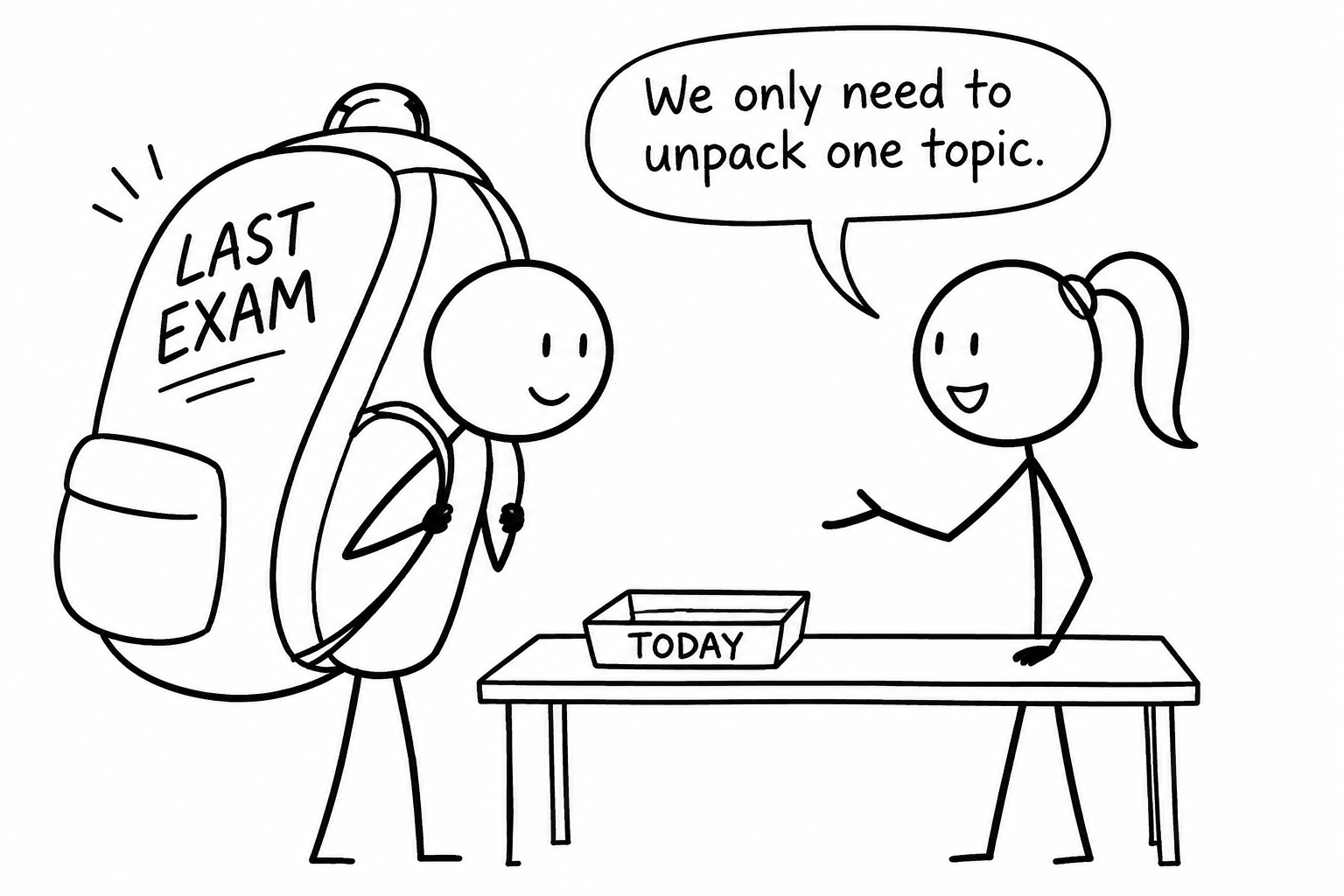 A post-16 student unpacking one revision topic rather than carrying the whole previous exam
Your substitution checklist
When you see a substitution question:
- identify the value of every letter
- rewrite the expression with the numbers inserted
- put negative values in brackets
- use the correct order of operations
- show your substitution line before calculating
- check signs and powers before writing the answer
That middle line matters. Even when the final answer goes wrong, clear working may allow the examiner to award a method mark.
What substitution means
A letter in algebra represents a number. Substitution means replacing that letter with a stated numerical value.
If x=5x=5x=5, then in the expression 3x+23x+23x+2, replace xxx with 555:
3x+2=3×5+23x+2=3\times5+23x+2=3×5+2The expression now contains only numbers, so it can be evaluated:
3×5+2=173\times5+2=173×5+2=17Notice that 3x3x3x means 3×x3\times x3×x. The multiplication sign is usually hidden in algebra, but it is useful to write it when substituting. This makes the structure visible and reduces careless errors.
You can revisit the underlying skills through the free GCSE Maths revision topics on MathsGenie. The revision lessons combine explanations, practice questions and video solutions, so you can repair a specific gap without restarting the entire course.
A reliable method for substitution grade 4 questions
Use the same process each time.
Write down the values
Read the question closely. A question may give several values even if the expression uses only some of them.
For example:
a=4,b=−3a=4,\qquad b=-3a=4,b=−3Keeping these values visible helps you avoid swapping the letters.
Insert the numbers
Rewrite the complete expression. Do not try to hold every step in your head.
If a value is negative, place it in brackets. For instance, substituting b=−3b=-3b=−3 into b2b^2b2 gives:
(−3)2(-3)^2(−3)2The brackets show that the whole negative number is being squared.
Follow the order of operations
Calculate brackets and powers before multiplication, division, addition and subtraction.
For substitution, this often means dealing with a square such as x2x^2x2 before completing the rest of the expression. If this feels uncertain, revise order of operations alongside substitution.
Check the answer against the expression
Look back at each sign. Ask whether every letter was replaced and whether multiplication was included where two symbols had previously appeared together.
This check takes a few seconds. It can protect a mark that took several minutes to earn.
Worked example with two variables
Question: Given that a=6a=6a=6 and b=4b=4b=4, work out the value of 3a−2b3a-2b3a−2b.
First, substitute the values into the expression:
3a−2b=3×6−2×43a-2b=3\times6-2\times43a−2b=3×6−2×4Calculate each multiplication:
3×6=183\times6=183×6=18 2×4=82\times4=82×4=8Then subtract:
18−8=1018-8=1018−8=10Therefore:
10\boxed{10}10The important step is not difficult, but it is visible: 3a3a3a became 3×63\times63×6, while 2b2b2b became 2×42\times42×4. Writing both products before subtracting keeps the calculation organised.
This is typical of useful GCSE Maths resit revision. The topic becomes manageable when you make the hidden operations explicit.
Worked example with a negative number and a power
Question: Given that x=−3x=-3x=−3 and y=5y=5y=5, work out the value of 2x2+y2x^2+y2x2+y.
Substitute both values, placing the negative value in brackets:
2x2+y=2×(−3)2+52x^2+y=2\times(-3)^2+52x2+y=2×(−3)2+5Calculate the power first:
(−3)2=(−3)×(−3)=9(-3)^2=(-3)\times(-3)=9(−3)2=(−3)×(−3)=9The expression becomes:
2×9+52\times9+52×9+5Now multiply, then add:
18+5=2318+5=2318+5=23Therefore:
23\boxed{23}23A frequent incorrect answer comes from treating (−3)2(-3)^2(−3)2 as −9-9−9. Squaring means multiplying the number by itself. Since a negative multiplied by a negative is positive, the square is 999.
If negative calculations are slowing you down, use MathsGenie's negative numbers lesson before returning to substitution practice.
Substitution into formulae
Substitution also appears in questions involving perimeter, area, speed and other formulae. The setting may change, but the method does not.
For example, the area of a triangle is represented by:
A=12bhA=\frac{1}{2}bhA=21bhIf values for bbb and hhh are given, replace those letters and evaluate the formula. Units matter in these questions. An area answer usually requires square units, such as cm2\text{cm}^2cm2.
This is one reason substitution is valuable for a grade 444 target. It is not confined to a single algebra exercise. It supports work across several parts of the GCSE course.
Use the GCSE Maths revision checklist to notice where the same skill reappears. Seeing those connections makes revision more efficient.
Mistakes that cost marks
Forgetting hidden multiplication
If x=7x=7x=7, then 4x4x4x means:
4×74\times74×7It does not mean 474747 or 4+74+74+7.
Losing a negative sign
If p=−2p=-2p=−2, write brackets when substituting:
5p=5×(−2)5p=5\times(-2)5p=5×(−2)This gives −10-10−10. Writing the brackets creates a useful pause before you calculate.
Squaring only part of a negative number
If x=−4x=-4x=−4, then:
x2=(−4)2=16x^2=(-4)^2=16x2=(−4)2=16The negative value must be treated as one complete number.
Ignoring the order of operations
For an expression such as 3x2+13x^2+13x2+1, square the value of xxx before multiplying by 333. Do not simply work from left to right.
Giving only the final answer
Mental calculation can feel quicker, but it removes your evidence. Write one clear substitution line. It helps the examiner follow your method and helps you locate an error when checking.
Swapping the values
When both aaa and bbb are given, students sometimes insert them into the wrong places. Copy the expression first, then replace one letter at a time.
How to practise for a resit
Substitution improves through short, focused repetition. Start with positive whole numbers, then add negative values, squares and formulae. Mark each set immediately so that an incorrect habit does not become familiar.
MathsGenie's GCSE practice papers help you meet substitution in a mixed exam setting. You can also use GCSE predicted papers as part of timed preparation, followed by the available mark schemes and video solutions.
A useful routine is:
- complete a short set of substitution questions
- mark it and label each error by type
- revisit the relevant revision lesson
- retry similar questions without notes
- test the skill later inside a mixed paper
The label matters. “Wrong” tells you very little. “Lost the negative sign” gives you something precise to correct.
Build the next paper around what you need
A resit is not a verdict on your ability. It is another attempt with better information. You now know that substitution is not about guessing what a letter means. It is a sequence: replace, use brackets, calculate and check.
When the method feels secure, build a targeted practice paper in MathsGenie's Mock Exam Builder. Include substitution alongside the grade 444 topics you most need to strengthen, then use your results to decide what to practise next.
You do not need to repair the whole course in one sitting. One dependable topic at a time is enough to move forwards.















