

Standard Form GCSE Maths Resit: Grade 4 Guide
Standard form GCSE maths resit revision made clear: learn the method, follow two exam-style examples and avoid common errors that lose valuable marks today.
A resit can make familiar topics feel heavier than they are. You may remember seeing standard form at school, but not quite remember whether the power should be positive, negative or something else entirely.
The useful answer is that standard form GCSE maths resit questions follow a small set of dependable rules. Learn what valid standard form looks like, practise converting numbers in both directions, then apply the index laws when calculating. For a grade 444, this is a focused skill worth making secure.
Standard form is part of GCSE number content and can appear on Foundation or Higher tier papers. It will not determine your grade by itself, but reliable marks across topics like this can build the total you need.
Your standard form checklist
Before attempting mixed exam questions, make sure you can:
- recognise the form A×10nA \times 10^nA×10n;
- check that 1≤A<101 \leq A < 101≤A<10;
- convert large numbers into standard form;
- convert small decimals into standard form;
- understand positive and negative powers of 101010;
- multiply and divide numbers written in standard form;
- give a final answer that is itself in valid standard form.
If one item feels uncertain, start with the Standard Form revision lesson. It combines explanations, questions and worked solutions, so you can rebuild the method before testing it.
What standard form means
A number is in standard form when it is written as:
A×10nA \times 10^nA×10nHere, AAA must satisfy:
1≤A<101 \leq A < 101≤A<10The power nnn must be an integer, meaning a positive whole number, a negative whole number or zero.
For example, 4.7×1054.7 \times 10^54.7×10⁵ is in standard form because 4.74.74.7 is at least 111 but less than 101010. However, 47×10447 \times 10^447×104 is not in standard form because 474747 is too large for the first number.
The power tells you how the decimal point moves:
- a positive power produces a large number;
- a negative power produces a number between 000 and 111;
- the size of the power tells you how many place-value moves are involved.
That final point matters. Students sometimes count the zeros they can see rather than counting how far the decimal point moves. Those counts are not always the same.
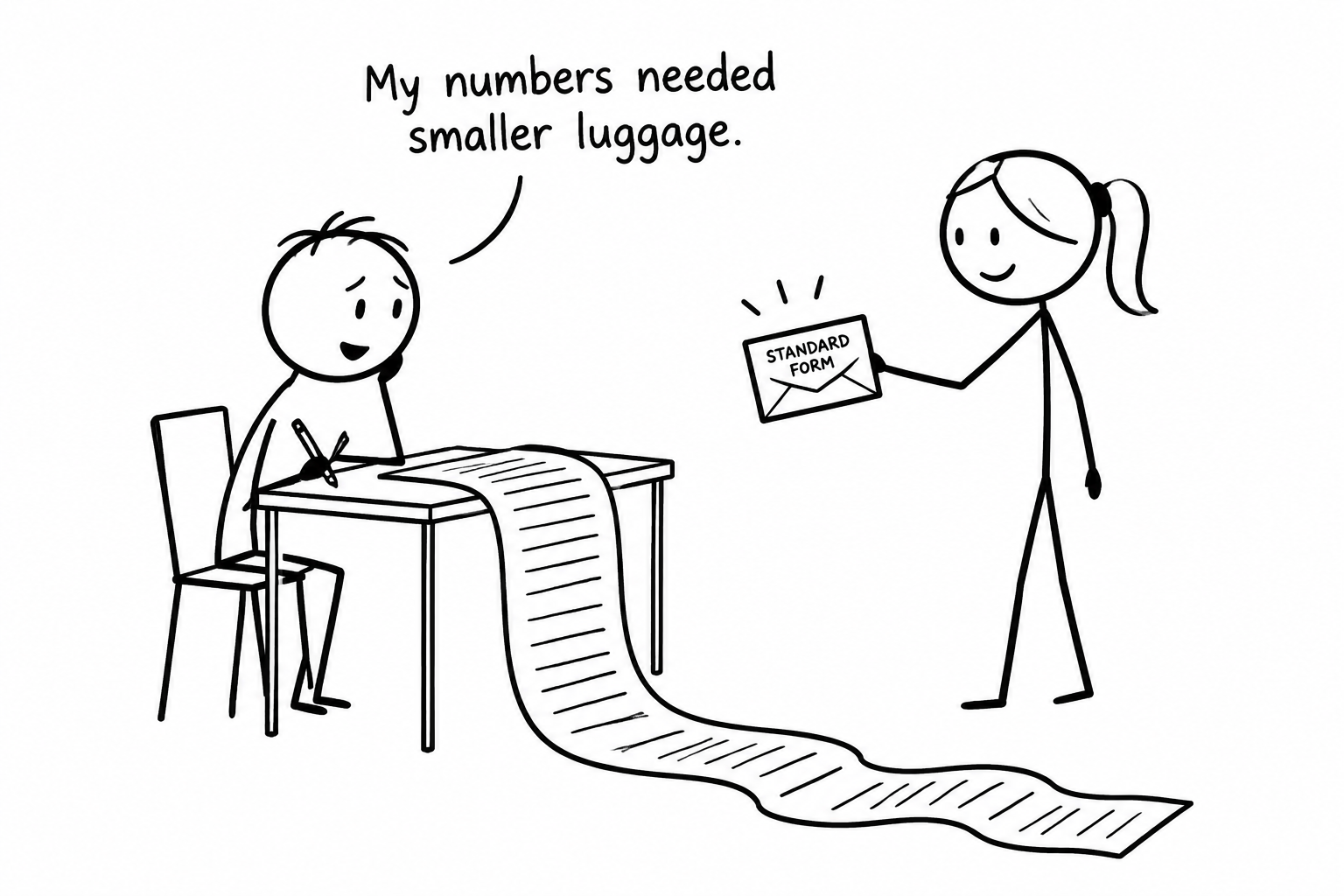 A resit student solves the problem of unwieldy numbers by giving them smaller luggage labelled standard form
Worked example: writing a small number in standard form
Question: Write 0.000720.000720.00072 in standard form.
Move the decimal point until the first number is at least 111 but less than 101010:
0.00072⟶7.20.00072 \longrightarrow 7.20.00072⟶7.2The decimal point has moved four places to the right. Because the original value is smaller than 111, the power is negative:
0.00072=7.2×10−40.00072 = 7.2 \times 10^{-4}0.00072=7.2×10⁻⁴The answer is therefore:
7.2×10⁻⁴\boxed{7.2 \times 10^{-4}}7.2×10⁻⁴A quick sense check helps. Since 10−4=0.000110^{-4}=0.000110−4=0.0001, multiplying it by 7.27.27.2 should still produce a small decimal. The negative power is reasonable.
For more questions presented in an exam format, use the Standard Form exam booklet. Attempt each question before looking at the answer, then compare your working with the mark scheme.
Worked example: multiplying in standard form
Question: Calculate
(3×10⁵)(4×10⁻²).(3 \times 10^5)(4 \times 10^{-2}).(3×10⁵)(4×10⁻²).Give your answer in standard form.
First multiply the ordinary numbers:
3×4=123 \times 4 = 123×4=12When multiplying powers with the same base, add their indices:
105×10−2=105+(−2)=10310^5 \times 10^{-2}=10^{5+(-2)}=10^3105×10−2=105+(−2)=103This gives:
12×10312 \times 10^312×103That value is correct, but it is not in standard form because 121212 is not less than 101010. Rewrite it so that the first number lies in the required interval:
12×103=1.2×10412 \times 10^3=1.2 \times 10^412×103=1.2×10⁴Therefore:
1.2×10⁴\boxed{1.2 \times 10^4}1.2×10⁴This last adjustment is easy to miss. An answer may have the correct value without being in the form requested by the question.
A practical grade 4 revision routine
Post-16 revision often has to fit around lessons, work, travel or caring responsibilities. A short, specific routine is usually more useful than waiting for a long free evening.
Relearn the rule
Spend a few minutes checking the definition and method. Write down 1≤A<101 \leq A < 101≤A<10 somewhere visible. That condition is the quickest way to test whether your final answer is valid.
MathsGenie's Edexcel GCSE Maths revision hub brings topic lessons, practice questions and past papers together. If you follow another board, use the matching course resources, such as the Eduqas Standard Form lesson or OCR Standard Form questions.
Practise one skill at a time
Begin with conversions. Then move to multiplication and division. Mixing every question type immediately can hide which step is causing difficulty.
A GCSE Maths mini test can help you practise under light time pressure. Use the worked solutions and mark schemes to diagnose errors rather than simply recording a score.
Return to the topic later
A method that feels obvious today can fade by next week. Reattempt two or three questions after a gap. If the steps still come back without notes, the skill is becoming secure.
Common mistakes that cost marks
Using the wrong sign for the power
Large ordinary numbers usually have positive powers in standard form. Small decimals between 000 and 111 have negative powers. Check whether your answer should represent something large or small.
Leaving an invalid first number
Expressions such as 0.6×1070.6 \times 10^70.6×10⁷ and 15×10315 \times 10^315×103 are not in standard form. The first number must satisfy 1≤A<101 \leq A < 101≤A<10.
Counting zeros instead of decimal moves
Place the decimal point explicitly, even if it is not printed. In 720007200072000, imagine 72000.072000.072000.0, then count the moves needed to obtain 7.27.27.2.
Mishandling negative indices
When multiplying, add the indices carefully. For example:
4+(−6)=−24+(-6)=-24+(−6)=−2Writing the intermediate calculation can prevent a sign error.
Stopping before checking the requested form
A calculator might display an equivalent value, but the question may require standard form. Check the coefficient and rewrite the answer if necessary.
Turn the method into exam marks
Standard form grade 444 revision is not about memorising dozens of disconnected tricks. It is about making a few decisions reliably: place the decimal point, choose the sign of the power, apply the index law and check the final coefficient.
Once the method feels settled, move beyond isolated worksheets. Use MathsGenie's Mock Exam Builder to build a targeted practice paper around the skills you need. Complete it without notes, mark it honestly, then return to the exact step that cost you marks. That cycle turns revision into evidence of what you can now do.















