

Solving Linear Equations: GCSE Maths Resit Grade 4
Solving linear equations GCSE maths resit guide for grade 4: learn a reliable method, avoid lost marks and practise with targeted exam questions for free.
A resit can make familiar maths feel heavier than it really is. You may remember doing equations at school, yet still hesitate when letters appear on both sides or a bracket changes the first step. For solving linear equations GCSE maths resit questions, the central method is reassuringly consistent: simplify the equation, perform the same operation on both sides, and continue until the unknown is isolated.
If grade 4 is your target, this is a useful topic to master. Linear equations appear within GCSE algebra across foundation and higher tier specifications, including equations where the unknown is on both sides. The aim is not to memorise dozens of tricks. It is to build one dependable process and show enough working for the examiner to follow it.
Your linear equations checklist
Before attempting a question, remember this sequence:
- Expand brackets if there are any.
- Collect like terms where possible.
- Move terms containing the unknown to one side.
- Move ordinary numbers to the other side.
- Divide by the coefficient of the unknown.
- Substitute your answer back into the original equation to check it.
You can strengthen the surrounding skills through the Edexcel GCSE Maths lessons and then focus specifically on forming and solving equations. The topic page brings together videos, lessons and practice resources, so you can move from explanation to questions without losing momentum.
What solving an equation actually means
An equation says that two expressions have the same value. Think of it as a balanced scale. If you change only one side, the statement is no longer balanced.
For example, consider:
x+5=12 x + 5 = 12 x+5=12To remove the 555, subtract 555 from both sides:
x+5−5=12−5 x + 5 - 5 = 12 - 5 x+5−5=12−5Therefore:
x=7 x = 7 x=7The phrase “move it to the other side and change the sign” can be a useful shortcut, but it sometimes hides the reason the method works. You are not moving a term by magic. You are applying the same inverse operation to both sides.
The important inverse pairs are:
- addition and subtraction
- multiplication and division
- squaring and taking a square root, although that belongs to a wider range of equations
For a grade 4 resit target, the first two pairs do most of the work in linear equations.
Worked example: unknown on one side
Solve:
5x−7=18 5x - 7 = 18 5x−7=18The goal is to isolate xxx. Begin by undoing the subtraction of 777. Add 777 to both sides:
5x−7+7=18+7 5x - 7 + 7 = 18 + 7 5x−7+7=18+7This gives:
5x=25 5x = 25 5x=25Now divide both sides by 555:
x=5 x = 5 x=5A quick substitution checks the answer:
5(5)−7=25−7=18 5(5) - 7 = 25 - 7 = 18 5(5)−7=25−7=18The left-hand side equals the right-hand side, so the solution is correct.
In an exam, avoid jumping directly from the original equation to x=5x=5x=5 unless the question is genuinely immediate. Clear intermediate lines can show a valid method even if a later arithmetic error affects the final answer.
Worked example: bracket and unknown on both sides
Solve:
3(x+4)=2x+19 3(x + 4) = 2x + 19 3(x+4)=2x+19Start by expanding the bracket:
3x+12=2x+19 3x + 12 = 2x + 19 3x+12=2x+19Now subtract 2x2x2x from both sides:
3x−2x+12=2x−2x+19 3x - 2x + 12 = 2x - 2x + 19 3x−2x+12=2x−2x+19This simplifies to:
x+12=19 x + 12 = 19 x+12=19Subtract 121212 from both sides:
x=7 x = 7 x=7Check by substituting x=7x=7x=7 into the original equation. The left-hand side is:
3(7+4)=3×11=33 3(7 + 4) = 3 \times 11 = 33 3(7+4)=3×11=33The right-hand side is:
2(7)+19=14+19=33 2(7) + 19 = 14 + 19 = 33 2(7)+19=14+19=33Both sides equal 333333, so the answer is correct.
This example combines three skills: expanding a bracket, collecting the unknown terms and using inverse operations. If expanding needs more attention, use the expanding and factorising questions before returning to equations.
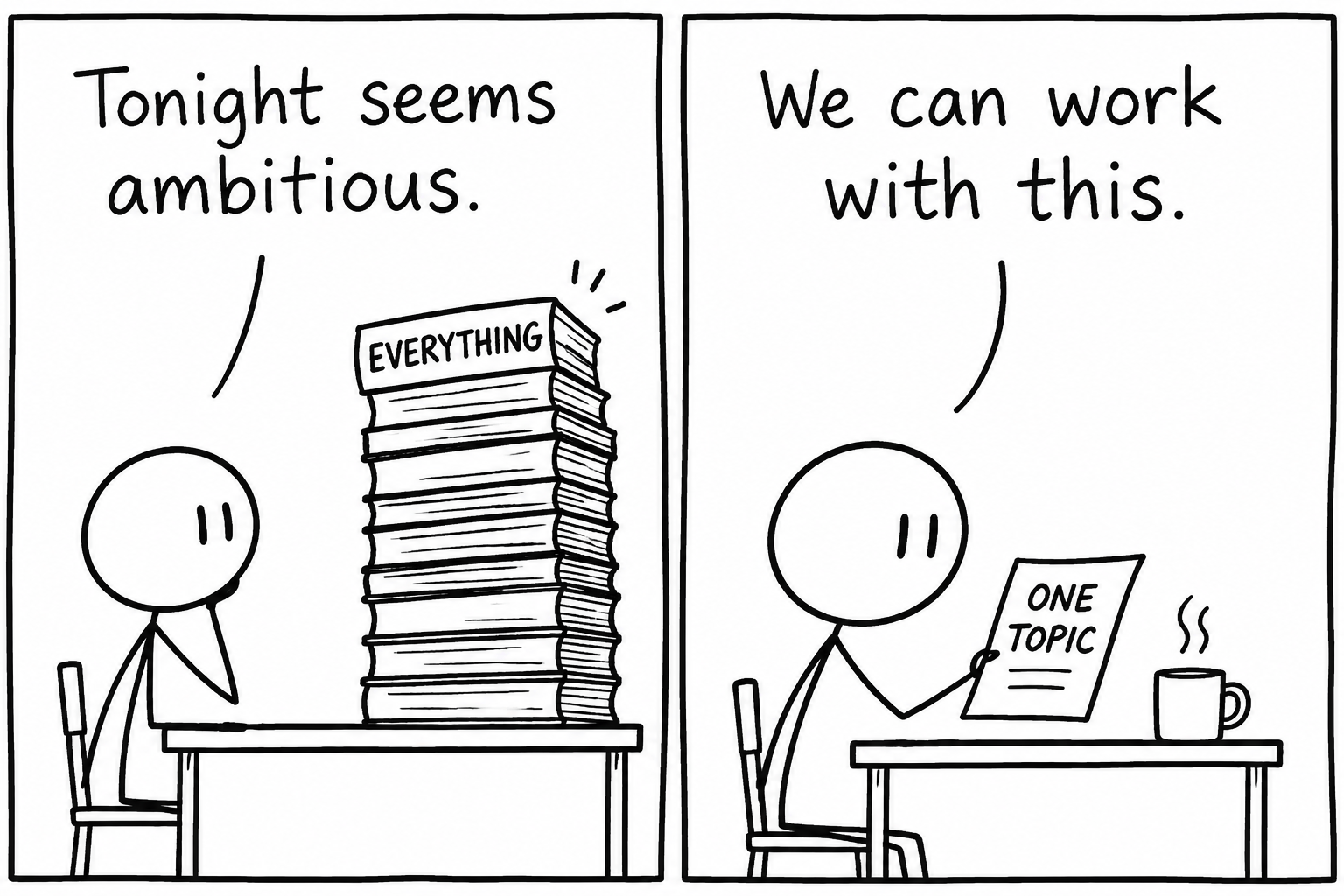 A post-16 student replaces an overwhelming revision pile with one manageable topic
How to practise for a grade 4 resit
Effective GCSE maths resit revision is usually narrower than students expect. Completing a large mixed paper can show you what went wrong, but it does not always give you enough repetition to correct it. A better short session has three stages.
Rebuild the method
Watch a topic explanation or read the forming and solving equations revision guide. Write down the balance principle in your own words, then complete a few straightforward equations without a time limit.
Increase the difficulty gradually
Move from one-step equations to equations requiring several operations. Then add brackets and unknowns on both sides. MathsGenie’s GCSE maths exam booklets provide topic-based practice, while mark schemes and video solutions let you compare methods rather than merely checking the final value of xxx.
Test the skill in a mixed paper
Once the method feels secure, place equation questions among other topics. This tests whether you can recognise the required technique without being told what to do. Use the GCSE Mock Exam Builder to create a targeted paper from past-paper questions, complete it under sensible exam conditions, and then mark it carefully.
A day-by-day revision planner can also stop one difficult topic from consuming the whole week. A short return to equations several times is generally more useful than one long session followed by silence.
Common mistakes that cost marks
Changing only one side
From:
4x+3=19 4x + 3 = 19 4x+3=19subtracting 333 must happen on both sides. Writing 4x=194x=194x=19 breaks the equality. The correct next line is:
4x=16 4x = 16 4x=16Losing a negative sign
In an equation such as:
6x−5=3x+10 6x - 5 = 3x + 10 6x−5=3x+10keep signs attached to their terms. Writing one small step per line makes sign errors easier to notice.
Expanding only part of a bracket
For:
4(x+3) 4(x + 3) 4(x+3)the 444 multiplies both terms:
4(x+3)=4x+12 4(x + 3) = 4x + 12 4(x+3)=4x+12It does not become 4x+34x+34x+3.
Dividing only one term
If you reach:
7x=42 7x = 42 7x=42divide the whole of both sides by 777:
x=6 x = 6 x=6Stopping before isolating the unknown
An answer such as 3x=153x=153x=15 is not finished when the question asks you to solve the equation. Continue to x=5x=5x=5.
Checking a different equation
Substitute your answer into the original equation, not just your final simplified line. This checks the expanding, collecting and arithmetic together.
Turn one reliable method into exam marks
A grade 4 is not secured by one topic, and no individual question can guarantee a grade. But solving linear equations is the kind of skill that connects to many other parts of GCSE algebra, including forming equations from contexts, sequences and rearranging formulae.
The useful change is often smaller than it first appears. Instead of thinking, “I need to relearn GCSE maths,” choose one method, practise it accurately, check the mistakes and return to it later. MathsGenie gives you the revision lessons, practice questions, mark schemes, video solutions and planning tools to make that process repeatable.
When you are ready, build a targeted practice paper in the Mock Exam Builder. Include linear equations alongside a few other grade 4 topics, complete the paper, mark every line of working and use the result to decide what to practise next.















