

Simultaneous Equations GCSE Maths Resit Guide
Simultaneous equations GCSE maths resit guide: learn elimination with two clear examples, avoid costly errors and practise with a targeted mock paper.
A resit can make familiar maths feel strangely unfamiliar. You may remember seeing two equations before, yet still hesitate over which operation comes next. For simultaneous equations GCSE maths resit questions, the essential idea is simple: find values that make both equations true at the same time.
For a student working towards grade 444, this is less about clever algebra and more about a dependable process. Align the equations, eliminate one letter, solve, substitute and check. Linear simultaneous equations appear in Foundation content across major GCSE specifications, although the exact questions and mark allocations vary between exam boards and papers.
Your simultaneous equations checklist
Use this routine whenever you meet two linear equations:
- Write the equations underneath one another.
- Choose a letter to eliminate.
- If necessary, multiply one or both equations so the chosen coefficients match.
- Add or subtract the equations.
- Solve the resulting one-variable equation.
- Substitute that value into an original equation.
- Check both answers in both equations.
That final check matters. It can reveal a sign error before it becomes a lost mark.
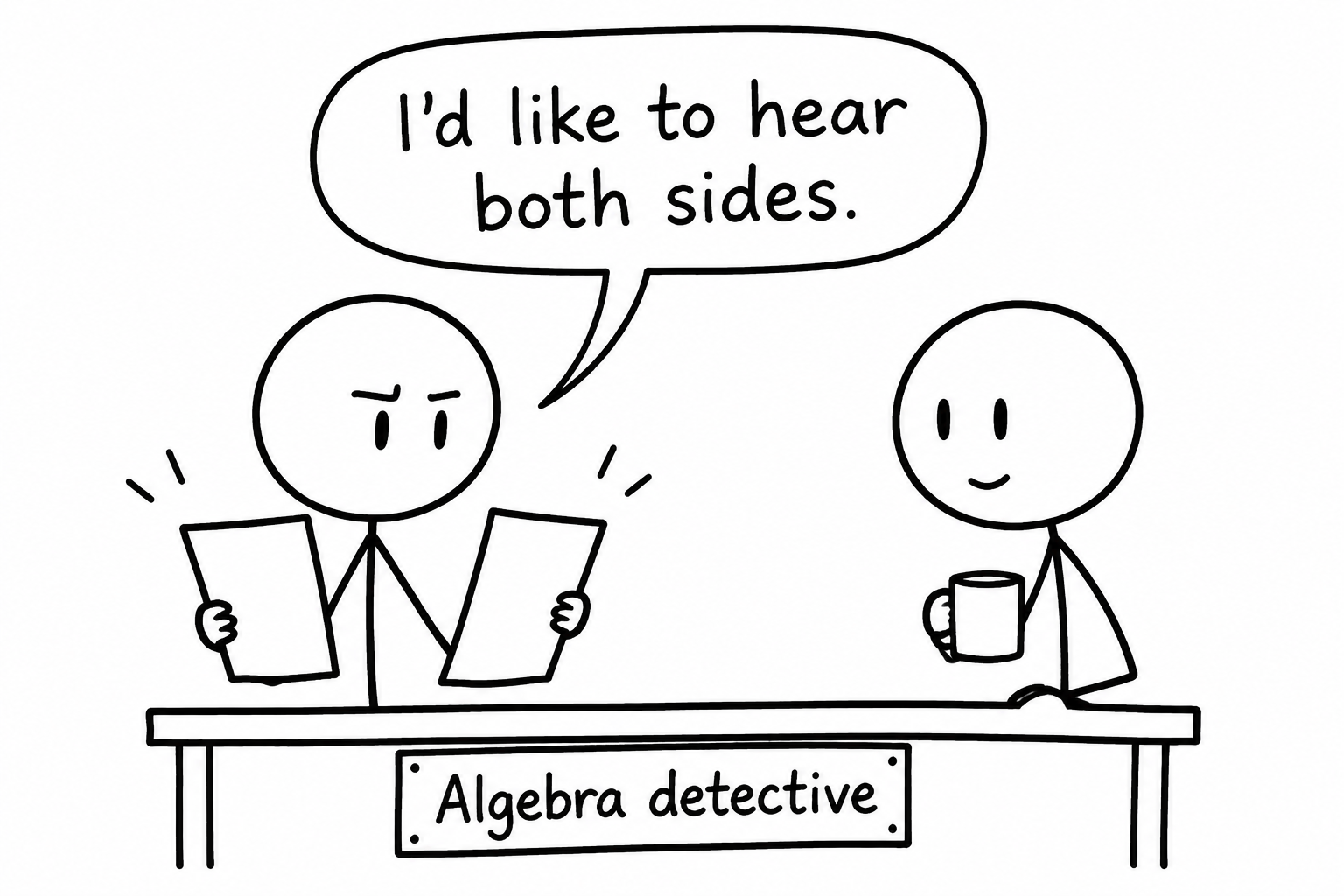 A student treats two pieces of algebra like witnesses in a detective interview
What does solving simultaneously mean?
Consider two equations such as:
x+y=9 x+y=9 x+y=9 2x−y=6 2x-y=6 2x−y=6Each equation describes a relationship between xxx and yyy. Solving them simultaneously means finding one pair of values that satisfies both relationships.
The elimination method works by combining the equations so that one letter disappears. You are not ignoring that letter. You are temporarily removing it to make the problem easier.
If your one-variable equation skills need refreshing first, use the GCSE solving equations revision lesson. That short step backwards can save considerable frustration later.
Worked example: eliminate immediately
Solve:
x+y=9 x+y=9 x+y=9 2x−y=6 2x-y=6 2x−y=6The coefficients of yyy are 111 and −1-1−1. Adding the equations will eliminate yyy:
x+y+2x−y=9+6 x+y+2x-y=9+6 x+y+2x−y=9+6 3x=15 3x=15 3x=15 x=5 x=5 x=5Now substitute x=5x=5x=5 into either original equation. Using the first:
5+y=9 5+y=9 5+y=9 y=4 y=4 y=4Therefore:
x=5,y=4 x=5,\quad y=4 x=5,y=4Check the second equation:
2(5)−4=10−4=6 2(5)-4=10-4=6 2(5)−4=10−4=6Both equations are satisfied, so the solution is correct.
Where the marks come from
An exam question may reward the method as well as the final answer. Clear lines showing the elimination, the value of the first variable and the substitution can protect method marks even if a later arithmetic slip occurs. Writing only the final pair gives the examiner nothing else to credit if that pair is wrong.
You can practise this structure using the Edexcel simultaneous equations revision lesson or the corresponding OCR simultaneous equations resources.
Worked example: multiply before eliminating
A pen costs ppp pounds and a notebook costs nnn pounds. Two pens and one notebook cost 111111 pounds. One pen and two notebooks cost 101010 pounds.
Form and solve two simultaneous equations.
The information gives:
2p+n=11 2p+n=11 2p+n=11 p+2n=10 p+2n=10 p+2n=10Neither variable can be eliminated immediately. Multiply the second equation by 222:
2p+4n=20 2p+4n=20 2p+4n=20Now subtract the first original equation:
2p+4n−(2p+n)=20−11 2p+4n-(2p+n)=20-11 2p+4n−(2p+n)=20−11 3n=9 3n=9 3n=9 n=3 n=3 n=3Substitute n=3n=3n=3 into p+2n=10p+2n=10p+2n=10:
p+2(3)=10 p+2(3)=10 p+2(3)=10 p+6=10 p+6=10 p+6=10 p=4 p=4 p=4A pen costs 444 pounds and a notebook costs 333 pounds.
Check against the first equation:
2(4)+3=11 2(4)+3=11 2(4)+3=11The calculation works, and the answers have been interpreted in context. This last sentence is important in a worded question. The examiner asked for prices, not merely ppp and nnn.
If turning written information into equations is the difficult part, work through forming and solving equations practice before returning to simultaneous equations.
A realistic grade 4 revision approach
A topic does not belong permanently to one grade. Its difficulty depends on the numbers, the algebra required and how the question is presented. Straightforward linear simultaneous equations can be accessible to a Foundation student, while more demanding versions may require several stages.
For effective GCSE maths resit revision, separate the skill into small sessions:
- First, practise questions where a variable eliminates immediately.
- Next, practise multiplying one equation before eliminating.
- Then, solve worded questions where you must form the equations.
- Finally, mix the topic with other algebra so you learn to recognise it without being told the method.
Use the Edexcel GCSE maths revision hub to move between revision lessons, practice questions, past papers, mark schemes and video solutions. The GCSE exam booklets are useful when you want focused topic practice rather than a complete paper.
A sensible routine is to attempt a small set without notes, mark it, and record why each mistake happened. A revision planner can then schedule another attempt after a gap. This is more useful than repeatedly watching a method that already feels familiar.
Common mistakes that cost marks
Adding when you should subtract
Look at the signs before combining equations. Equal coefficients with the same sign usually require subtraction. Equal coefficients with opposite signs usually require addition.
Multiplying only part of an equation
If you multiply an equation by 222, every term must be multiplied, including the number on the right. For example:
p+2n=10 p+2n=10 p+2n=10becomes:
2p+4n=20 2p+4n=20 2p+4n=20not 2p+4n=102p+4n=102p+4n=10.
Losing a negative sign
Use brackets when subtracting a whole equation. This makes it easier to see that every term in the second equation changes sign.
Stopping after finding one variable
Finding xxx is only half the solution. Substitute it back to find yyy, then present both values clearly.
Skipping the check
Substitute your answers into both original equations. One successful equation is not enough because an incorrect pair can occasionally satisfy only one of them.
Turn the method into exam practice
Simultaneous equations become manageable when the sequence stops changing. Eliminate, solve, substitute, check. The questions may look different, but the engine underneath remains the same.
Start with a MathsGenie revision lesson, use the practice questions and video solutions to correct your method, then test the skill under paper conditions. You can also use past papers and predicted papers to see how algebra appears among other GCSE topics.
When you are ready, open the MathsGenie Mock Exam Builder and build a targeted practice paper around the algebra you need most. Complete it without notes, mark every line honestly, and let the mistakes choose your next revision session.















