Revise GCSE Geography Alone or With Others?
Revise GCSE geography alone or with others? Compare both methods, match each to the right topics, and build a focused plan alongside maths revision.
The room is quiet, your notes are open, and after twenty minutes you realise you have read the same paragraph three times. Yet revising with friends can create the opposite problem: plenty of conversation, but very little that would earn marks.
If you are wondering whether to revise GCSE geography alone or with others, the best answer is usually both. Revise alone when you need concentration, accurate recall and timed exam practice. Work with others when explaining processes, testing case-study knowledge or comparing evaluations. The method should follow the task, rather than your mood.
That matters if you are also preparing for maths exams. Your revision time is limited, so every geography session needs a clear purpose and an end point.
A quick revision method checklist
Use this simple decision guide before each session:
- Revise alone for learning key terms, memorising case-study evidence, practising calculations and completing timed questions.
- Revise with others for verbal testing, explaining geographical processes, discussing fieldwork limitations and comparing extended answers.
- Use both methods for topics that require knowledge and judgement, such as urban change, resource management and natural hazards.
- Return to solo practice before the exam so you know what you can produce without prompts.
- Check your exam-board specification because AQA, Edexcel, OCR and Eduqas organise content and assessment differently.
A productive session is not defined by how long it lasts. It is defined by what you can recall, explain or apply when the notes disappear.
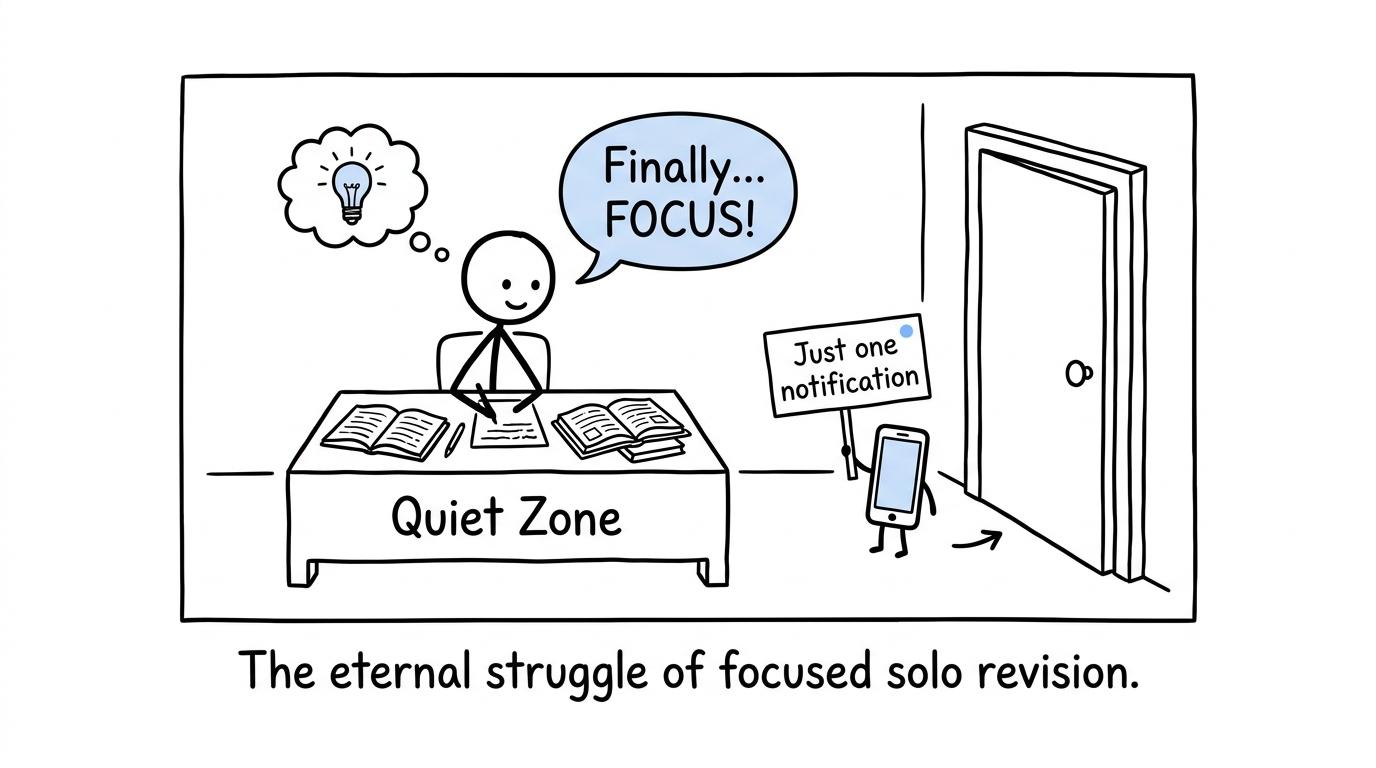 A student defending a quiet revision zone from a persistent phone notification
When revising GCSE Geography alone works best
Solo revision gives you control. You choose the topic, pace and level of difficulty, and there is nowhere for uncertainty to hide.
This makes it particularly valuable for retrieval practice. Close your notes and write down everything you remember about a named case study, coastal process or fieldwork method. Then check what is missing. Rereading can feel smooth because the page supplies the information; retrieval shows whether you can supply it yourself.
Working alone is also better when you need sustained attention. Map skills, graph interpretation and exam questions are difficult to practise properly while several conversations are happening around you.
Geography topics suited to solo revision
Solo sessions are usually effective for:
- definitions and command words;
- named locations and case-study evidence;
- physical and human geography terminology;
- map symbols, grid references and scale;
- interpreting photographs, maps, tables and graphs;
- geographical calculations;
- timed short-answer and extended-response questions;
- correcting answers with a mark scheme.
Geography includes mathematical skills that reward careful individual practice. Depending on your specification, these may involve averages, percentages, ratios, scale, data presentation and interpreting trends.
For example, percentage change is found using:
percentage change=new value−original valueoriginal value×100\text{percentage change} = \frac{\text{new value} - \text{original value}}{\text{original value}} \times 100percentage change=original valuenew value−original value×100You need to understand the calculation, select the correct data and interpret what the result means geographically. MathsGenie's free GCSE maths revision lessons can help strengthen the numerical skills that also appear in geography.
Solo revision does have a weakness: it is easy to avoid difficult material. A student may repeatedly revise attractive diagrams while postponing the fieldwork question they cannot explain. A written topic list helps prevent comfort from becoming the plan.
When revising Geography with others works best
Good group revision turns memory into conversation. One student asks a precise question; another answers without notes; someone else challenges an unsupported claim. The value comes from explaining and checking, not simply occupying the same room.
Explaining a topic aloud can expose gaps that silent reading leaves hidden. You may recognise the words constructive waves, for instance, but struggle to explain the complete sequence connecting wave action, deposition and beach formation. That struggle is useful evidence about what to revise next.
Group revision can also improve evaluation. Geography often asks students to consider different consequences, viewpoints, methods or management strategies. Another person may identify a social, economic or environmental factor you overlooked.
Geography topics suited to group revision
Structured collaboration is particularly useful for:
- testing case studies without looking at notes;
- explaining sequences such as river, coastal or tectonic processes;
- comparing the impacts of hazards in different places;
- discussing the advantages and disadvantages of management strategies;
- evaluating fieldwork methods and data quality;
- planning extended responses;
- identifying evidence that supports a conclusion;
- interpreting unfamiliar resources from different perspectives.
Fieldwork is well suited to discussion because evaluation rarely stops at saying a method was “good” or “bad”. You may need to consider reliability, accuracy, sampling, risk, bias and whether the evidence supports the original enquiry. These ideas become clearer when someone asks, “Why?” or “What would you improve?”
The danger is that discussion feels productive even when nobody is recalling anything accurately. Keep notes and the specification available for checking, but do not leave them open during every question.
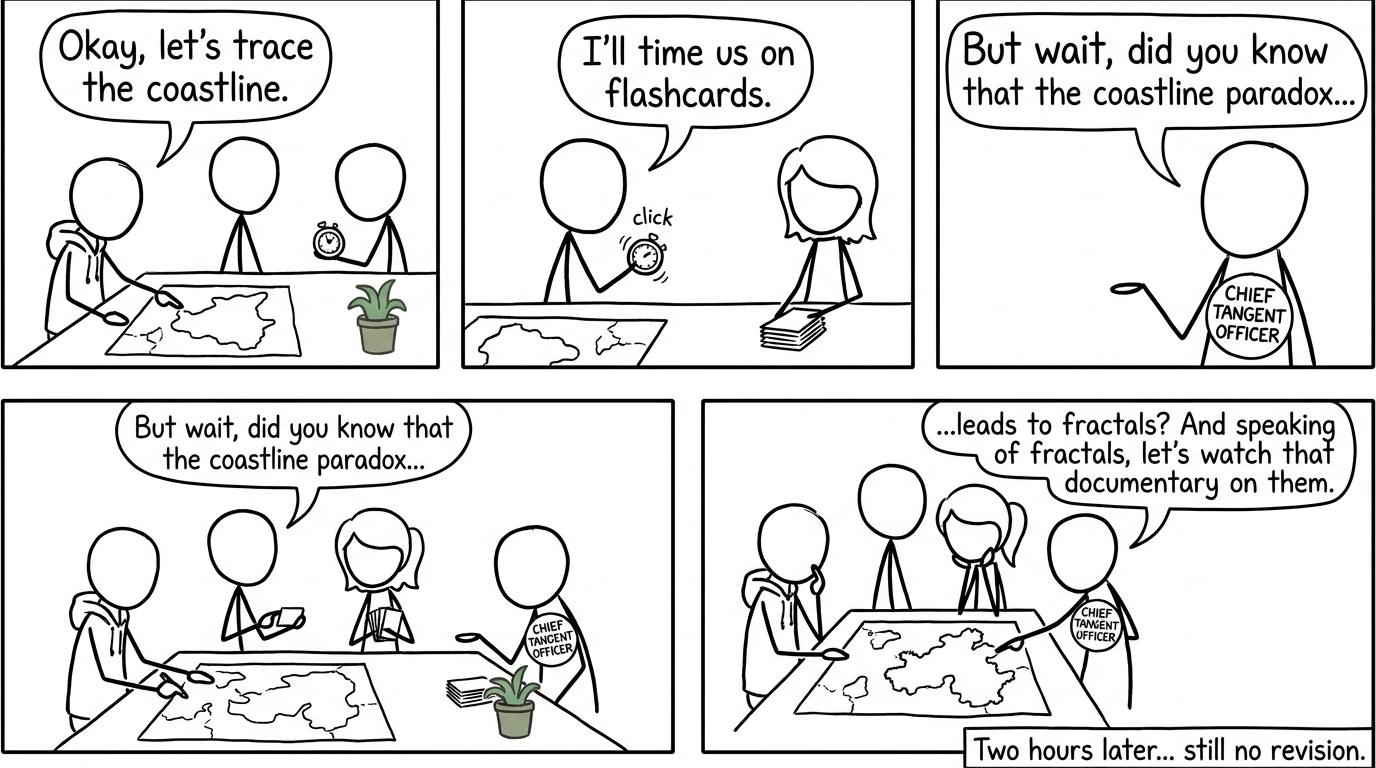 A GCSE revision group featuring a map, flashcards and a chief tangent officer
How to make group revision genuinely useful
A group needs more structure than a solo session, not less. Agree on one topic and one outcome before beginning. “Revise rivers” is vague. “Test river-landform processes, then plan two fieldwork evaluation questions” is measurable.
Give each person an active role. One can ask questions, another answer, and another check the specification or mark scheme. Rotate the roles so nobody becomes a permanent spectator.
Useful group activities include:
- closed-book questioning with answers checked afterwards;
- taking turns to explain a process from beginning to end;
- sorting evidence into social, economic and environmental categories;
- comparing response plans and identifying missing evidence;
- challenging vague language such as “a lot” or “things improved”;
- reviewing an answer against the level descriptors or mark scheme.
Set a finish time and record individual follow-up tasks. Group work should produce a shorter list of weaknesses, not just a pleasant memory of revision.
The strongest approach is a revision cycle
Solo and group revision solve different problems. A simple hybrid cycle lets each method do the work it handles best.
Learn and diagnose alone
Begin with your specification or class checklist. Attempt retrieval without notes, identify gaps and review the necessary material. This prevents the group from spending most of its time teaching content that members could have prepared independently.
Test and explain together
Meet with a clear question set. Explain processes, challenge case-study evidence and discuss evaluation. If the group cannot settle a factual disagreement, flag it and check an authoritative source such as your specification, teacher materials or approved textbook.
Apply alone
Finish by answering exam questions independently and under realistic time pressure. The examination will not provide friends, shared notes or hints, so the final stage must test individual performance.
Use the mark scheme to decide what needs another cycle. Maths students can apply the same principle by using GCSE maths past papers after revision lessons and topic practice. MathsGenie predicted papers can provide further maths practice close to the examination period, but they should complement rather than replace official past papers.
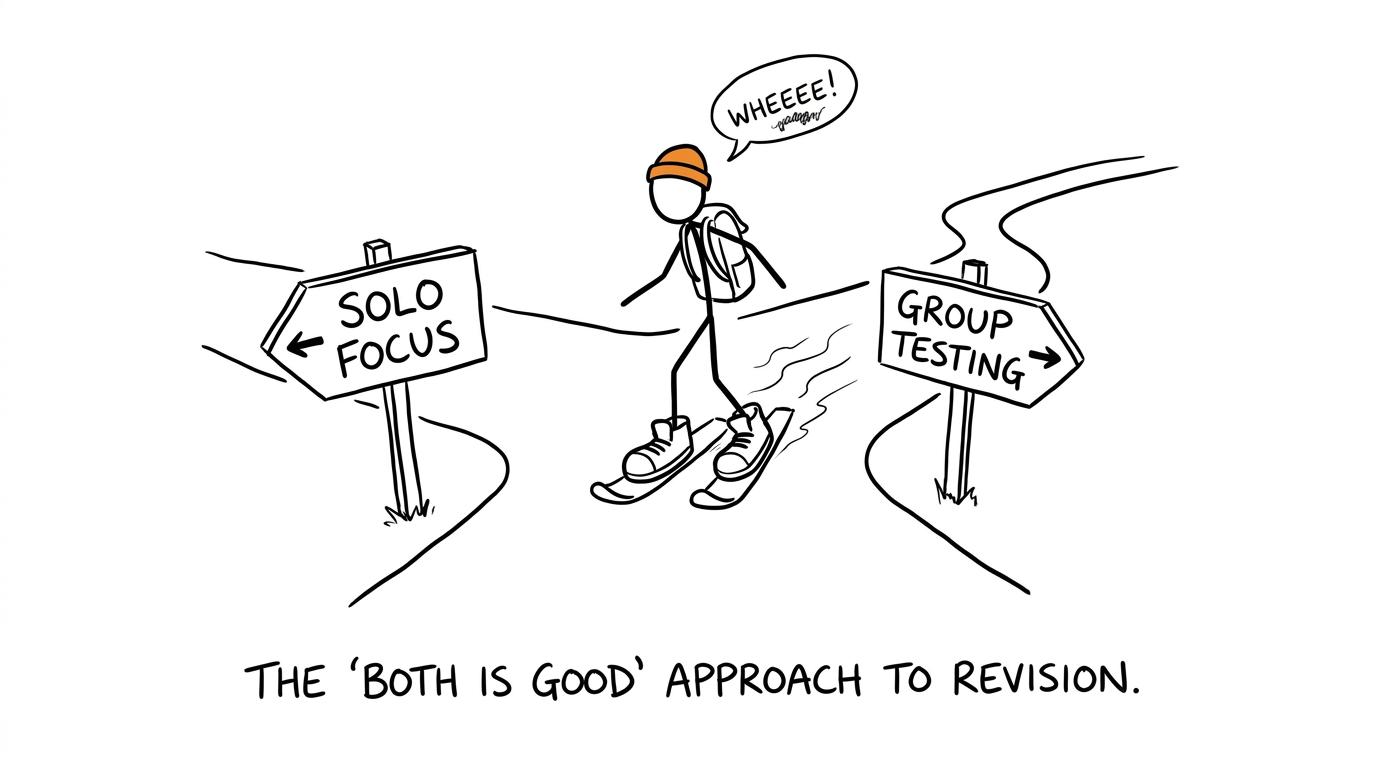 A student combining the paths of solo focus and group testing
How to balance Geography with maths revision
Subjects compete for time, but they do not always require the same kind of session. Geography may involve recall, evaluation and extended writing. Maths improvement depends heavily on solving questions, checking methods and returning to errors.
Build your timetable around actions rather than subject names. A block labelled “Maths” is easy to postpone because it gives no starting point. “Complete a foundation algebra mini test and correct every error” is clearer. So is “Recall the river fieldwork method and answer one evaluation question”.
MathsGenie's free revision resources organise GCSE topics by grade and provide videos, practice questions and solutions. Use these resources to identify a manageable task, then record errors in your revision planner. Students considering the next stage can also explore the A Level maths revision resources, while current A Level students can use A Level past papers to test complete-paper performance.
Do not assume that revising geography calculations replaces maths practice. The overlap is useful, but GCSE Maths requires a much broader range of techniques. Equally, being confident with percentages does not remove the need to interpret the result in its geographical context.
Common mistakes when choosing how to revise
Revising with friends without a plan
A group chat, snacks and open textbooks do not automatically create useful revision. Choose the topic, questions and finish time in advance. Social time can follow afterwards rather than quietly taking over.
Copying the strongest person
Watching someone else produce a good answer can create an illusion of understanding. Every person should answer questions independently before comparing ideas.
Revising alone but only rereading
Highlighting and rereading may help you become familiar with material, but the exam requires recall and application. Close the book, retrieve what you know and answer questions.
Treating every topic in the same way
A case-study fact, a geographical process and a fieldwork evaluation are different learning problems. Use retrieval for factual knowledge, verbal explanation for connected processes and exam practice for applying both.
Using inaccurate shared notes
Confidently repeated information can still be wrong. Check case-study requirements and topic coverage against the specification used by your school. Exam-board structures differ, so do not rely on a friend following another specification.
Never testing yourself alone
Group revision should support independent performance. If you can explain an answer only after someone supplies the first idea, the knowledge is not yet secure. Finish with a closed-book task completed alone.
Choose the method that matches the next task
The real choice is not between being an independent student and a sociable one. It is between methods suited to different jobs. Learn facts, practise skills and complete timed work alone. Use a focused group to test recall, explain processes and deepen evaluation. Then return to independent exam questions.
As you balance Geography with GCSE Maths, make MathsGenie your free revision base. Start with the GCSE revision page, follow the revision lessons, complete the practice questions and mini tests, and then move on to past papers, predicted papers, mark schemes and video solutions. Choose one precise task today, and make sure the revision you do can eventually be reproduced on your own.