

Review Exam After Sitting GCSE Food and Nutrition?
Review exam after sitting GCSE Food and Nutrition: learn when a short debrief helps, when to move on, and how to protect focus for your next maths paper.
The doors open, everyone steps out, and the questions begin before you have reached the corridor. What did you write for food provenance? Was that nutrient question asking for a function or a source? Did anyone else find the final section difficult?
If you are wondering whether to review exam after sitting GCSE Food and Nutrition, the short answer is: only briefly, and only if the review gives you something useful for a future paper. You cannot change an answer once the exam has finished. A long post-exam investigation is therefore more likely to consume attention than recover marks.
A calm debrief can still help. Note one lesson about timing, question interpretation or exam technique, then move on. If comparing answers makes you anxious, skip the discussion entirely and protect your concentration for the next exam, particularly if GCSE maths is approaching.
The post-exam checklist
Use this simple decision process after leaving the exam hall:
- Recover first: drink some water, eat if necessary and give your mind time to settle.
- Identify what can still change: your completed Food and Nutrition answers cannot, but your approach to the next paper can.
- Keep any review short: focus on technique rather than trying to reconstruct every answer.
- Avoid answer-comparison spirals: another student sounding confident does not make their answer correct.
- Record one useful lesson: perhaps you need to read command words more carefully or divide your time more deliberately.
- Turn towards the next exam: use a clear revision plan rather than revising according to panic.
That is the central distinction: reflection is useful when it changes future behaviour. Rumination simply repeats the past.
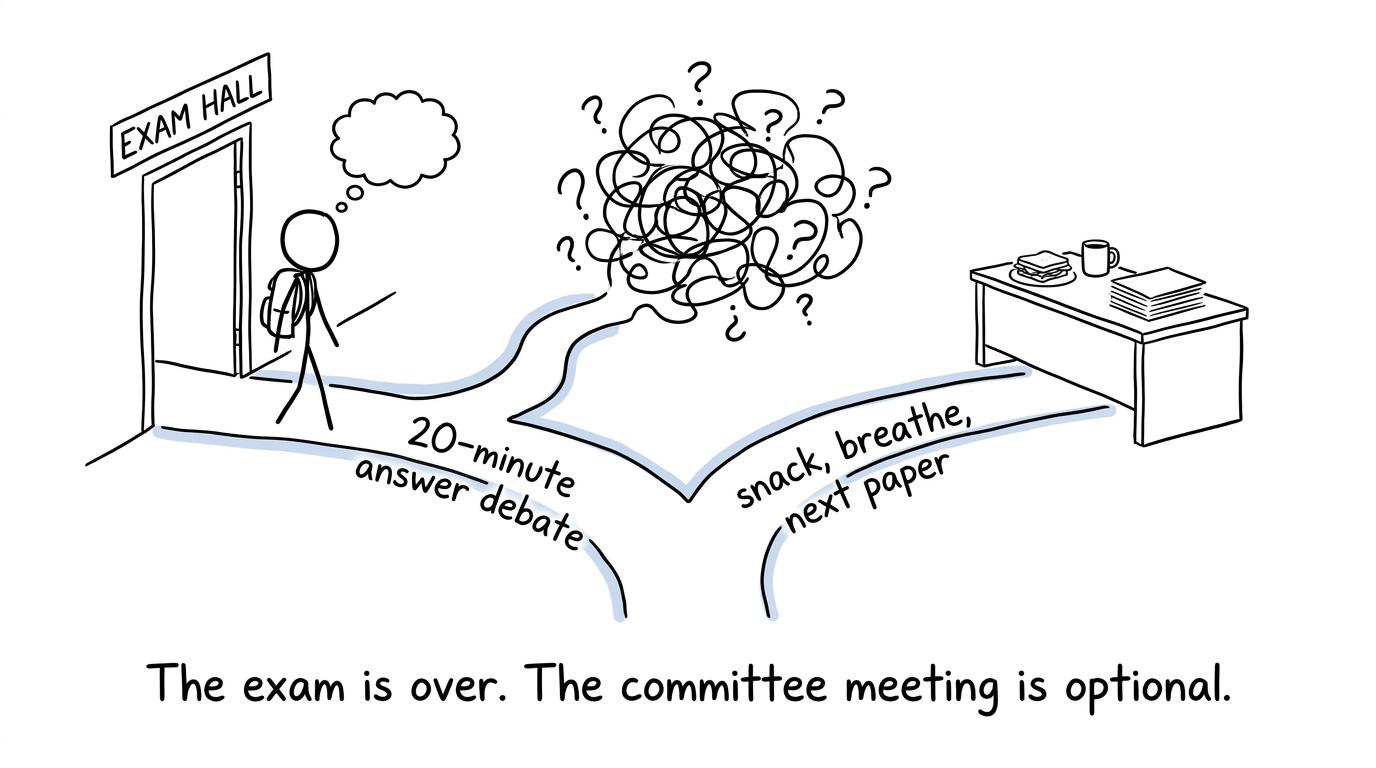 A student choosing between an answer debate and calmly preparing for the next paper
Why replaying the Food and Nutrition exam feels irresistible
Uncertainty is uncomfortable. When an exam ends, your mind wants an immediate result, but GCSE results arrive much later. Comparing answers can feel like a way to close that gap.
Unfortunately, corridor conversations provide unreliable evidence. Students remember questions imperfectly, describe answers differently and may overlook valid alternative responses. You also do not have the official mark scheme or the examiner's interpretation in front of you.
GCSE Food Preparation and Nutrition specifications vary by exam board. For AQA, OCR and Eduqas, the written examination contributes half of the qualification, with the remainder assessed through non-examined assessment. The content and paper length are not identical across boards, so any serious review must eventually use the correct specification, paper and official mark scheme rather than somebody else's memory.
Even then, immediately after the exam is rarely the best moment. Your recall may be vivid, but your judgement can be distorted by tiredness and adrenaline. A question that felt disastrous may have earned method or knowledge marks. A familiar-looking question may have contained a command word you did not notice.
The honest position is simple: until the paper and mark scheme are available through legitimate channels, you cannot calculate your result reliably.
When reviewing the exam can genuinely help
A review is worthwhile when it produces a specific lesson that applies to another assessment.
Review the process, not every remembered answer
Ask questions such as:
- Did I leave enough time for extended responses?
- Did I distinguish between command words such as describe, explain, evaluate and calculate?
- Did I use the information supplied in tables, photographs or other stimulus material?
- Did I show units and calculation stages clearly?
- Did I return to questions I had temporarily skipped?
These questions are useful because they concern decisions you can change. They also transfer naturally into maths. Reading a Food and Nutrition question inaccurately and misreading a GCSE maths problem often share the same cause: moving to an answer before identifying exactly what the question requires.
Capture one transferable lesson
Suppose you noticed that you spent too long on early short-answer questions. Your note might be: “Check the available marks and keep moving.” That instruction can improve your next science, humanities or maths paper.
The review should end when you have captured the lesson. You do not need to hold a courtroom trial for every sentence you wrote.
Review properly after the examination period
Once your exams are finished, a broader reflection can be valuable. You might compare your preparation with the demands of the paper and consider which revision methods worked. This is particularly helpful if you continue to A Level or plan to resit a qualification.
The timing matters. Reflection after the exam series can shape future learning. Detailed analysis between two important papers may simply drain the attention needed for the second one.
When it is better to leave the exam alone
Do not review the paper immediately if the conversation is making you more anxious, you have another exam soon, or you are repeatedly searching for unofficial answers without gaining a practical lesson.
Current wellbeing guidance for young people recognises that comparing answers after an exam can be stressful. NHS advice similarly recommends discussing what went well and then focusing on the next test rather than dwelling on something that cannot be changed.
Leaving the exam alone is not avoidance. It can be disciplined attention management. Your remaining papers are still open opportunities; the completed one is not.
Be especially careful about reproducing or sharing live examination content online. Follow your school, exam board and invigilator instructions. Do not photograph, request or circulate secure paper content, and avoid posting remembered questions while an examination window may still be active.
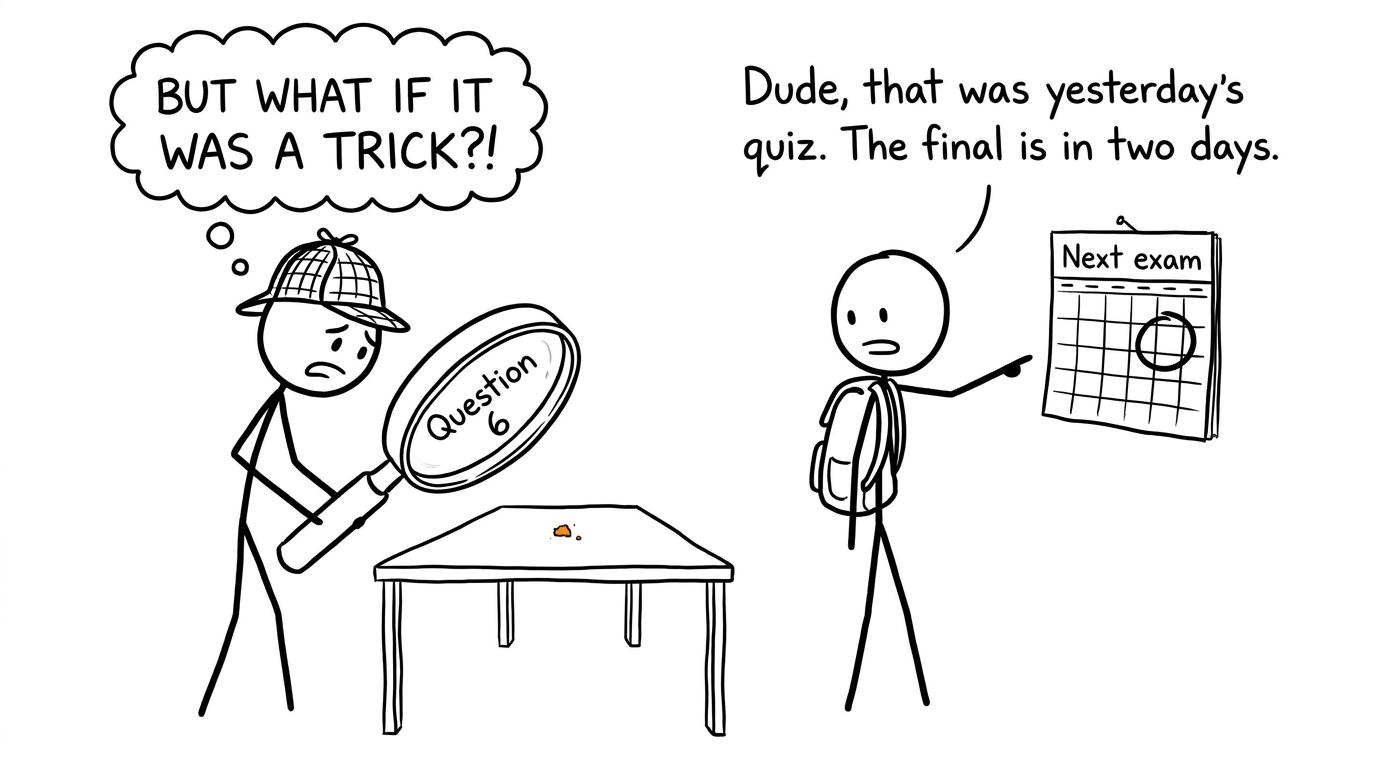 A student detective overanalysing one question while the next exam waits
A better post-exam routine for GCSE students
A useful routine has three phases: reset, reflect and redirect.
Reset your body and attention
Leave the immediate answer-comparison crowd if you need to. Have some water, eat an appropriate snack and take a short walk or quiet break. Exams require sustained concentration, so recovery is part of preparation for what comes next.
This is not lost revision time. A tired student staring at notes is not necessarily learning from them.
Reflect within clear boundaries
If you want a debrief, keep it factual and limited. Write down:
- one aspect that went well;
- one technique you would change;
- one action for your next paper.
Avoid estimating a grade from remembered answers. GCSE grade boundaries are based on the completed assessment process, and your informal reconstruction cannot account reliably for every mark you may have earned.
Redirect towards maths
Open your timetable and decide what your next maths task actually is. Avoid the vague instruction “revise maths”. Choose a defined activity such as completing a paper, checking errors or revisiting one weak topic.
MathsGenie's GCSE Maths revision hub organises topics by grade and provides revision videos, exam questions and solutions. If you need realistic paper practice, use the GCSE Maths past papers with the relevant mark schemes.
You can also use GCSE predicted papers for additional exam-style practice. Predicted papers are practice resources, not promises about the exact questions that will appear, but they can help you rehearse timing and switching between topics.
For shorter sessions, MathsGenie mini tests make it easier to test one manageable group of skills without committing to a full paper.
Turning Food and Nutrition lessons into better maths technique
Food and Nutrition and maths assess different knowledge, but the habits needed in the examination room overlap.
If a nutritional calculation caused difficulty, strengthen the underlying skill rather than repeatedly replaying that particular question. Relevant MathsGenie lessons include percentages, percentage change and ratio.
If interpreting data was the problem, revise the mathematical structure behind tables, charts and summaries through the averages and range lesson. The aim is not to recreate the Food and Nutrition paper. It is to become more secure with a skill that may appear again in another context.
Past papers then reveal whether that revision has worked. Complete questions under timed conditions, mark them carefully and classify each lost mark:
- a knowledge gap;
- a misread question;
- an incomplete method;
- an arithmetic error;
- weak time management.
This classification is more valuable than simply recording a score. A score tells you what happened. An error category suggests what to do next.
Common mistakes after sitting an exam
Treating confident classmates as a mark scheme
Confidence and accuracy are different things. Another student may have misunderstood the question, remembered it incorrectly or given one of several acceptable answers.
Trying to predict an exact grade
You rarely remember every response precisely, and you do not know how an examiner will apply the official mark scheme. A post-exam estimate can create certainty without reliable evidence.
Spending the next revision session on a finished paper
The emotional pull of the completed exam can displace preparation for the next one. Ask which action can still earn marks. Usually, that means preparing for a future paper.
Ignoring what went well
A useful review is balanced. If your timing worked or you remained calm after a difficult question, keep that behaviour. Reflection should preserve effective habits as well as identify weaknesses.
Turning one difficult question into a verdict
Students naturally remember the question that troubled them. That does not mean the whole paper went badly. One uncertain response is evidence about one response, not a final result.
Revising immediately without recovering
Moving straight from an intense exam into unfocused revision may produce little useful learning. Take a deliberate break, then return with a specific task and an end point.
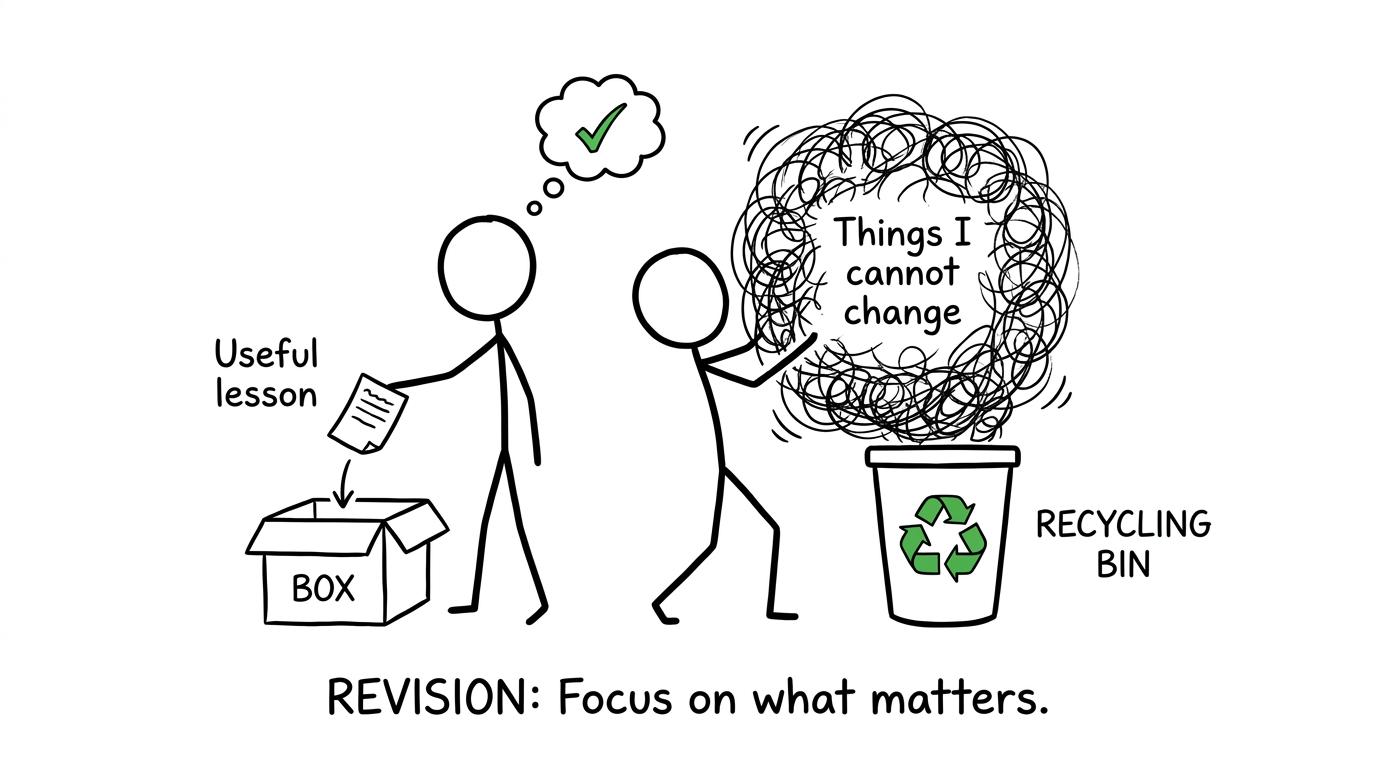 A student saving one useful lesson and recycling everything that cannot be changed
The most useful question to ask yourself
Do not ask, “How many marks do I think I lost?” Ask, “What can I do now that could improve my next result?”
Sometimes the answer is to note a timing problem. Sometimes it is to practise percentages. Sometimes it is to close the conversation, eat, rest and begin again later. All three can be sensible responses.
A finished GCSE Food and Nutrition exam does not need to occupy the rest of your day. Review it briefly if there is a transferable lesson, but do not confuse replaying the paper with productive revision. Once the lesson is captured, let the exam become what it is: completed.
Then put your attention where it can still make a difference. Visit the MathsGenie GCSE revision page, choose a focused revision lesson, answer the practice questions and check your work with the video solutions or mark scheme. Follow that with past papers, predicted papers or a mini test. Calm, specific practice is how one exam experience becomes better technique in the next.










