Reset After a Bad Week of GCSE English Literature
Reset after bad week GCSE English Literature revision with a practical plan to rebuild recall, restart essays and balance maths without panic or cramming.
A bad revision week can feel surprisingly final. The timetable slipped, the quotations blurred, and the essay you meant to write remained an empty page. Meanwhile, maths homework and every other GCSE subject kept moving.
If you need to reset after bad week GCSE English Literature revision, the answer is not to recover every missed hour. It is to make the next useful action small enough to begin: identify one weak area, complete one focused recall task, then plan the next few days around what your exams actually require.
You are not trying to repair the past. You are rebuilding a routine.
Your GCSE English Literature reset checklist
Use this checklist before creating another ambitious timetable:
- Accept that the missed week has finished.
- Check which texts and exam components your exam board requires.
- Choose one text, character, theme or poem to restart with.
- Test your memory before rereading notes.
- Complete a short piece of exam practice.
- Review it using a mark scheme or teacher guidance.
- Plan only the next few days in detail.
- Protect time for maths and your other GCSE subjects.
- Finish each session by deciding the next action.
The order matters. A reset starts with diagnosis, not decoration. Colour-coding a new timetable may feel productive, but it cannot tell you whether your real weakness is quotation recall, analysis, context, comparison or essay structure.
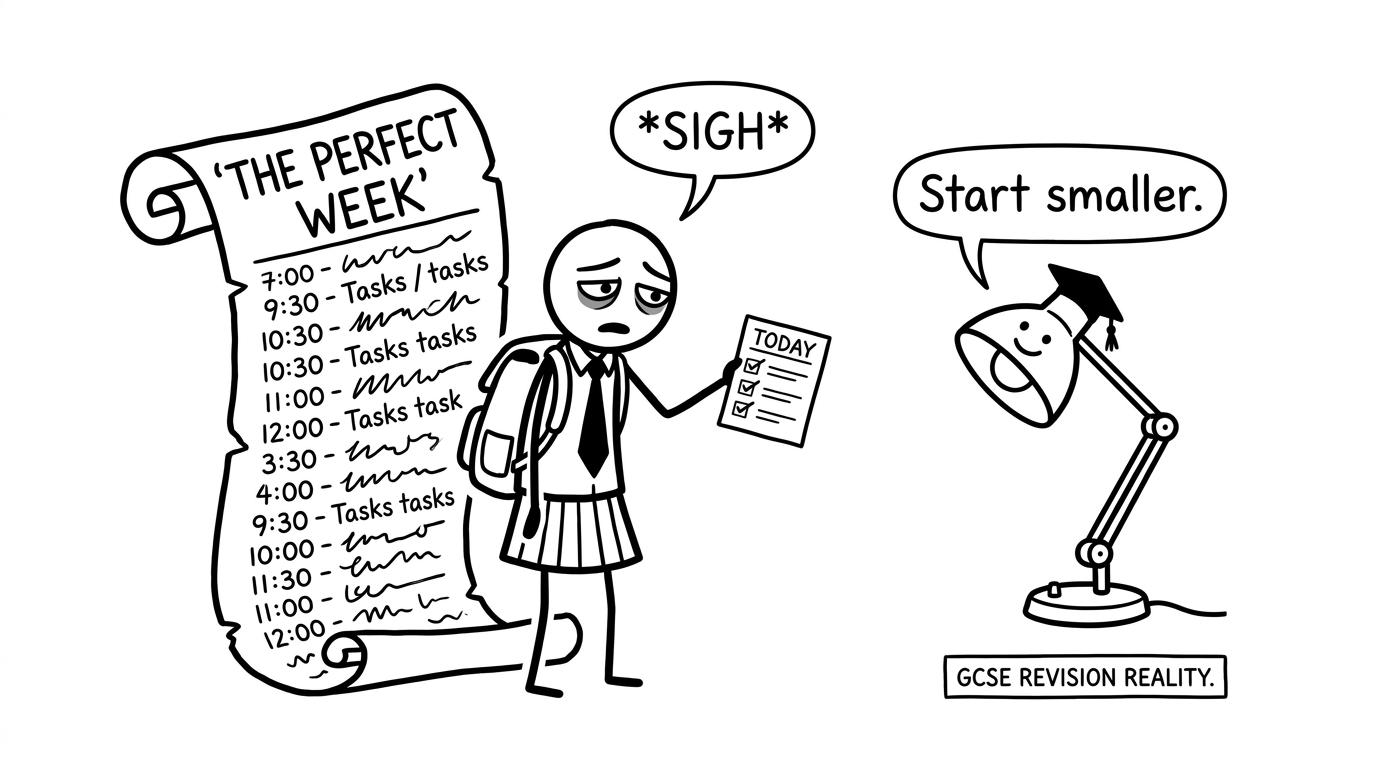 A student replaces a toppled perfect timetable with a small checklist for today
Stop trying to repay revision debt
Students often respond to a lost week by doubling everything. Two missed sessions become four sessions tomorrow. Every text becomes urgent. Breaks begin to look irresponsible.
This creates revision debt: the belief that missed time must be repaid hour for hour. It usually produces a plan that is harder to follow than the original one.
Instead, separate your work into three groups:
Essential knowledge
This includes secure knowledge of your set texts, key events, central characters, major themes and a flexible selection of short quotations. You should also understand the relevant context and how it shapes meaning, rather than collecting disconnected historical facts.
Exam performance
You need to interpret questions, build an argument, select evidence and analyse the writer's choices. Depending on the paper, you may also need to compare poems or discuss an extract alongside the wider text.
Optional refinement
Extra quotations, alternative interpretations and more sophisticated contextual links can improve a strong response. They should not replace essential knowledge or timed practice when you are rebuilding momentum.
Begin with the first serious gap in the first two groups. Leave optional refinement until your foundation is stable.
Check your specification before revising harder
GCSE English Literature is not identical across Edexcel, AQA, OCR and Eduqas. Set texts, paper structures, assessment objectives and question styles vary. Rules concerning extracts and access to texts can also depend on the specification and component.
Use the current specification and materials identified by your school. Confirm:
- the texts you are responsible for;
- which texts appear on each paper;
- whether a question includes an extract;
- where comparison is required;
- the time available and marks assigned;
- the assessment objectives being tested.
This prevents an expensive mistake: revising a familiar task rather than the task you will actually face.
The same principle applies to maths. Your tier and exam board affect the content and papers you sit, so keep your GCSE maths revision resources aligned with your own course.
Use a minimum viable revision session
After a bad week, the first session should be easy to start but meaningful enough to count. A useful structure is:
- recall one topic without notes;
- check what was missing;
- practise one exam skill;
- record the next priority.
For English Literature, that might mean retrieving what you know about one character, checking the text or your class notes, and planning a paragraph around a relevant question. It does not require a complete essay every time.
The important distinction is between reducing the size of the task and reducing its quality. A short, focused paragraph can reveal whether you can make a clear argument, use evidence and analyse language. An hour of passive highlighting may reveal very little.
Make starting automatic
Prepare the book, question and paper before the session begins. Write a precise instruction such as “recall the development of one character” rather than “revise the novel”.
Vague tasks create decisions. Decisions create delay. A defined task gives you somewhere to place your attention.
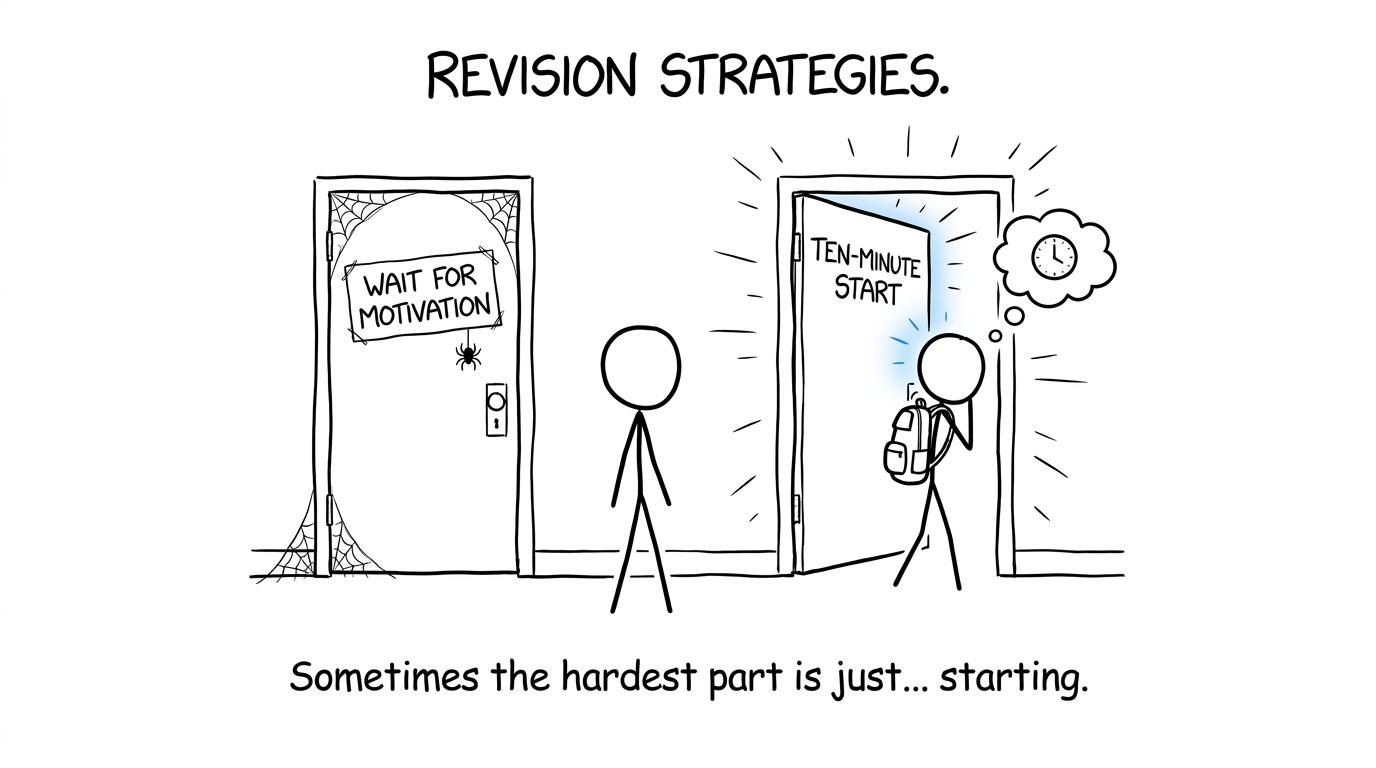 A student chooses the ten-minute start instead of waiting for motivation
Rebuild knowledge through retrieval
Rereading can make a text feel familiar, but familiarity is not the same as being able to retrieve an idea under exam conditions. Start with closed-book recall, then check the gaps.
Useful retrieval tasks include:
- drawing a character or theme map from memory;
- listing key moments in chronological order;
- recalling short quotations linked to several themes;
- explaining why a quotation supports an interpretation;
- sorting poems by theme, viewpoint, form or tone;
- writing possible arguments for an unseen question.
Keep quotations short and flexible. The aim is not to memorise enormous passages. It is to remember evidence accurately enough to support a relevant interpretation and analyse the writer's methods.
Context needs retrieval too, but it should remain connected to the text. Ask how a contextual idea changes your interpretation of a character, conflict or authorial choice. A detached fact is rarely as useful as a relevant explanation.
Restore essay practice in stages
A full timed essay can feel too large on the first day back. Build towards it without avoiding it indefinitely.
Start with planning
Read a question and decide your central argument. Then choose the main points and evidence that would develop it. This practises selection without the burden of writing every sentence.
Move to focused paragraphs
Write a paragraph that makes a clear claim, uses precise evidence and explores how the writer creates meaning. Check whether every sentence contributes to the argument.
Return to timed responses
Once planning and paragraph construction feel less hesitant, complete a timed answer using the conditions required by your course. Afterwards, use the relevant assessment objectives, mark scheme and teacher feedback to identify one improvement priority.
Do not reduce feedback to a grade. A grade tells you where the response landed; a specific target tells you what to do next.
Balance English Literature with GCSE maths
A difficult week in one subject can quietly disrupt every subject. The solution is not to alternate between neglect and marathon sessions. Give each subject a defined job.
English Literature benefits from frequent retrieval, argument planning and regular writing. Maths benefits from solving questions, checking methods and returning to errors. Both need active practice rather than prolonged exposure to notes.
You might pair a Literature recall task with a short set of maths practice questions. On another day, combine an essay plan with a maths mini test. MathsGenie's GCSE past papers can provide longer exam practice, while the GCSE revision page helps you select a particular topic when time is limited.
When exams approach, MathsGenie predicted papers can add useful practice. Treat any predicted paper as practice rather than a promise of what will appear. The full specification still matters.
Students taking different qualifications can also find dedicated iGCSE maths revision and A Level maths revision resources. Choose the page that matches your actual course.
Plan the next few days, not the perfect month
A recovery plan should be short enough to trust. Give the next few days clear purposes, such as:
- reconnect with one set text;
- retrieve quotations and key ideas;
- plan responses to two different questions;
- write one focused paragraph;
- complete one timed response;
- review mistakes and select the next priority.
Include breaks, schoolwork and other subjects before deciding how much revision fits. Sleep and recovery are part of a workable plan, not prizes awarded after exhaustion. If stress is affecting your sleep, concentration or daily life, speak to a parent, carer, teacher or another trusted adult rather than trying to solve everything through a stricter timetable.
At the end of each session, leave a restart note. Record the exact text, question or skill you will tackle next. Tomorrow's session then begins with action rather than negotiation.
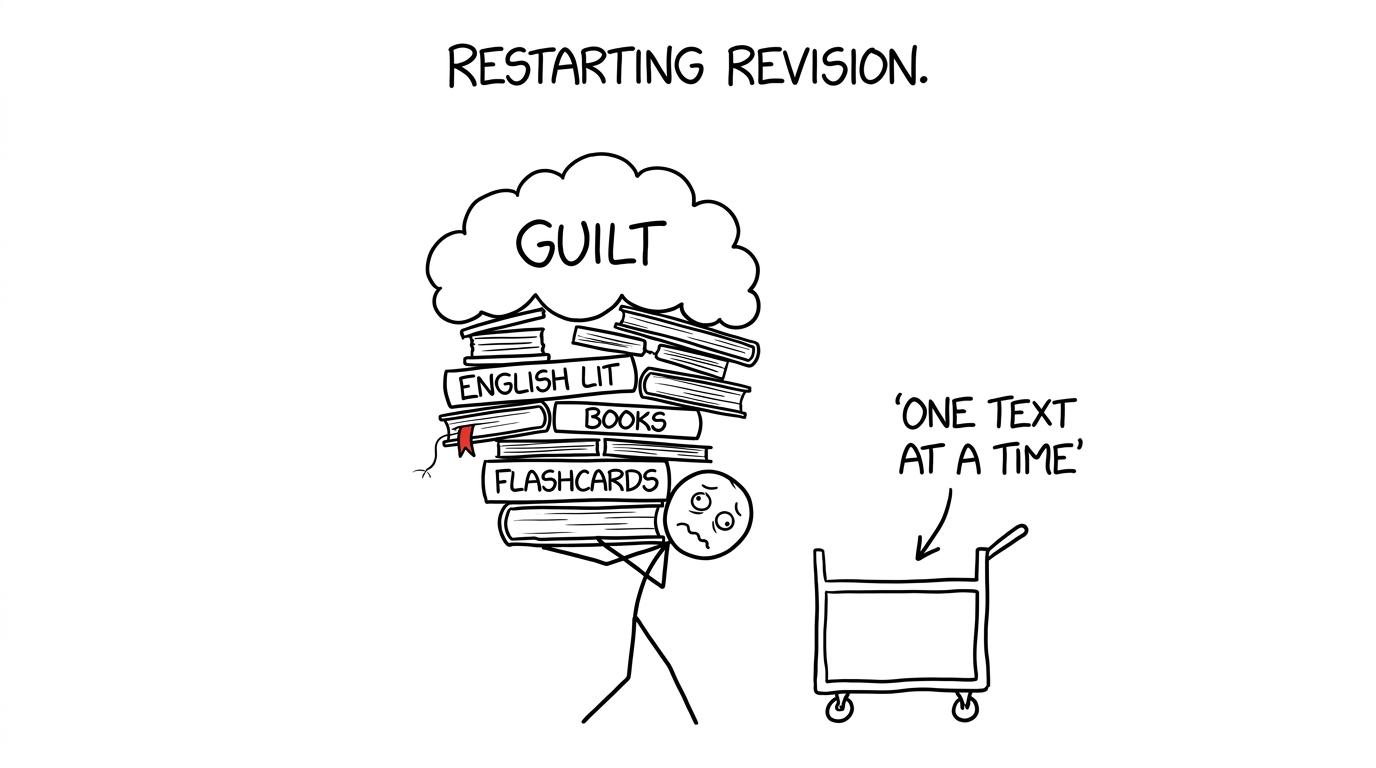 A student uses a one-text-at-a-time trolley instead of carrying every revision worry
Common mistakes when restarting revision
Rewriting the entire timetable
A completely new plan can provide temporary relief without improving your knowledge. Adjust the existing plan around your current priorities instead.
Starting with the easiest material
Easy tasks can restore confidence, but repeating only secure content hides the gaps that cost marks. Start small, then move towards a genuine weakness.
Memorising quotations without interpretations
Evidence is useful when it supports an argument. Link each quotation to characters, themes, methods and more than one possible question.
Collecting context instead of analysing the text
Context should illuminate meaning. Avoid attaching historical information to a paragraph when it does not strengthen the interpretation.
Avoiding exam questions until you feel ready
Readiness often develops through practice. Use plans and focused paragraphs as stepping stones, then return to timed responses.
Sacrificing every other subject
One lost Literature week does not justify losing a maths week as well. Maintain a small, active routine across subjects, using free MathsGenie revision lessons to target the topics that need attention.
Treating one mark as a verdict
A practice response is evidence, not identity. Review why marks were gained or missed, choose one change and test that change in the next response.
A reset is a direction, not a dramatic event
The strongest reset is rarely a heroic weekend. It is a sequence of ordinary decisions: open the correct text, retrieve before rereading, answer the question that was set, and return tomorrow.
Begin with one manageable English Literature task today. Then protect a separate block for your other GCSE priorities. For maths, use MathsGenie's free revision lessons and practice questions to repair individual gaps, move on to past-paper practice, and use mark schemes and video solutions to understand mistakes. Add mini tests, predicted papers and a realistic revision plan as exams get closer.
A bad week is information about a plan that stopped working. It is not evidence that you cannot succeed. Make the next action clear, small and useful; then begin.