

Reset After a Bad Week of GCSE English Revision
Reset after a bad week of GCSE English Language and Literature revision with a calm, practical plan to rebuild momentum without guilt or cramming.
A bad revision week can feel larger than it is. Perhaps you avoided a practice question, forgot quotations you thought you knew, or watched your timetable collapse under the weight of school, tiredness and other GCSE subjects. By Sunday evening, one difficult week can start to look like evidence that the whole plan has failed.
It is not. If you searched reset after bad week GCSE English Language and Literature, the practical answer is simple: stop trying to recover every missed hour, identify the next useful task, and complete a short piece of active revision today. Then build a realistic seven-day rhythm around English Language, English Literature and maths.
You do not need a dramatic comeback. You need a restart small enough to begin.
Your revision reset checklist
Use this checklist before creating another detailed timetable:
- Accept that missed sessions are gone rather than moving all of them into this week.
- Check the specification and texts for your exam board.
- Separate English Language skills from English Literature knowledge.
- Choose one weak but manageable task for today.
- Plan short sessions that produce something you can assess.
- Protect time for maths and your other GCSE subjects.
- Review your work using a mark scheme, teacher feedback or a model response.
- Decide tomorrow's first task before finishing.
That is the reset. Everything else is refinement.
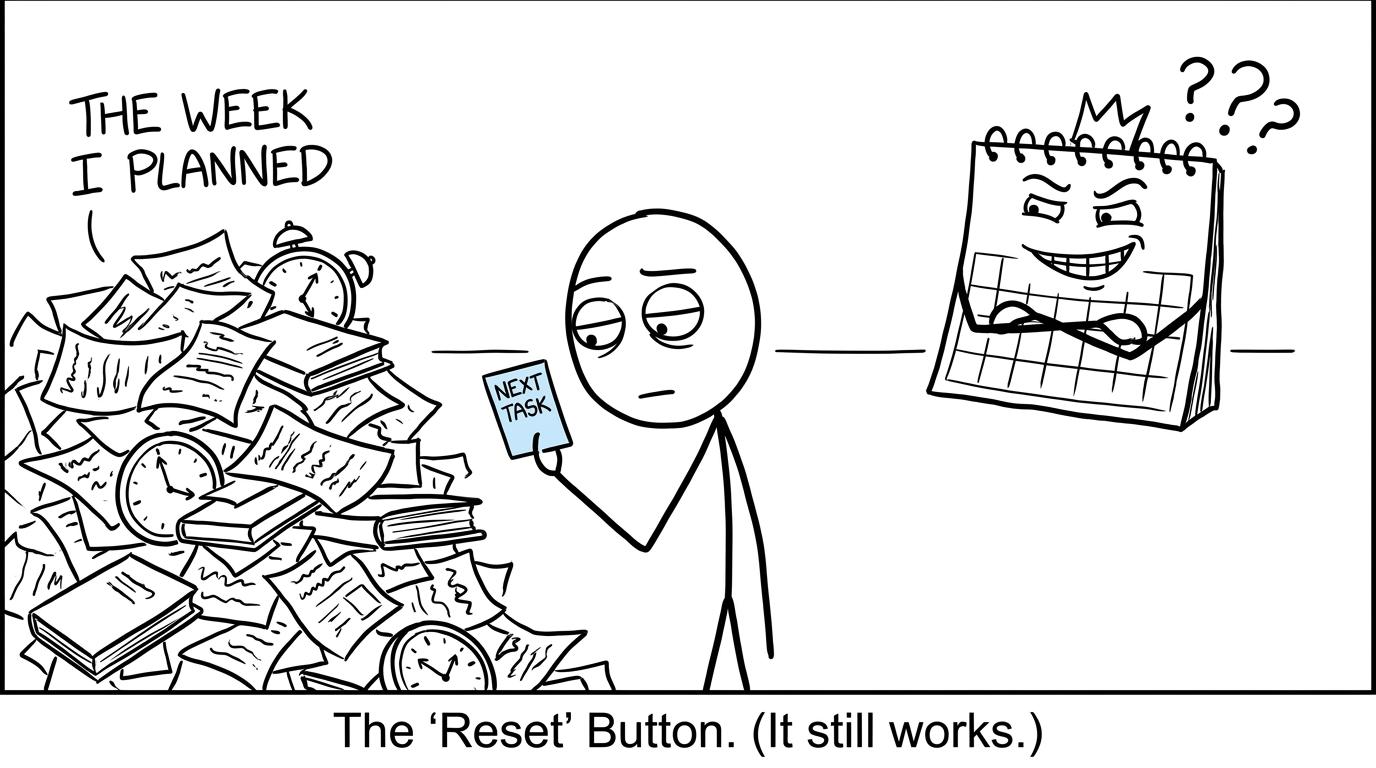 A student choosing one manageable revision task while an abandoned calendar monster looks confused
Treat the bad week as information, not debt
Students often respond to missed revision by creating revision debt. Three missed sessions become three extra sessions next week. The new plan becomes crowded, intimidating and easy to avoid. Another missed day then produces an even larger plan.
A better question is not, “How can I repay every lost hour?” It is, “Why did the plan break?”
Perhaps each session was too long. Perhaps “revise Macbeth” was too vague to start. Perhaps you planned English after an exhausting school day but left easier tasks for the weekend. Perhaps maths, science and homework were competing for the same evening.
Write down the cause without turning it into a judgement about yourself. Then make one practical adjustment:
- shorten sessions;
- define a precise output;
- move demanding work to a better time;
- reduce the number of daily priorities;
- keep your phone outside reach;
- schedule rest rather than hoping you will not need it.
A failed plan does not prove that you cannot revise. It shows that the plan did not fit the week you actually had.
Separate English Language from English Literature
English Language and English Literature require overlapping reading and writing abilities, but they are not interchangeable revision tasks.
For English Language, revision should usually involve unfamiliar texts, close reading, selecting evidence, analysing methods, comparing ideas where required, and practising extended writing. The exact papers and assessment objectives depend on whether you take AQA, Edexcel, OCR or Eduqas, so use the current specification and materials provided by your school.
For English Literature, you need secure knowledge of your set texts alongside the ability to develop an argument. Useful work may include retrieving quotations, connecting themes to characters, planning responses, analysing methods and practising writing under time pressure.
Do not write “English” five times on a timetable. Name the outcome instead:
- annotate one unfamiliar extract and select the strongest evidence;
- plan one Language response;
- retrieve quotations for one Literature theme;
- create a thesis for one past-paper question;
- write and review one timed paragraph.
Specific tasks reduce the effort required to begin. They also tell you whether the session was completed.
Use a two-day reset before planning the whole week
When revision has fallen apart, a perfect monthly timetable is rarely the best first move. Begin with the next two days.
Today: reduce uncertainty
Spend about 101010 minutes checking what you are actually preparing for. Confirm your exam board, set texts, paper structure and any teacher priorities. Do not rely on a friend's timetable because different schools may teach different specifications or Literature texts.
Next, choose one task lasting roughly 202020 to 303030 minutes. Make it active. A quotation-retrieval grid, an essay plan or a response to part of a Language paper gives you more useful evidence than reorganising folders.
Finish by writing tomorrow's first task on paper. This removes a decision from the moment when you next sit down.
Tomorrow: create a small success loop
Complete two focused blocks with a genuine break between them. One might cover Language and the other Literature. Alternatively, use one English block and one maths block if maths also slipped during the week.
Each block should follow a simple cycle:
- retrieve or attempt without notes;
- check against reliable material;
- identify one improvement;
- record the next action.
The purpose is not to feel busy. It is to generate feedback.
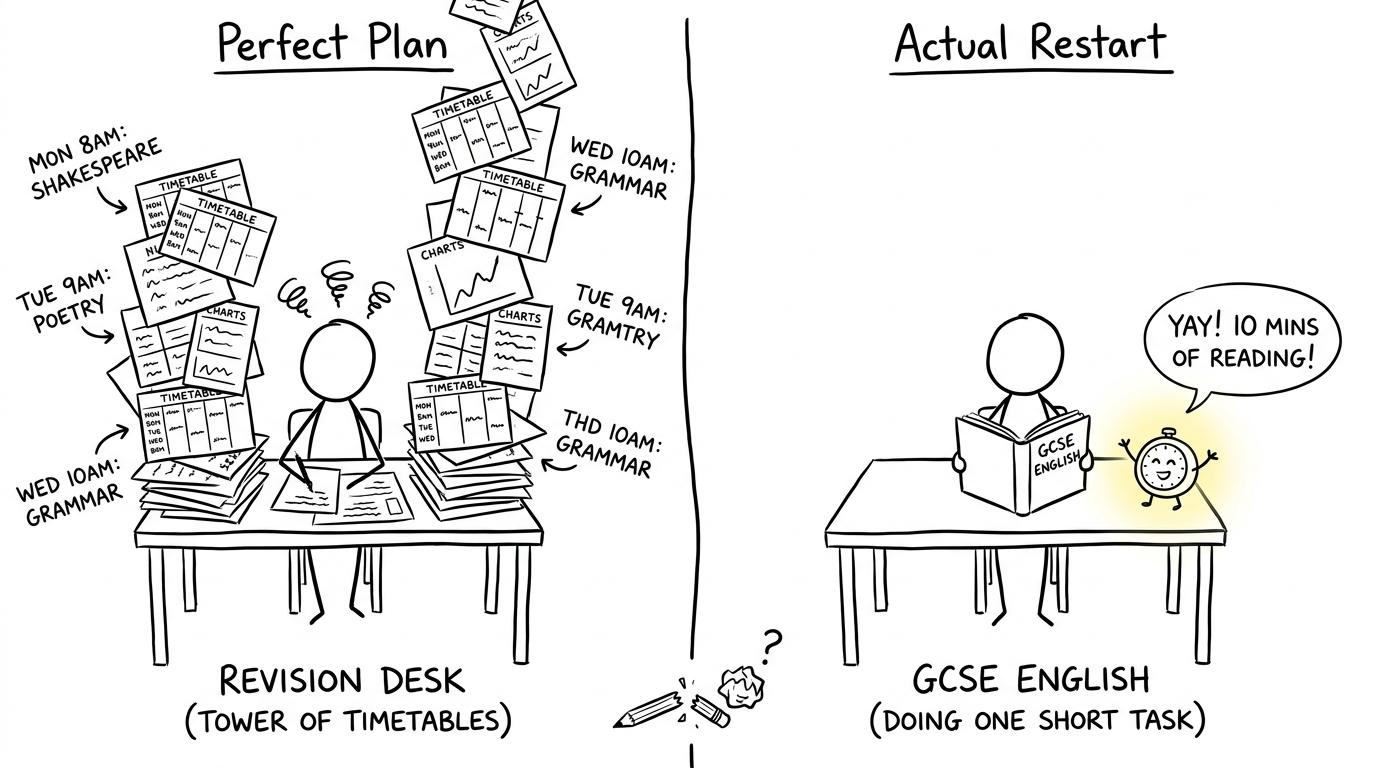 A huge perfect timetable loses to one small revision task that is actually being completed
Build a realistic seven-day rhythm
Once you have completed the two-day reset, plan the following week. Start with fixed commitments such as school, travel, meals, clubs and sleep. Revision fits around reality, not the other way round.
Aim for a mixture of task types rather than repeating your favourite activity. A balanced English week might contain:
- quotation retrieval for Literature;
- a Literature essay plan;
- analysis of an unseen Language extract;
- a timed Language response;
- review using feedback or a mark scheme;
- one short session revisiting errors.
Alternate demanding writing with lighter retrieval when possible. Completing a full response every evening is unlikely to be sustainable alongside maths, science and other subjects. Equally, reading notes all week can create familiarity without showing whether you can construct an answer.
Leave some free space. A timetable with no spare capacity can be defeated by one piece of unexpected homework. A resilient plan includes room to move a session without losing the entire week.
Keep maths moving while you reset English
The target audience for MathsGenie is often balancing English recovery with GCSE maths preparation. The danger is switching all available time to the subject that currently feels most worrying. That may relieve guilt for an evening, but it creates another backlog elsewhere.
Keep one or two fixed maths anchors in your week. Choose the next topic from the free GCSE maths revision resources, then complete questions rather than only watching explanations. MathsGenie revision lessons combine videos with exam-style practice, helping you move from recognising a method to applying it yourself.
If organisation is the main problem, use the GCSE maths revision planner to give maths a defined place instead of relying on whatever time remains after English.
Past papers should be introduced purposefully. The Edexcel GCSE maths past papers, AQA GCSE maths past papers and OCR GCSE maths past papers let you select resources for the correct board. Check whether you take foundation or higher tier before beginning.
You do not always need to complete a whole paper. A short selection can reveal which skills deserve the next revision lesson. As exams approach, MathsGenie predicted papers can provide further practice, but they should complement specification coverage and past papers rather than replace them.
Make every English session produce evidence
A productive session leaves something behind: an answer, plan, quotation test, annotation or list of improvements. This matters because feelings are unreliable measures of learning. A familiar page can feel easy even when you cannot recall its ideas independently.
For Language, begin with the question rather than spending the whole session collecting technique names. Work out what the task asks you to do, select relevant evidence and explain how it supports your interpretation. When practising writing, leave time to review structure, clarity, vocabulary, punctuation and whether you actually fulfilled the purpose.
For Literature, quotation knowledge matters most when it supports an argument. Organise compact quotations around themes, characters and relationships, then practise retrieving them without looking. Follow retrieval with plans that connect your evidence to the wording of a question.
Use your teacher's feedback to choose targets. If the same issue appears repeatedly, such as underdeveloped analysis or unclear paragraph structure, place that target at the top of your next response. One specific improvement is more actionable than “write better essays”.
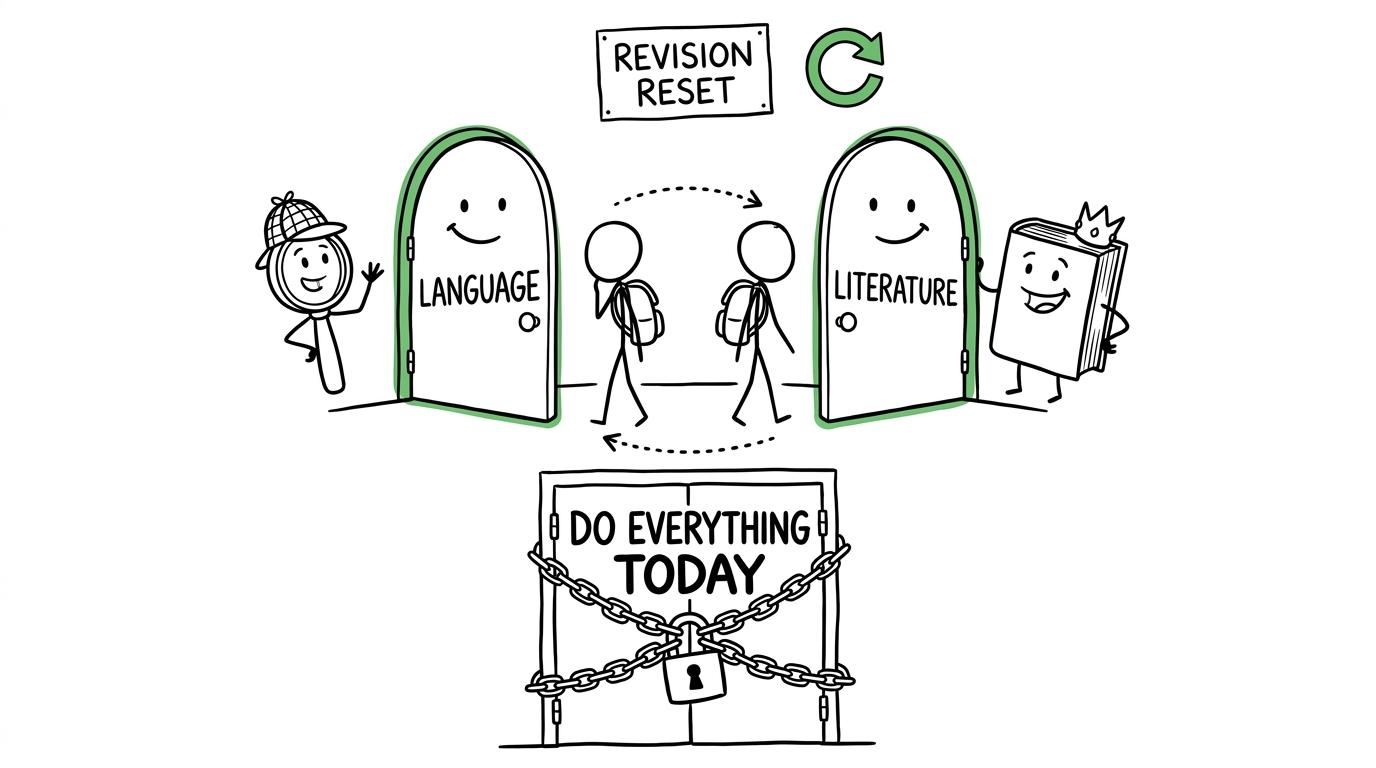 A student sensibly alternates between Language and Literature while avoiding a giant door labelled do everything today
Protect energy as well as time
Revision plans usually count hours but ignore attention. A tired hour is not equivalent to a focused hour.
Keep breaks separate from revision, eat regularly and protect a consistent sleep routine where possible. If worry is stopping you from sleeping, attending school or functioning normally, speak to a parent, carer, teacher, pastoral lead or another trusted adult. A revision timetable is not a substitute for support.
Avoid punishing yourself with a late-night catch-up session. It may make the timetable look repaired while leaving you less able to concentrate the following day. The aim is a repeatable routine, not one heroic evening.
Common mistakes when restarting GCSE English revision
Rewriting the entire timetable
Planning can feel safe because it postpones the difficult part: attempting a question. Limit reset planning, then begin one defined task.
Moving every missed task forwards
This turns last week's unrealistic plan into this week's overloaded plan. Delete, reduce or reprioritise missed work instead.
Revising only the comfortable component
Some students retrieve Literature quotations while avoiding Language writing; others practise creative writing while neglecting set texts. Use recent feedback and attempted questions to identify the real gap.
Measuring success only by hours
Time matters, but output and feedback matter more. Record what you attempted, what you checked and what you will change.
Using the wrong paper or text
Exam boards differ. Confirm your board, specification, set texts and paper requirements before downloading practice material. The same applies to selecting the correct foundation or higher maths paper.
Waiting to feel motivated
Motivation often arrives after starting rather than before it. Make the first action almost frictionless: open the paper, read the question and set a short timer.
Your next useful step
A bad week does not require a dramatic rescue. It requires one honest review, one manageable task and a plan that respects the rest of your GCSE workload.
Choose today's English task now. Make it specific, active and short enough to finish. Then protect your next maths session by selecting a lesson from MathsGenie's free GCSE revision hub. Use the videos, practice questions, past papers, predicted papers and mark schemes to find gaps and act on them.
The week that fell apart is over. Your next session is still available, and that is where progress starts.










