

Redo GCSE Drama Mock Timed: Is It Worth It?
Redo GCSE Drama mock timed or review it first? Use this practical plan to improve timing, answer quality and protect valuable maths revision time.
A disappointing mock creates a strong urge to start again. Clear the desk, reset the clock and prove that the first result was not the real you. But if you plan to redo GCSE Drama mock timed, pause before committing an entire evening.
For most students, reviewing the first attempt is the better starting point. Redo the full paper under timed conditions only when timing, stamina or choosing questions under pressure was a genuine problem. If weak knowledge, vague analysis or misunderstood questions caused the lost marks, another timed attempt may simply reproduce the same weaknesses more quickly.
That matters particularly when GCSE Maths is competing for the same revision hours. The goal is not to complete the most papers. It is to make each hour change what you can do.
The quick decision checklist
Review your marked Drama mock and ask:
- Did you leave questions unfinished because time ran out?
- Did your answers weaken noticeably near the end?
- Did you know the content but struggle to organise it quickly?
- Have you received feedback and corrected the important weaknesses?
- Can you use a fresh paper rather than relying on remembered answers?
- Is a full resit the best use of time alongside your other GCSE subjects?
If the first three answers are mostly yes, a full timed mock may be worthwhile. If the fourth answer is no, review first. If knowledge gaps dominate, targeted revision and individual questions will usually offer better value.
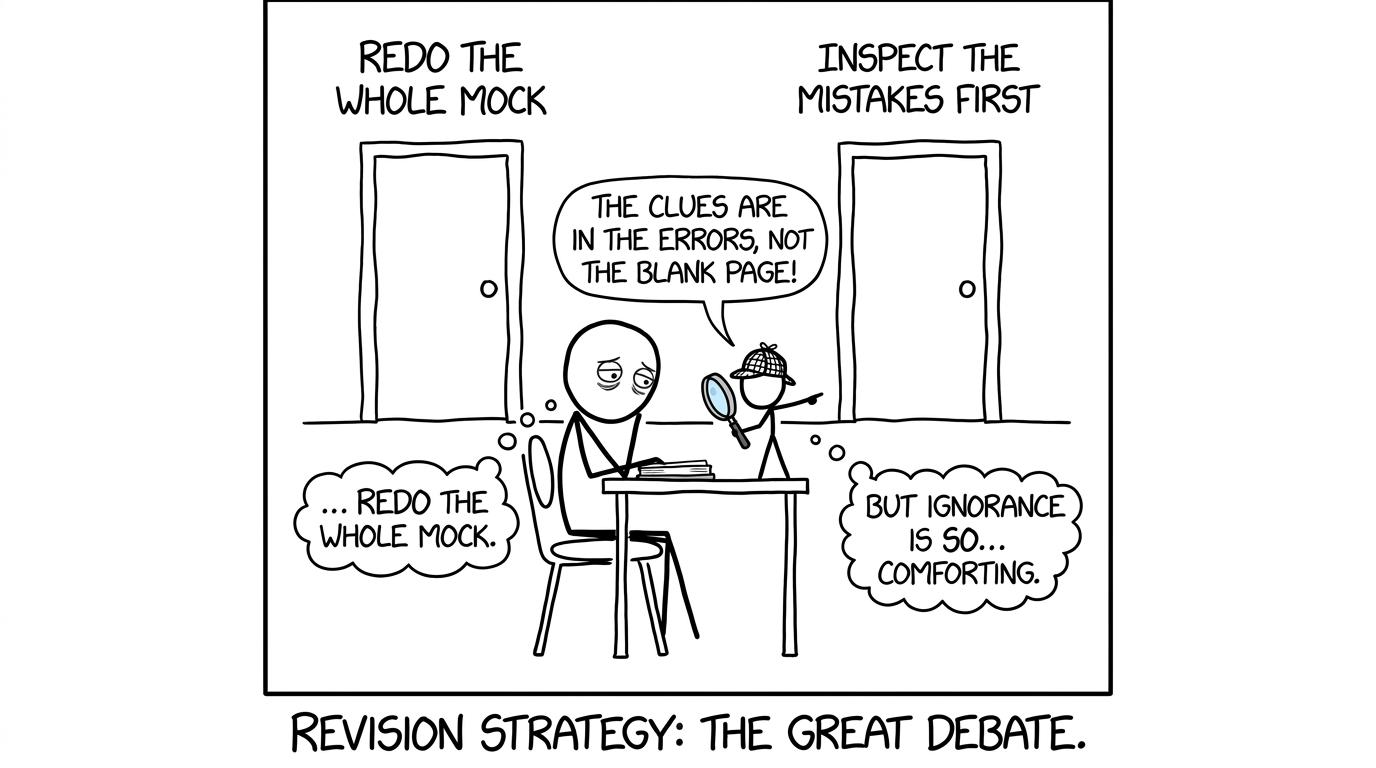 A student chooses between redoing a whole mock and inspecting mistakes
Review the first attempt before you repeat it
A mock paper is not just a grade. It is evidence. The total mark tells you that something went wrong; the script and feedback help you find out what.
Separate lost marks into four categories:
| Type of weakness | What it may look like | Best next step |
|---|---|---|
| Knowledge | Inaccurate references to a set text, production or theatrical choice | Revisit notes and test recall |
| Interpretation | Misreading a command word or answering only part of the question | Annotate questions and compare with assessment guidance |
| Development | Naming a technique without explaining its effect or significance | Improve selected paragraphs or plans |
| Timing | Rushed final answers, unfinished sections or poor allocation of time | Complete timed sections, then a full mock |
The categories can overlap. A rushed answer may actually reflect insecure knowledge: when recall is slow, writing becomes slow. Equally, a knowledgeable student can lose marks by spending too long perfecting an early response.
Read every teacher comment and identify the smallest action that would prevent the same loss next time. That might be learning precise terminology, supporting interpretations with relevant detail, balancing description with evaluation, or planning answers more efficiently. Drama specifications and written assessment requirements differ across AQA, Edexcel, OCR and Eduqas, so use the current materials for your own exam board and follow your teacher's guidance.
Only after this review can a timed resit test whether anything has improved.
When redoing the entire mock is worth it
A full timed resit has a clear purpose when it tests exam performance rather than merely repeating content.
You ran out of time despite knowing what to write
If substantial questions were incomplete, the mark may not represent your knowledge. A full paper lets you practise allocating time, moving on and sustaining an appropriate pace.
You can set an approximate time budget using the paper's total writing time and available marks:
time per mark=available writing timetotal marks\text{time per mark} = \frac{\text{available writing time}}{\text{total marks}}time per mark=total marksavailable writing timeTreat this as a guide rather than a rigid rule. Longer responses may need planning, and your teacher may recommend a specific approach for your board. Reserve some time to check that every question has been attempted.
Your performance declined across the paper
Completing isolated questions cannot fully recreate the concentration required by a whole examination. If your first answers were controlled but later answers became brief, repetitive or careless, practising the complete paper can build stamina and reveal when your focus drops.
You have already acted on feedback
Feedback becomes valuable when it changes your next response. Before resitting, you should be able to state what you will do differently: plan more briefly, use more precise theatrical vocabulary, develop effects on an audience or answer the exact command word.
The second script then becomes a useful comparison. Look beyond the total mark. Check whether the specific weaknesses identified in the first attempt have improved.
You can create realistic conditions
Use the correct duration for your current specification, remove notes, silence your phone and take only the materials permitted for the assessment. Do not pause whenever an answer feels difficult. The value comes from observing your decisions under genuine time pressure.
When reviewing is the better use of time
Redoing a full paper is less useful when the main problem is not timing.
If you cannot yet recall the relevant material, another mock mainly confirms that gap. If you misunderstood several questions, you need to examine their wording. If your responses lack explanation or evaluation, improving a few carefully selected sections is likely to produce more learning than writing the entire script again.
There is also a memory problem. Repeating the same paper too soon can feel easier because you remember its questions, feedback or even phrases from the mark scheme. That fluency can be mistaken for progress. If possible, use a fresh paper for the final timed test and keep the original for diagnosis.
This is the same principle that makes GCSE Maths past papers most useful after topic weaknesses have been addressed. A paper samples many skills. It does not automatically teach the missing ones.
A more efficient revision sequence
The strongest approach is usually review, repair, test.
Diagnose the first script
Mark unfinished responses, misunderstood questions and places where analysis became vague. Use teacher feedback, the relevant mark scheme and your exam board's current assessment materials. Do not focus only on the questions with the fewest marks; look for weaknesses that recur.
Repair one weakness at a time
Choose short tasks matched to the diagnosis. You might create concise plans, practise openings, retrieve key details without notes or rewrite one underdeveloped section. This is deliberately smaller than a whole mock. Its purpose is to improve the process that produced the answer.
Test individual sections under time pressure
Once the technique is more secure, complete selected questions with a realistic time allowance. This separates knowledge and writing quality from whole-paper stamina. If the section remains weak, return to review rather than repeatedly racing the clock.
Complete a fresh full paper
Use a full mock when the individual parts are ready to be combined. Compare the finished script with the original using the same assessment expectations where appropriate. Ask whether you completed the paper, maintained quality and corrected the patterns identified earlier.
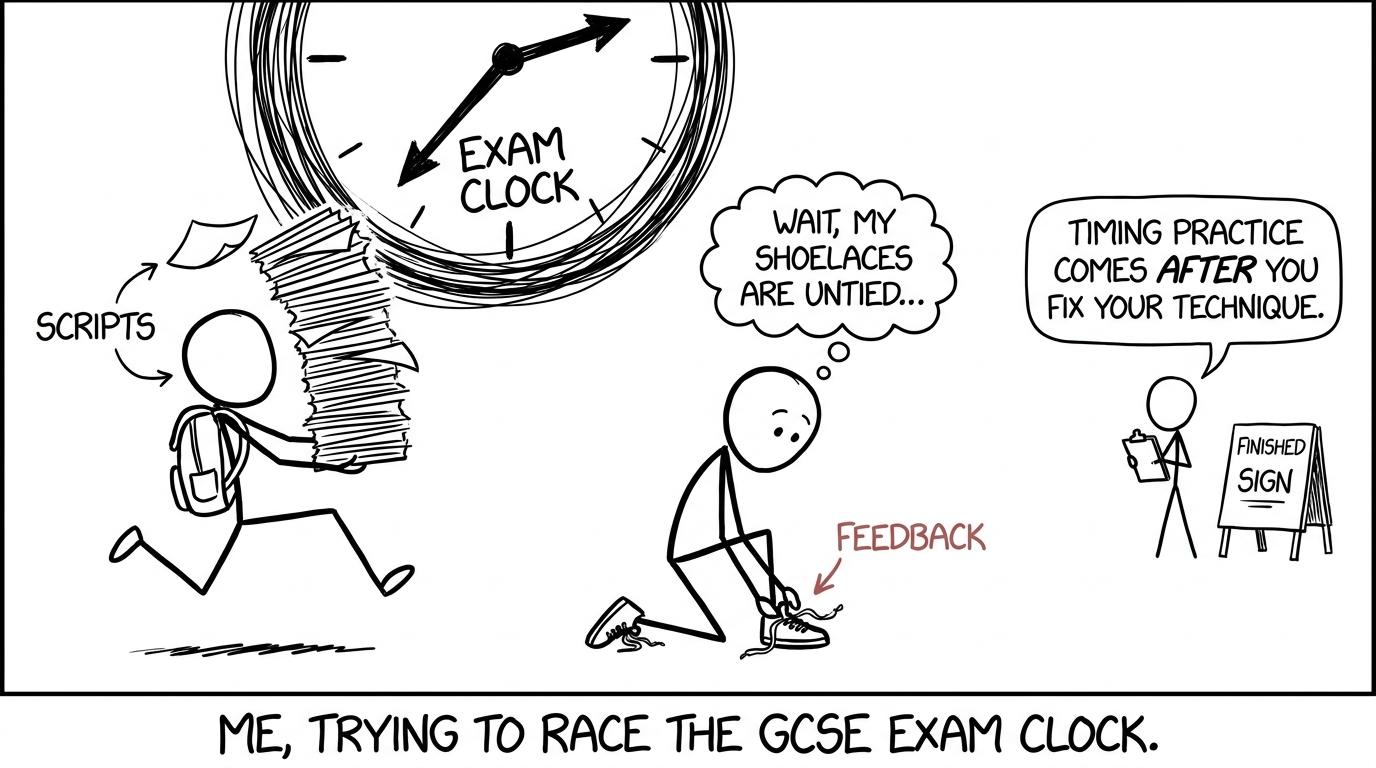 A student pauses an exam-clock race to tie feedback shoelaces
Protecting your GCSE Maths revision time
The hidden cost of a full Drama mock is the revision you cannot do elsewhere. If the paper, marking and review occupy several hours, those hours need a clear return.
This does not mean Maths should automatically take priority. It means your timetable should respond to evidence. Compare upcoming assessment dates, current grades, topic gaps and the amount of improvement each task is likely to create.
MathsGenie's GCSE Maths revision resources make this easier because you can move between short topic practice and complete papers. If foundational skills need attention, use the focused lessons and questions on the Grade 4 revision page. Students consolidating intermediate higher-tier content can work through Grade 5 topics, while those aiming for the top grades can target more demanding material through Grade 7 revision.
A simple weekly balance could include:
- short sessions repairing specific Drama weaknesses;
- regular Maths topic practice with video support;
- one timed section from the subject that most needs exam technique;
- a full paper only when there is a clear question it will answer;
- time to mark, correct and revisit every test.
MathsGenie's predicted GCSE Maths papers can support final exam preparation, but they work best alongside revision lessons, practice questions and previous papers rather than replacing them.
Common mistakes when repeating a mock
Resitting before reading the feedback
This turns the second attempt into a test of the same habits. Translate each useful comment into a specific action before writing again.
Chasing a higher mark through memory
Remembering a question is not the same as becoming better at unfamiliar questions. Leave a sensible gap before repeating the original paper or use a fresh equivalent paper.
Treating every lost mark as a timing problem
Writing faster will not fix missing knowledge or undeveloped analysis. Identify why the response took too long before imposing more time pressure.
Marking too generously
If you assess your own response, use the relevant guidance carefully and avoid awarding marks because you know what you intended to say. Ask your teacher to review uncertain judgements where possible.
Completing papers without correcting them
A pile of finished papers can look like progress while preserving the same errors. In Maths, use video solutions and mark schemes to understand corrections, then revisit weak topics through MathsGenie's free GCSE resources. Apply the same correction habit to Drama.
Ignoring the rest of the revision timetable
A full mock should earn its place. If targeted Drama work and a focused Maths session would address two known weaknesses in the same time, that combination may be more valuable.
Make the resit answer a specific question
Before starting, complete this sentence: “I am redoing this paper to find out whether I can...”
A useful ending might concern finishing every section, maintaining analytical depth or applying feedback without notes. “Get a better grade” is too broad. A specific purpose tells you what evidence to inspect afterwards.
So, is it worth redoing an entire GCSE Drama mock under timed conditions? Yes, when you have reviewed the first attempt, repaired its main weaknesses and need to test timing or stamina. Otherwise, review and targeted practice should come first.
Use the same disciplined sequence for Maths: learn through MathsGenie's free revision lessons, practise focused questions and mini tests, then test yourself with past papers and predicted papers. Build these tasks into your revision planner and check every answer with the available mark schemes and video solutions. The clock matters, but improvement begins before it starts.











